



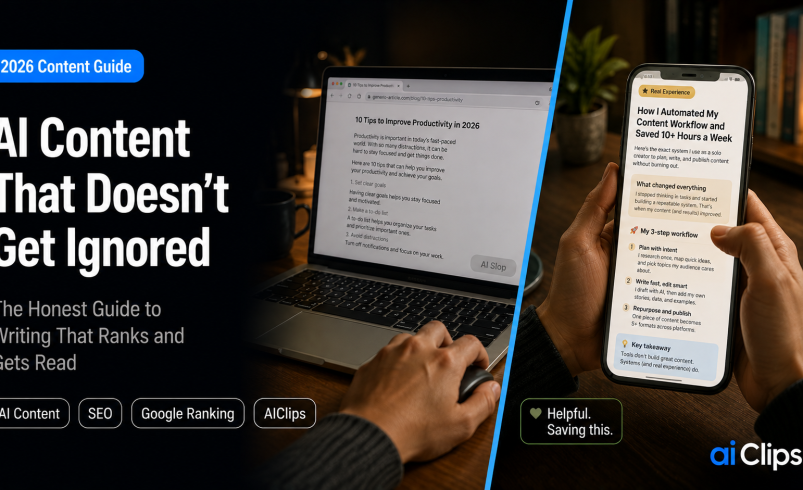

Almost three in four new web pages now contain AI-generated text. The internet is drowning in it, most of it forgettable, and readers have learned to smell it — more than half say they disengage the moment they realise something was written by a machine. So here is the uncomfortable question this guide answers: if everyone is using AI, how do you make AI content that people actually read and Google actually ranks? The good news is that the answer is clear, and most of the AI content out there is ignoring it.
I use AI to help write, and I am not going to pretend otherwise. What I have learned is that the tool was never the problem. Lazy use of it is. Get one idea right — that AI handles the scaffolding while a human handles the substance — and everything else in this guide simply follows from it.
| The flood | 74% of new web pages contain AI content, but only 2.5% are pure AI. The rest are human-AI blends. |
| The reader problem | 52% of people disengage the moment they detect content is AI-made, even though most trust it in general. |
| Google’s real stance | Near-zero link between AI use and penalties. Google punishes low quality, not AI. Its liaison put it as “not anti-AI, anti-crap.” |
| What wins | Information gain — something AI cannot invent: firsthand experience, real expertise, original data, a genuine point of view. |
| The formula | AI for research, drafting, and structure; humans for judgment, voice, and trust. The blend beats both pure AI and pure human. |
The Data Nobody Wants to Hear
Let me put the numbers on the table, because they reframe the whole debate. An Ahrefs study of 900,000 pages found that 74.2% of newly created web pages now contain AI content. But here is the twist that changes everything: only 2.5% are pure AI. The overwhelming majority are human-AI blends. AI content is no longer experimental or fringe — it is simply the default way the web is written now, and pretending you are above using it is just leaving speed on the table.
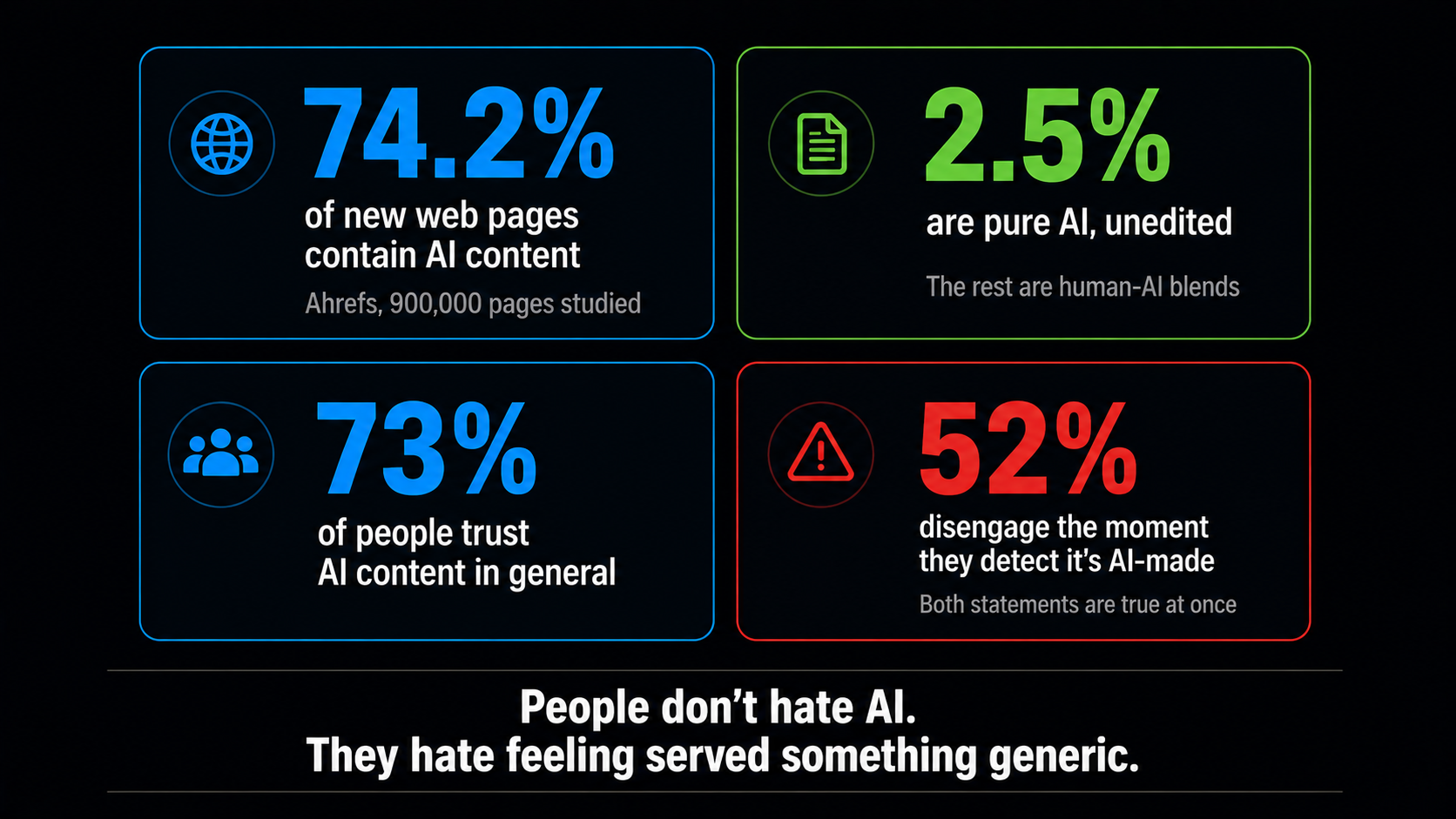
The reader side is where it gets interesting. Around 73% of people say they trust AI content in general, yet 52% disengage the instant they identify something as machine-made. Both things are true at once. People do not hate AI. They hate the feeling of being served something generic and soulless, and “AI” has become their shorthand for that feeling. That distinction is the entire game, so hold onto it. Solve for the soulless part and the “AI” objection quietly disappears, because nobody actually minds how a genuinely good article was made.
What Google Actually Penalises
The biggest myth I hear is that Google penalises AI content. It does not. The measured correlation between AI use and ranking penalties is essentially zero. Google has said, repeatedly and plainly through its search liaison, that it is not anti-AI — it is, in their words, “anti-crap.” What it targets is scaled content abuse: mass-producing pages primarily to manipulate rankings, with little or no value for a reader. A human churning out thin articles gets treated exactly the same as a bot doing it.
And the enforcement has teeth. Through 2025 and into 2026, Google ramped up action against this, and the core updates of early 2026 named it a primary target. Sites publishing AI content at scale — the prompt-and-publish factories — watched 50% to 80% of their organic traffic vanish inside two weeks. None of that means “avoid AI.” It means the criteria quietly shifted from judging the tool to judging the value, and value is now the only thing that survives an update.
What “AI Slop” Really Is
The industry has a name for the stuff getting filtered out: AI slop. It is worth defining precisely, because avoiding it is most of the job. AI slop is content that rephrases what the top few search results already say, carries no opinion or expertise, contains no original data, and exists mainly to fill a keyword gap. It is frictionless, flavourless, and forgettable — the sixth version of an article you have already read five times.
Google’s 2026 updates put a sharp name on the fix: information gain. The question the algorithm now asks is how much new value your page adds compared to what already exists. If your article says the same thing as the current top result in slightly different words, your information gain is zero, and to Google, zero information gain means zero value, full stop. That is the exact test your AI content has to pass, and generic AI content fails it every time.
The One Thing That Beats the Slop
If information gain is the test, the way to pass it is to include what an AI model cannot hallucinate on its own. That is the whole strategy, and it is refreshingly concrete.
- Firsthand experience. What actually happened when you did the thing. A model can describe using a tool; only you can say it broke on the third try and how you fixed it.
- Real expertise and a point of view. An opinion, a stance, a “most guides get this wrong” that comes from knowing the topic. Generic content has no opinions; experts do.
- Original data. You do not need to be a research lab. Your own numbers, a small survey, results from your own tests — any proprietary data an AI has never seen.
- A genuine angle. The unusual take, the local context, the thing true in your market that global content ignores.
Every one of these is something AI cannot generate for you, which is exactly why they work. The moment your AI content contains real experience or real data, it stops being interchangeable AI content, and interchangeable is the only thing Google and readers are actually rejecting.
The Human-in-the-Loop Formula
Here is the split that makes all of this practical. The winners in 2026 are not the people who write everything by hand, and they are not the ones who let AI publish untouched. They are the ones who put humans and AI in their proper lanes.
| Let AI handle | Keep for humans |
|---|---|
| Research and gathering | Strategy and the angle |
| First drafts and structure | Firsthand experience and opinion |
| Outlines and formatting | Judgment on what is true and useful |
| Speed and scale | Voice, tone, and trust |
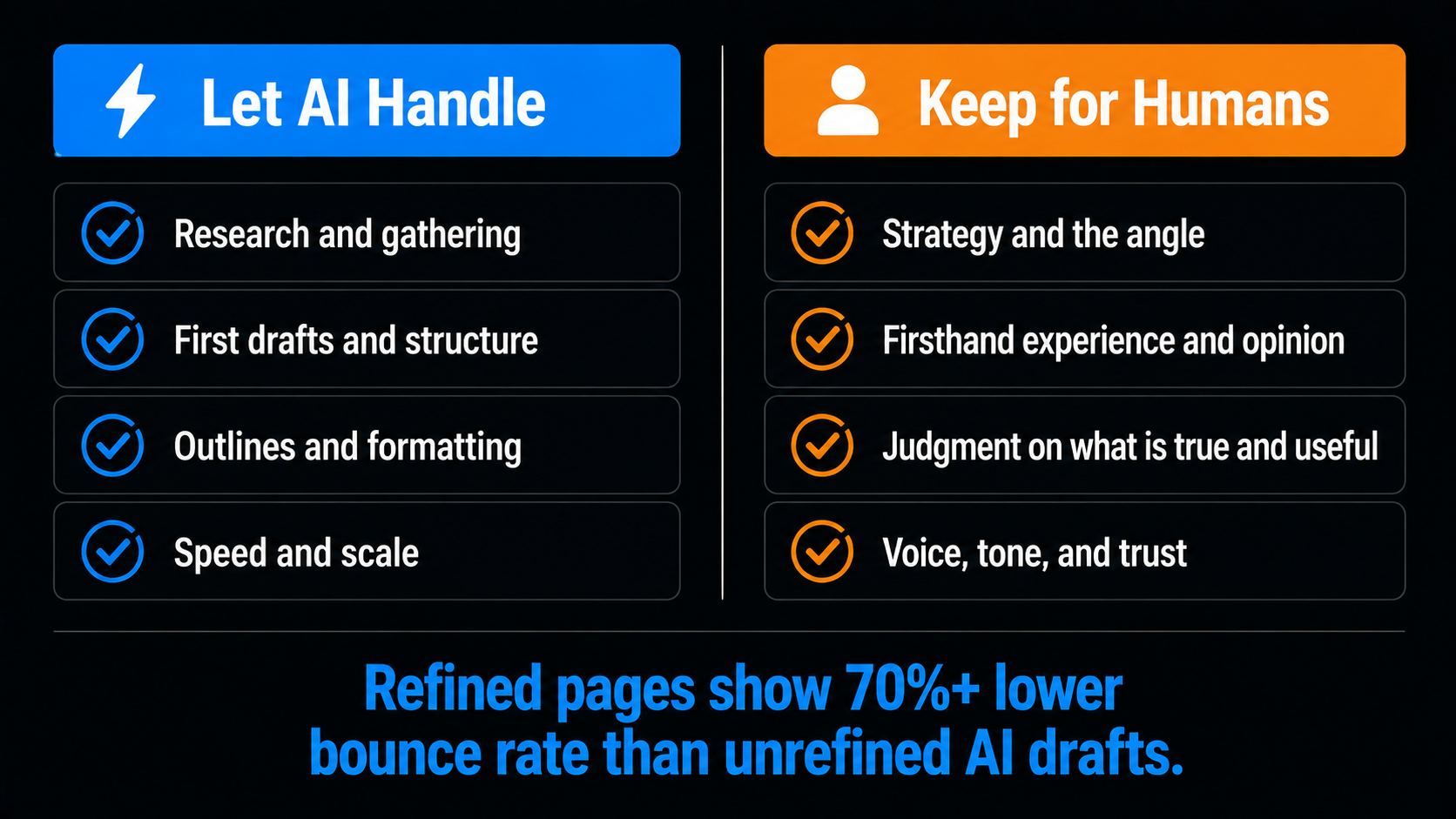
People treat this as a compromise. It is actually the highest-performing setup there is. Content that blends AI drafting with human refinement outperforms both pure AI and pure human work, and refined pages have shown bounce-rate reductions of over 70% against unrefined ones. The human is not there to slow the AI down. The human is there to add the exact things — judgment, experience, voice — that turn a fast draft into something worth reading.
How to Make AI Content That Doesn’t Sound Like AI
Passing the value test is half the battle for AI content. The other half is not tripping the reader’s “this was written by a machine” alarm, because that is what triggers the 52% to leave. Here is how to strip the tells.
1. Add a Real Opinion VOICE
AI hedges by default. Take a side. “This is the mistake most people make” reads as human because a machine rarely commits. A clear point of view is the fastest way to sound like a person who actually knows the subject.
2. Get Specific DETAIL
Replace vague claims with concrete detail — a real number, a named example, a specific moment. “It saved me about four hours a week” beats “it boosts productivity.” Specificity is almost impossible for generic AI content to fake.
3. Cut the AI Tics EDIT
Kill the giveaways: the endless rule-of-three lists, the “in today’s fast-paced world” openers, the inflated “it’s a testament to” phrasing, the neat little summary after every point. Read it aloud. If it sounds like a corporate brochure, rewrite it plainer.
4. Vary Your Rhythm FLOW
AI writes in even, same-length sentences. Humans do not. Mix a long, winding sentence with a short one. Break a pattern on purpose. The unevenness is what makes writing feel alive rather than assembled.
5. Bring Yourself In EXPERIENCE
Add the line only you could write — what you tried, what surprised you, what went wrong. Firsthand experience is both the thing Google rewards and the thing that instantly signals a real human to a reader. It does double duty.
Should You Disclose That You Used AI?
My honest view: transparency helps, but it is widely misunderstood. The 52% who disengage are not reacting to a disclosure label — they are reacting to content that feels generic. Nobody bounces from a genuinely useful, well-written article because a footnote mentions AI assisted it. They bounce from soulless writing, whether it is labelled or not.
So disclose where it matters — anything that could mislead, anything in a sensitive or regulated space, anything where a reader would reasonably want to know. But do not treat a disclosure as your fix. The real protection against the disengagement problem is not a label; it is making AI content good enough that no one would have guessed. Honesty and quality work together, not in place of each other.
The Opportunity Hiding in the Slop
Here is the part I find genuinely exciting, and it is a reason to feel optimistic rather than defeated. The flood of AI slop is an opportunity, not just a threat. Every generic, prompt-and-publish article your competitors churn out is a question their audience is not really being served on. Each of those is a gap you can own with a single piece that is expert-authored, firsthand, and backed by something real.
For an Indian creator or business, this is sharper still. So much AI content is generic and Western-default, which means any topic where genuine local knowledge matters is wide open for better AI content. The specifics of the Indian market, the regional nuance, the on-the-ground reality that global slop gets vaguely wrong — that is information gain no model can fake, and it is sitting there unclaimed. The competitor who prompts-and-publishes cannot touch it, because they have never lived it. If you want to go deeper on writing for the way search now works, our guide to the Indian AI ecosystem is a useful next step.
Before You Hit Publish: A Quick Checklist
Everything above collapses into a short list you can run against any draft. If a piece of AI content cannot pass these five checks, it is not ready, no matter how fast it was to produce.
- Does it say something new? If it only rephrases the current top results, your information gain is zero. Add a real insight, or do not publish.
- Is there a human in it? A genuine opinion, a firsthand detail, an example only you could give. AI content without a human fingerprint reads as slop.
- Would you have guessed it was AI? Read it aloud. If it sounds assembled rather than written, strip the tics and add some rhythm before it goes live.
- Is every fact checked? AI invents statistics and quotes with total confidence. Verify anything specific, because one hallucinated number destroys trust.
- Is it actually useful? Would a real person leave the page glad they read it? That is the only test Google and readers ultimately apply.
Run that list and your AI content clears the bar most of your competitors never even aim for. It takes a few minutes, and those few minutes are the entire difference between content that ranks and content that quietly disappears in the next core update.
Where AIClips Fits
This is, honestly, the whole philosophy AIClips is built on, so let me be plain about it. AIClips is a production engine — it helps you make content faster, whether that is the visuals, the video, the voiceover, or the scaffolding around your words. What it will never do, and what no tool should claim to do, is supply the judgment, the experience, and the voice that make content worth ranking.
That part is yours. Used the right way, AIClips takes the slow production work off your plate so you can spend your time on the human substance that actually wins — across 461 models in one dashboard at ₹349/month with UPI. The tool handles the scale; you handle the reason anyone should care. For more on that thinking, here is why we built AIClips.
Frequently Asked Questions
Does Google penalise AI content?
Why do people disengage from AI content?
What is information gain?
Is it better to write with AI or by hand?
Should I tell readers I used AI?
How does AIClips help with this?
Produce Faster, Stay Human, on AIClips
Let AIClips handle the visuals, video, and scaffolding while you add the substance. 461 models, one dashboard, from ₹349/month.
Start on AIClips →