



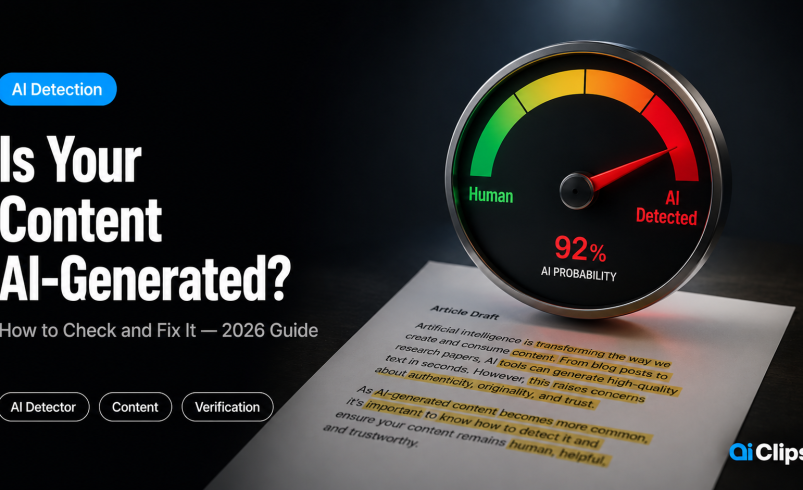

An AI content detector tells you the probability that a piece of text was generated by an AI. In 2026, that number matters — clients ask for it, universities check for it, and some publishers require it before accepting work. This guide shows you how to check AI generated content using AIClips’ detector, what the scores actually mean, and when to take them seriously (and when not to).
The honest version: AI content detectors are useful, but they are not reliable enough to be the final word on anything. Independent tests show real-world accuracy between 65% and 90% depending on the tool and text type. False positives — human writing flagged as AI — are a documented problem. This guide covers what the tool can do for you and where it breaks down.
| What it does | Runs your text through a detection model and returns a probability score indicating how likely the content is AI-generated. |
| Tool on AIClips | AI Content Detector — 3 credits per generation, available on all plans. |
| Real-world accuracy | 65–90% in independent tests. Vendor claims of 99% do not hold up under third-party testing. |
| Biggest limitation | False positives. Polished human writing, non-native English, and short texts under 300 words are disproportionately flagged as AI. |
| Who needs it | Content agencies delivering to clients with AI-free requirements, marketers, educators, and anyone checking their own work before submission. |
When AI Content Detection Actually Matters
Not everyone needs to run content through an ai detection tool. But several specific situations make it worth doing.
Content agencies and freelancers. More clients in 2026 include AI-free clauses in their content briefs. They want verification, not just assurance. Running a score through an ai content detector before delivery gives you something concrete to point to — and flags any sections that might trip a client’s own checks.
SEO and publishing teams. Google’s official stance is that it rewards high-quality content regardless of whether AI was involved in writing it. But some publishers have their own policies, and certain niches (finance, health, legal) face stricter content authenticity requirements. Knowing your score before submission matters here.
Checking your own AI-assisted work. A lot of creators use AI to draft and then edit heavily. The question is whether the final version still reads as AI-generated after your edits. Running it through a detector before posting answers that question.
Academic context. Universities including several Indian IITs and IIMs have adopted Turnitin’s AI detection layer. Students and educators both need to understand what the scores mean — and crucially, what they do not mean.
How AI Detectors Work (The Short Version)
AI detectors analyse two main signals in text: perplexity and burstiness.
Perplexity measures how predictable the text is. AI-generated text tends to be statistically predictable — the model picks the most likely next word repeatedly. Human writing is less predictable, with more unexpected word choices, idioms, and structural variation.
Burstiness measures how much sentence length varies. Humans write in bursts — some very short sentences, some very long ones. AI models tend toward more uniform sentence lengths.
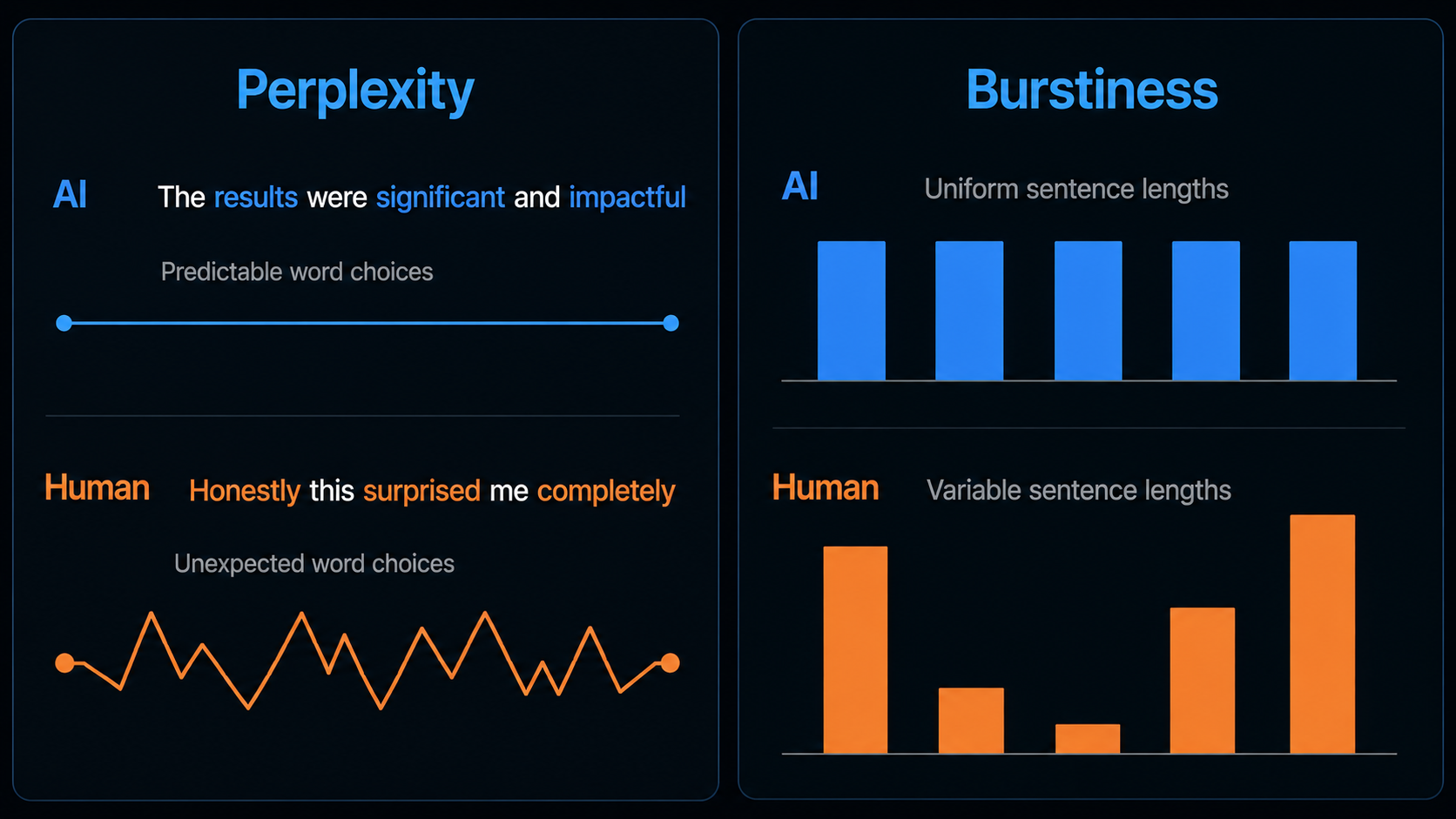
The problem is that these are tendencies, not rules. A careful human writer who edits for clarity produces polished, predictable, evenly-paced text — which looks like AI output to a detector. A non-native English speaker writing formal content produces text that scores similarly. This is where false positives come from, and it is a real limitation that no current gpt detector has fully solved.
Run Your Content Through the AIClips AI Content Detector
Go to app.aiclips.net and find the AI Content Detector under the writing tools section. It costs 3 credits per check — one of the cheapest tools on the platform.
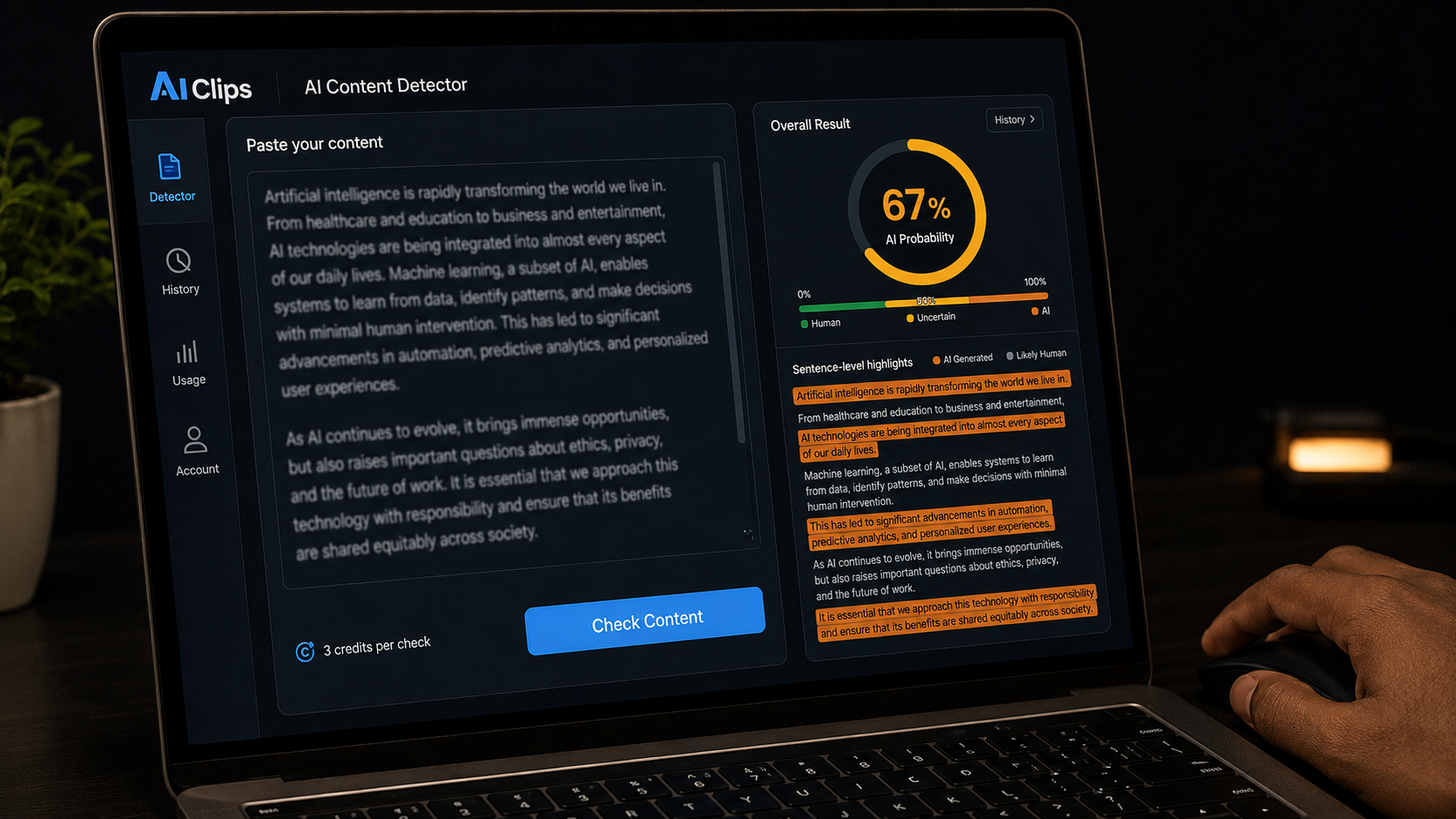
Paste your text into the input field. A few things to keep in mind before you hit generate:
- Minimum length matters. Do not check texts under 300 words. GPTZero itself acknowledges that false positive rates rise sharply below this threshold. Short texts do not give the detector enough signal to make a reliable call.
- Check one section at a time for longer content. A 2,000-word article run as a single block gives you an average score. Running it in 400-word sections tells you which parts of the article read as AI-generated, which is far more actionable.
- Check the original, not a copy. If you reformatted or edited a copy of the text, check that version — not the original draft. Formatting and minor edits can shift the score noticeably.
Interpret the Score Correctly
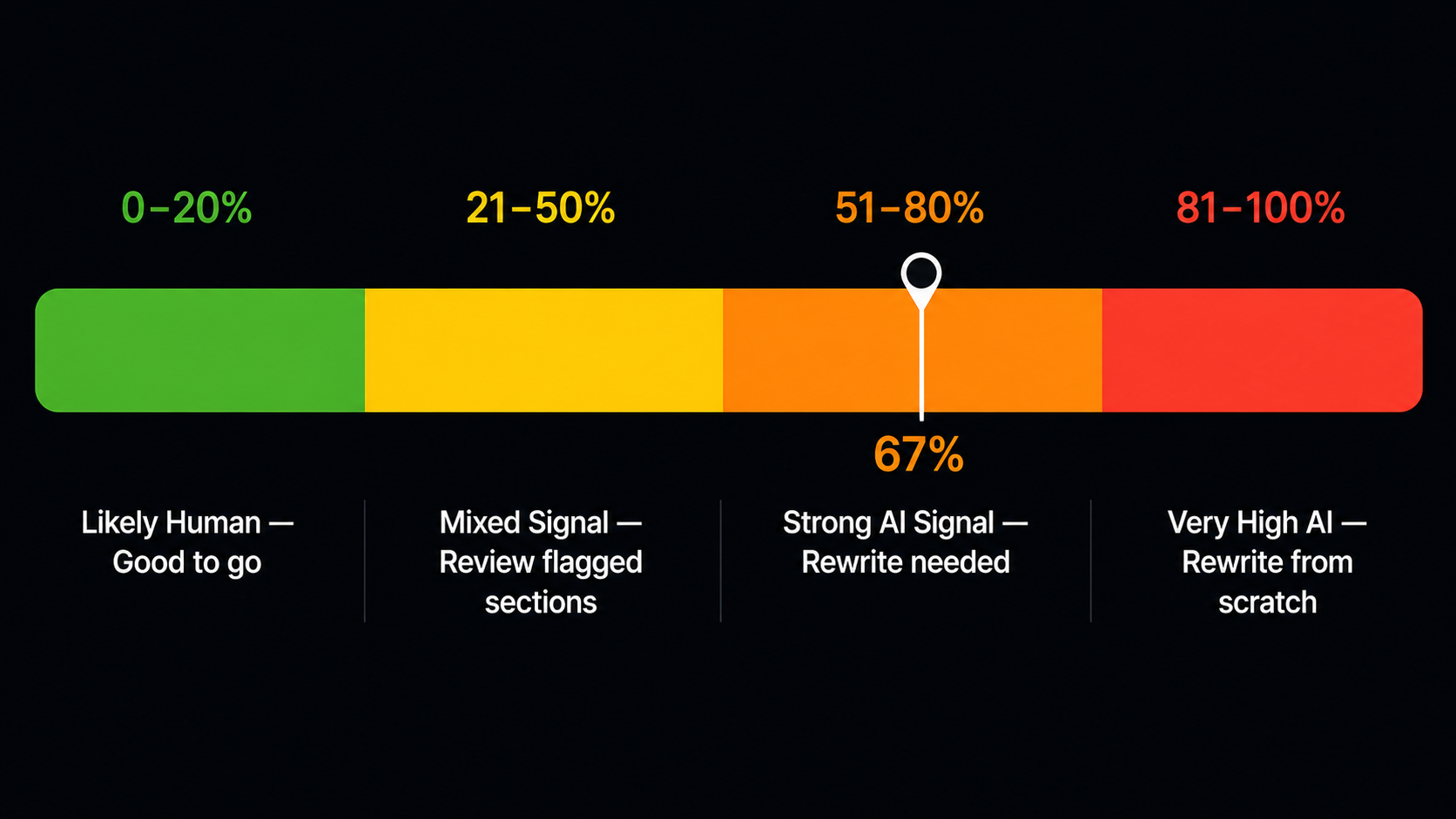
Most ai detection tools return a percentage: “87% likely AI-generated” or “23% AI probability.” Here is what those numbers actually mean in practice.
| Score Range | What It Means | What to Do |
|---|---|---|
| 0–20% | Likely human-written. Low AI signal detected. | Good to go for most use cases. If the client is very strict, do a quick pass anyway. |
| 21–50% | Mixed signal. Could be human, could be lightly AI-assisted, could be a false positive on polished writing. | Review flagged sections. Edit for more natural variation before submitting to clients with strict requirements. |
| 51–80% | Strong AI signal. Either AI-generated or heavily edited from AI output. | This section needs a proper rewrite before submission. See Step 3 below. |
| 81–100% | Very high AI probability. | Rewrite from scratch using the AI output as a reference point, not as the text itself. |
Who Gets False Positives Most Often
Three groups are disproportionately flagged by ai content detectors, even for entirely human-written work:
- Non-native English writers. Careful, formal English from non-native speakers follows more predictable patterns than casual native writing — which looks like AI output to detection models. This is a documented problem that affects Indian content writers significantly.
- Polished, edited human writing. The more carefully you edit for clarity and flow, the more your writing resembles AI output statistically. Structured, professional content gets flagged more often than casual, conversational writing.
- Short texts under 300 words. Not enough signal for the detector to work reliably. Product descriptions, social captions, and short emails routinely produce unreliable scores.
Edit Flagged Content to Lower the Score
If your content scores above 50% on the ai content detector and you need to reduce that score before submission, here are the specific edits that work.
Add Personal Opinions and Specific Observations
AI-generated text rarely expresses genuine opinions or specific reactions. Adding sentences like “I found this counterintuitive at first” or “In our tests, this behaved differently than expected” injects a human signal the detector can pick up. Do not fabricate opinions — add real ones from your actual experience with the subject.
Break the Rhythm
AI text has consistent sentence lengths and parallel structure. Read your flagged sections aloud. If every sentence takes the same amount of time to say, the rhythm is too uniform. Deliberately vary length — put a very short sentence after a long one. Fragment a thought. Start one with “And” or “But.”
Replace Vague Claims with Specific Numbers
AI models default to generalisations — “many users,” “significant improvement,” “widely used.” Replace these with specific data points wherever possible. “3 out of 5 clients” beats “many clients.” “Reduced production time by 40 minutes” beats “significantly faster.” Specificity reduces the AI probability score reliably.
Remove Parallel Lists
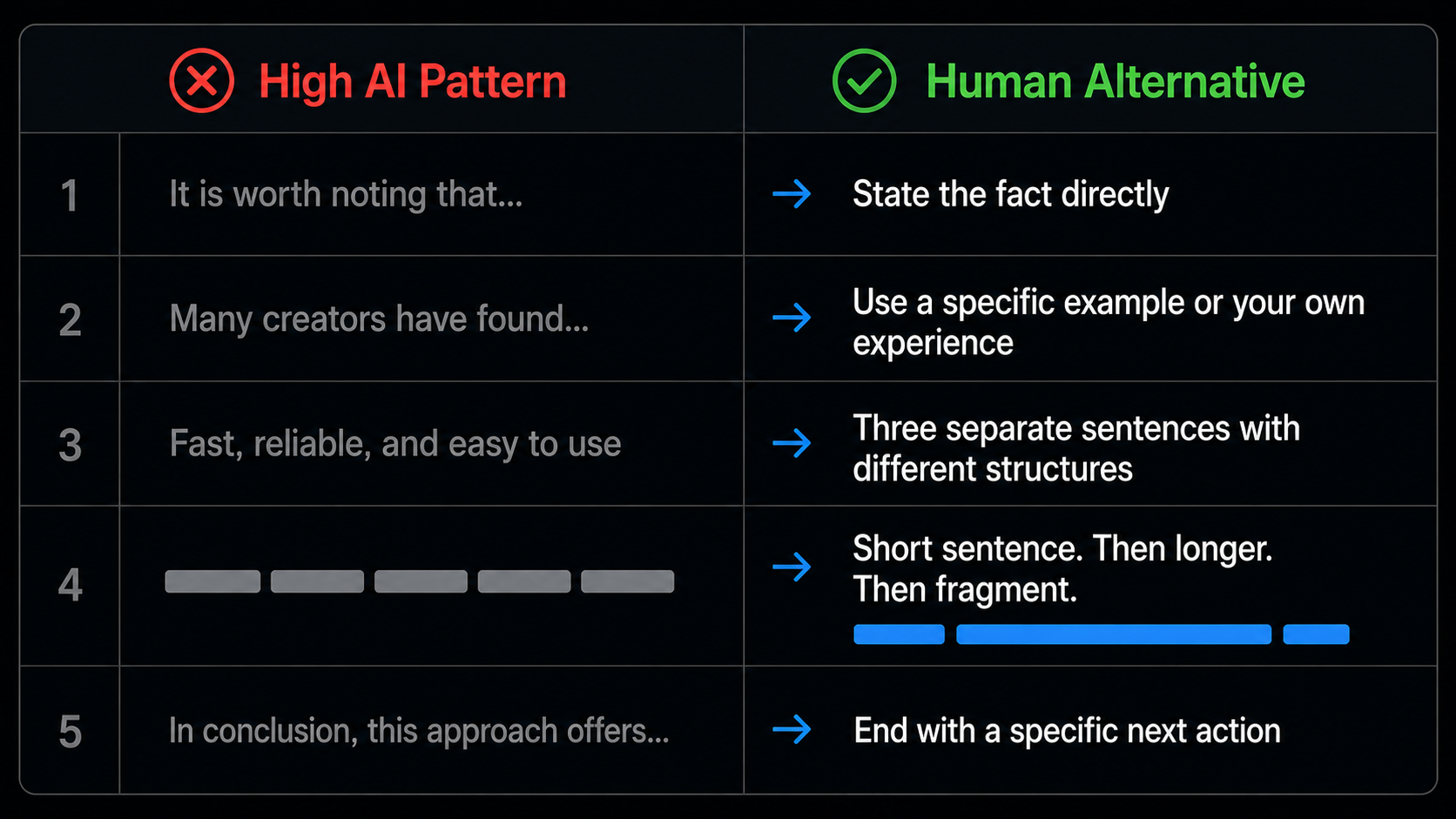
AI loves parallel structure. “This tool is fast, reliable, and easy to use.” “The platform offers flexibility, affordability, and scalability.” Three-part parallel claims are a strong AI signal. Break them into individual sentences with different structures.
| High-AI Pattern | Human Alternative |
|---|---|
| “It is worth noting that…” | Just state the fact directly |
| “This is a powerful tool that…” | Say specifically what it does |
| “Many creators have found that…” | Name a specific example or use your own experience |
| “In conclusion, this approach offers…” | End with a specific action or concrete next step |
| Three-part parallel claims | Single statements with varied structure |
| Uniform sentence lengths throughout | Short sentences. Then longer ones. Then a fragment. |
What AI Detectors Cannot Do
This section matters as much as how to use the tool.
No current ai detection tool can reliably detect AI content that has been heavily humanized. When AI text is processed through a humanizer before submission, detection accuracy drops by 20% or more across all major tools. A score of 0% does not confirm the content is human-written — it confirms the detector did not find AI patterns, which is different.
Detectors also cannot tell you how much of a document is AI-generated versus human-written when the two are mixed. They return an average signal for the whole text, not a precise breakdown of which sentences are AI and which are human. The sentence-level highlighting some tools offer is an approximation, not a map.
And critically: no detector is reliable enough to justify punishing someone based on the score alone. Several US lawsuits have been filed over false positive AI detection accusations in academic contexts. The technology is a screening tool, not evidence.
AI Detection in Academic vs Commercial Contexts
| Context | Common Tool Used | How Seriously to Take the Score | Risk of False Positives |
|---|---|---|---|
| University submissions | Turnitin AI Detection | High — institutions often act on scores above 20% | High — especially for non-native writers |
| Client content delivery | Originality.ai, GPTZero | Medium — a starting point for review, not final verdict | Medium — depends on writing style |
| SEO publishing | Various | Low — Google does not penalise AI content directly | Low impact — publishers care about quality, not score |
| Journalism and news | Internal tools + Originality | High — editorial standards require human authorship | Medium |
| Self-checking before publish | AIClips AI Detector | Use as a guide to improve writing quality, not as a pass/fail test | Low-impact — you control the outcome |
AI Content Detector Tools — How AIClips Compares
| Tool | Cost | Best For | Limitation |
|---|---|---|---|
| AIClips AI Detector | 3 credits/check (~₹1–2) | Quick checks before publishing; integrated with other AIClips writing tools | Not designed for academic submission verification |
| GPTZero | Free (10,000 words/month), ₹1,080/month paid | Education, accuracy-focused checks, detecting GPT-5 and Claude | Real-world accuracy 62% in independent tests despite vendor claims |
| Originality.ai | ~₹1.67 per 100 words | SEO teams, publisher workflows, bundled plagiarism checking | 4.79% false positive rate — highest among major tools |
| Turnitin AI Detection | Institutional pricing | Academic institutions | Not available to individuals; institutional decisions carry real consequences |
For most Indian content creators and agencies, the AIClips AI Content Detector at 3 credits per check is the most practical option for routine content review. If you are submitting to clients who specifically run Originality.ai or GPTZero checks, test your content on those tools directly before delivery — do not assume the AIClips score will match.
Frequently Asked Questions — AI Content Detector
How accurate is the AIClips AI content detector?
Why is my human-written content being flagged as AI?
Can I check AI generated content for free?
Does Google penalise AI-generated content?
What is the difference between a GPT detector and a general AI content detector?
Should I run my content through multiple detectors?
Check Your Content on AIClips
AI Content Detector — 3 credits per check. Available on all plans from ₹349/month.
Try AIClips AI Detector →