
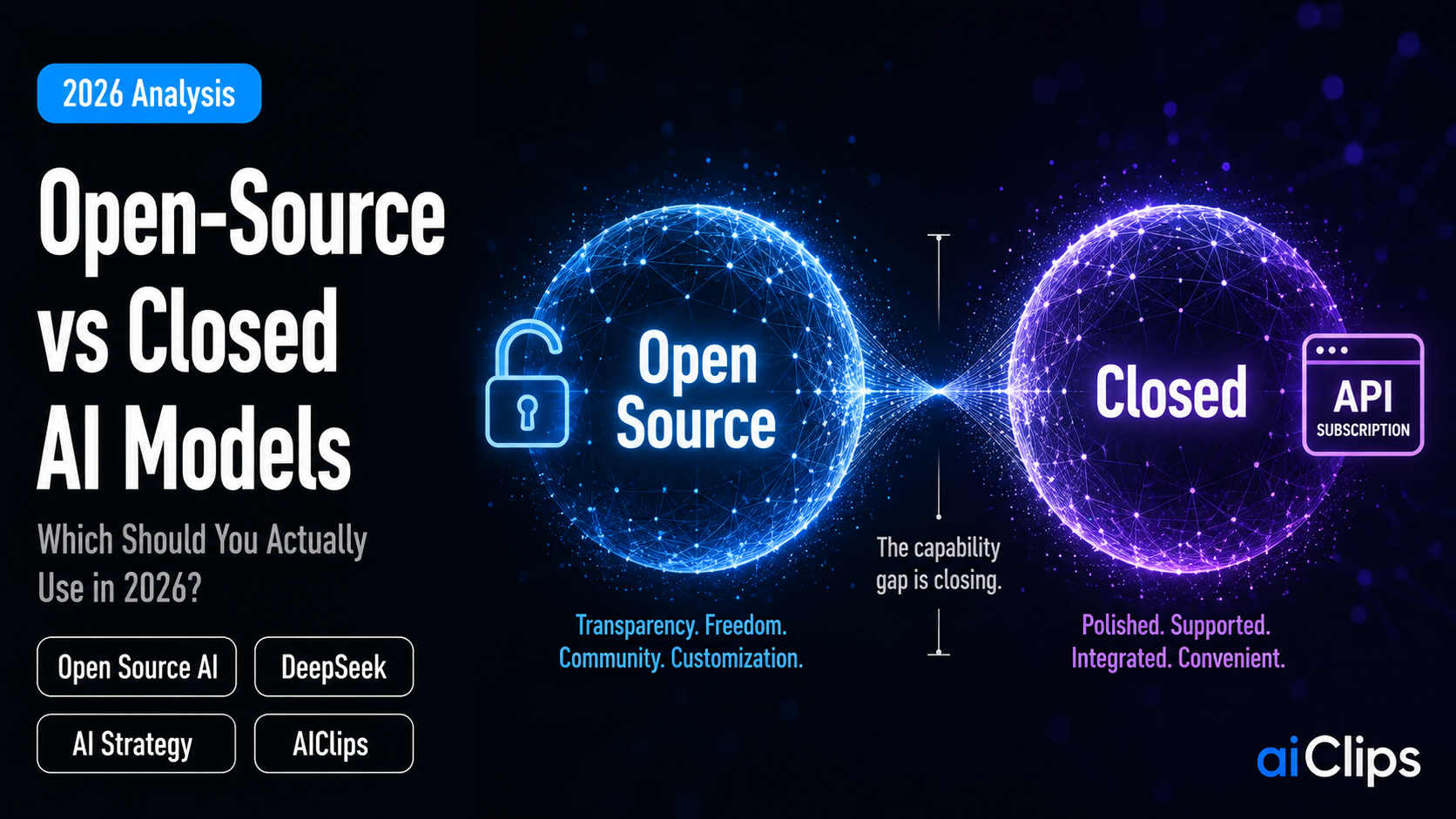



At the end of 2023 this was an easy question. The best closed model scored around 88% on the MMLU knowledge benchmark, the best open alternative managed roughly 70.5%, and if you wanted quality you paid for an API. By early 2026 that 17.5-point gap has effectively closed. Open source AI now matches or beats proprietary models on knowledge, maths, and graduate-level science, and five independent model families got there at once, which makes it a structural shift rather than a fluke. This guide explains what genuinely changed in open source AI, where closed models still win, and how to choose without the ideology.
The most useful thing I can tell you early: for most people the answer is not one or the other. The default architecture in 2026 is closed models where the capability ceiling shows, open models where the cost gap outweighs the capability gap.
| The gap closed | 17.5 points on MMLU at end-2023, effectively zero by early 2026, and single digits on most reasoning tasks. |
| Where open wins | Cost (often 5–10× cheaper per token), customisation, on-premises and air-gapped deployment, no vendor lock-in. |
| Where closed wins | Production coding, complex agentic and long-horizon tasks, human preference, and zero-ops managed APIs. |
| Self-hosting maths | Running a frontier open model costs roughly $2–5K a month in GPU. It only beats API pricing above ~50M tokens a month. |
| Adoption | Around 89% of enterprises now run at least one open model in production. |
What “Open” Actually Means
A quick definition of open source AI, because the terminology misleads people. Most models described as open source AI are more precisely open-weight: the trained weights are published and you can download, run, and fine-tune them, but the training data and full pipeline usually are not released. That distinction matters less than it sounds for practical use, and more than it sounds for the word “open”.
The practical consequence is the important bit. Once you have downloaded a set of weights, no external party can take them away from you. Your access does not depend on a company’s pricing decisions, its terms of service, or its continued existence. A closed model, by contrast, is a service you rent — excellent while the relationship works, and entirely outside your control if it does not.
The Gap That Closed
The convergence is the headline story of open source AI in 2026, and the numbers are stark. At the end of 2023 the best closed model sat around 88% on MMLU against roughly 70.5% for the best open alternative. By early 2026 that difference is effectively zero on knowledge benchmarks, and single digits on most reasoning tasks.
What makes this open source AI shift structural rather than a one-off is that it did not happen to one model. Five independent families — DeepSeek, Qwen, Kimi, GLM, and Mistral — reached frontier quality at roughly the same time, alongside Meta’s Llama line. When six labs across three continents converge simultaneously, that is an industry-wide capability floor rising, not a single lucky release.
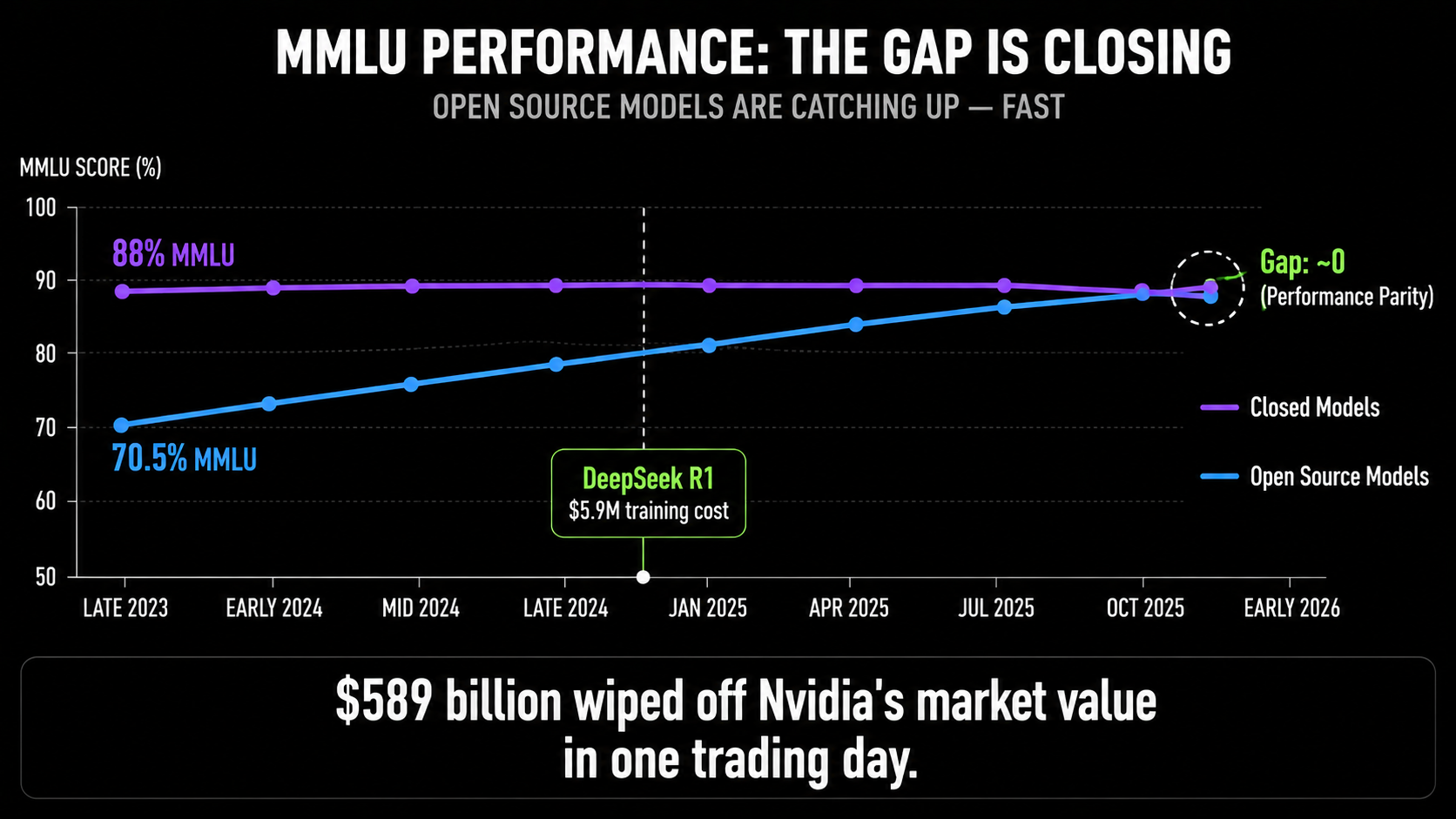
The moment that made everyone pay attention was DeepSeek’s R1, which matched a leading reasoning model on many benchmarks at a reported training cost of around $5.9 million — a number small enough that it knocked roughly $589 billion off Nvidia’s market value in a single trading day. The point was not the model. It was the demonstration that frontier capability no longer required a frontier budget.
Where Each Side Still Wins
Convergence on benchmarks does not mean open source AI has parity everywhere. The remaining differences are specific and worth knowing.
| Open models lead on | Closed models lead on |
|---|---|
| Knowledge benchmarks (MMLU) | Production coding (SWE-bench Verified) |
| Mathematics (AIME, MATH-500) | Complex agentic and long-horizon tool use |
| Graduate-level science (GPQA) | Overall human preference in head-to-head tests |
| Cost per token, often 5–10× cheaper | Zero-ops managed API with an enterprise SLA |
| Fine-tuning and domain adaptation | The absolute top end of multimodal reasoning |
| On-premises and air-gapped deployment | Convenience — nothing to run or maintain |
That closed-model lead on hard agentic coding and long-horizon reliability is real, and for teams whose product depends on those last few points of consistency, the premium is still worth paying. But notice how narrow the list has become. Two years ago the honest summary was “closed is better.” Today it is “closed is better at a handful of specific things.”
The Economics: Where the Real Decision Lives
There is a middle path in open source AI that most people miss. You can use open models through a hosted API without running any infrastructure at all, which captures most of the cost advantage while skipping the operations burden entirely. That, rather than a rack of GPUs, is what using open source AI looks like for the vast majority of teams.
Hardware Reality
If you are tempted by self-hosting anyway, understand what frontier open source AI actually requires. The strongest open source AI models are enormous — several hundred billion parameters, with the largest around a trillion — which means multiple high-end data-centre GPUs to serve at full precision. This is not a laptop project.
The genuinely interesting development is at the smaller end. Mixture-of-experts architectures activate only a fraction of their parameters per token, so a model with tens of billions of active parameters can deliver frontier-adjacent quality at a fraction of the compute. A few of these now run on a single consumer GPU, which is what makes local open source AI realistic for an individual developer rather than only for a funded lab.
The Families Worth Knowing
You do not need to track every release, but knowing who is shipping what makes the landscape far less confusing. Six labs now produce genuinely competitive open source AI, and each has a character.
- DeepSeek. The name most people recognise, and currently the benchmark leader among open weights, particularly strong on coding and reasoning. The models are enormous, so self-hosting means serious hardware.
- Qwen. Alibaba’s family, notable for punching above its weight class thanks to mixture-of-experts efficiency and unusually strong multilingual performance.
- Llama. Meta’s line, still the default reference point for many teams, spanning tiny models to frontier scale — useful when you want one family across very different jobs.
- Mistral. The European option, which matters enormously for teams with data-residency requirements on the continent.
- GLM and Kimi. Two more labs that reached frontier quality in the same window, and part of why this convergence counts as structural.
- Gemma and Phi. Small open models from Google and Microsoft, built for efficiency rather than benchmark leadership — often the right pick for on-device work.
The takeaway is not to memorise the list. It is that “best open model” is now a question with six credible answers that change every quarter, which is the healthiest sign in this whole space.
How to Choose
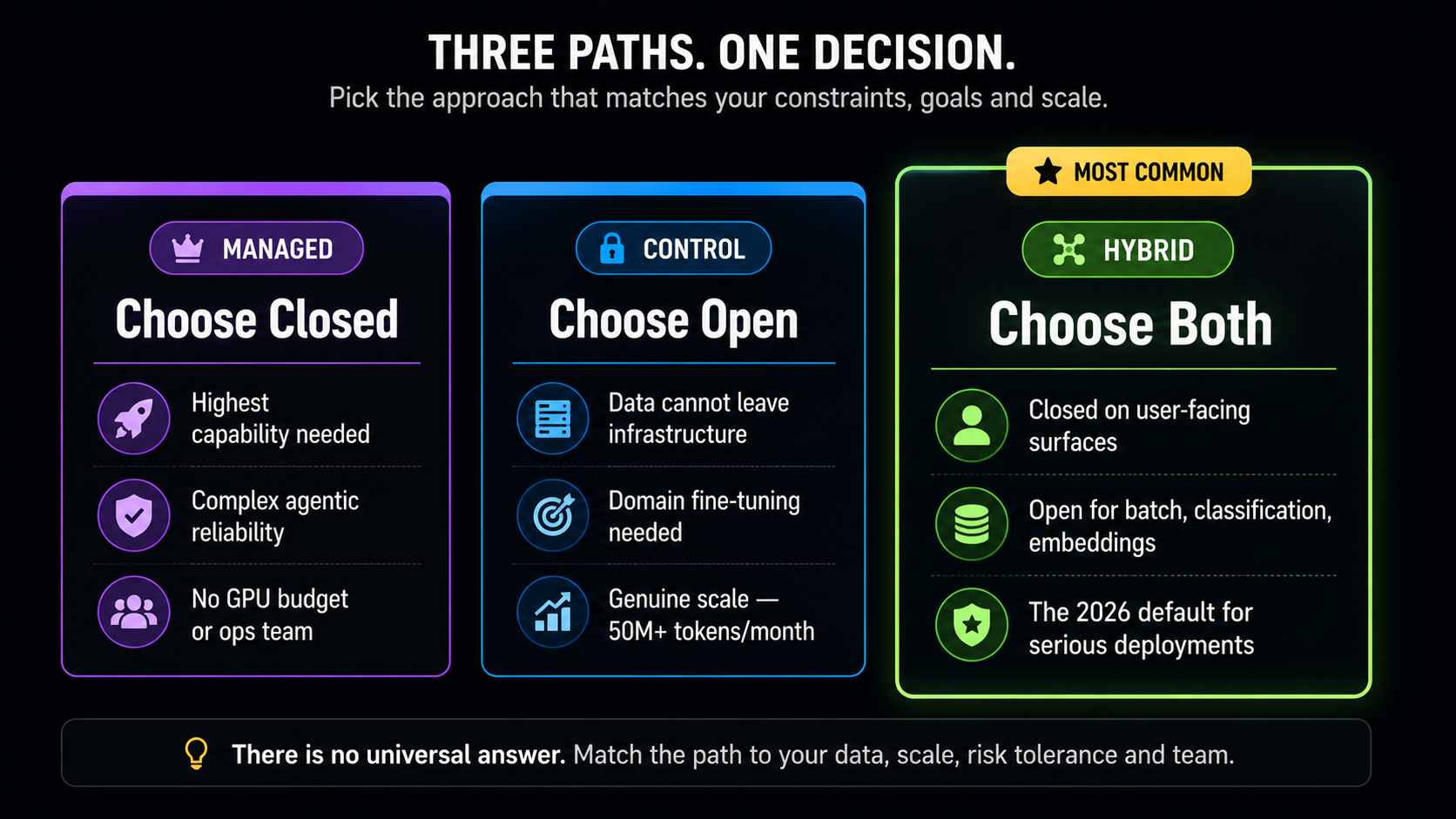
Choose Closed When… MANAGED
You need the highest capability regardless of cost, your product depends on complex agentic reliability or production-grade coding, or you have no GPU budget and no operations capacity. A managed API with an SLA is the right answer far more often than open-source enthusiasm admits.
Choose Open When… CONTROL
Your data cannot leave your infrastructure, you need domain fine-tuning, you are operating at genuine scale where per-token cost dominates, or sovereignty and lock-in are strategic concerns. Regulated industries and air-gapped environments have no real alternative.
Choose Both, Which Is Usually Right HYBRID
The 2026 default: closed models on the user-facing surface where the capability ceiling shows up, and fine-tuned open models for batch inference, classification, embeddings, and any task where the capability gap is small relative to the cost gap. Most serious deployments are hybrids, not converts.
The Risks Nobody Mentions
Three honest cautions before you commit to open source AI, none of them dealbreakers but all worth planning around.
- Licences can change. Today’s permissive terms apply to today’s version. Future releases may not carry them, so pin to a specific model version and keep the ability to switch families.
- Supply chain and geopolitics. Access to future updates could be disrupted by trade or political friction — though weights you have already downloaded cannot be revoked, which is precisely the point.
- Pace of obsolescence. Release cadence has compressed to the point where a model that was state of the art in January was often superseded by June. Build so you can swap models, not so you are married to one.
On trusting open source AI, the picture is reassuring rather than alarming. Model weights are deterministic artefacts, the community independently audits major open releases for backdoors and hidden behaviour, and no credible evidence of intentional compromise has surfaced in any major open model. Verification is possible with open weights in a way it simply is not with a closed API.
Why This Matters Especially in India
There is a sovereignty argument here that lands harder in India than in most markets, and it is not abstract. Indian-language capability has never been a priority for the largest closed labs, whose commercial incentives point elsewhere. Open source AI lets Indian teams fix that themselves — Sarvam’s models build directly on the open ecosystem to handle Indian-language reasoning specifically, which is exactly the kind of work that only becomes possible when you can fine-tune rather than merely call an API.
The cost argument matters more here too. Per-token pricing in dollars is a heavier burden on an Indian startup’s runway than on a funded Western one, so a 5–10× reduction in inference cost changes what is buildable. Between language sovereignty and unit economics, open source AI is arguably more consequential for the Indian ecosystem than for the markets where these models are made. Our piece on the Indian AI ecosystem covers that shift in more depth.
What This Means If You Are Not an Engineer
Most readers of this blog are creators, founders, and marketers rather than MLOps engineers, so let me translate. You will almost certainly never self-host open source AI, and that is fine. What the convergence gives you is leverage of a different kind: competition. When five open source AI families match the proprietary leaders, closed-model pricing comes under pressure and capability diffuses faster to the tools you actually use.
The practical version of this is simply not marrying one model. Route the job to whichever model does it best today, knowing that “best” changes every quarter. The person who built a workflow entirely around one provider in January had to rebuild it by June. The one who stayed portable just switched.
Where AIClips Fits
Being precise: AIClips is not a self-hosting platform, a fine-tuning service, or an MLOps tool. If you need to run open source AI on your own infrastructure, adapt a model to your domain, or work air-gapped, you need proper infrastructure and engineering, and no aggregator substitutes for that.
What AIClips does offer is the practical version of the argument above. Across 461 models you get both camps of open source AI and proprietary models through one dashboard at ₹349/month with UPI, so you can route each job to whatever performs best without holding six subscriptions or committing to one lab’s roadmap. Given how fast the leaderboard turns over, that portability is worth more than backing a winner.
The Bottom Line
The argument that dominated 2024 has quietly resolved itself. Open source AI is no longer the compromise option you settle for when you cannot afford the good stuff, and closed models are no longer automatically better at everything. The gap survives in a few specific places — hard agentic work, production coding reliability, and the convenience of a managed service with someone else on call.
For almost everyone reading this, the practical takeaway is not which camp to join. It is to stay portable. Route each job to whatever handles it best right now, keep your workflow independent of any one provider, and let the labs compete for your work rather than picking a side and hoping. Given that the leaderboard turns over every quarter, that flexibility is worth more than loyalty to either camp — and it is the one strategy that keeps paying no matter which way open source AI develops next.
Frequently Asked Questions
Are open source AI models as good as closed ones in 2026?
Is self-hosting an open model cheaper?
What does “open weight” mean versus open source?
Should my business use open or closed models?
Are open models safe to use in production?
Does AIClips let me use open models?
Use Both Camps Without Picking a Side
Open-weight and proprietary models, 461 of them, in one dashboard. INR pricing, UPI, from ₹349/month.
Start on AIClips →