

Margins in Indian food service are being squeezed from every direction — food costs, wages, rent, commercial LPG, and delivery commissions that keep climbing. Nobody running a café has spare cash for a photographer or a social media agency. That is precisely why AI for restaurants has become genuinely useful rather than a novelty: it lets a two-person operation produce the menu photos, social content, and promo videos that fill tables, for the price of one subscription. This guide covers the AI for restaurants that actually works, in the order you should do it.
Before any of it, though, one piece of advice that could save you money today: both Swiggy and Zomato offer free food photography when you list with them, and most owners never claim it. Start there, not with a tool.
| Do this first | Claim the free Swiggy and Zomato onboarding photoshoot. Swiggy shoots 20+ menu items; ask your account manager if you missed it. |
| Free AI already there | Swiggy’s Owner app has an AI Photoshoot feature that enhances phone photos for listings — 10,000+ restaurants used it in month one. |
| Priority order | Delivery listings first (they convert to orders directly), then Instagram, then everything else. |
| The discovery shift | Roughly 1 in 5 diners now uses an AI tool to find somewhere to eat, and Instagram is being crawled by Google. |
| The hard rule | AI may enhance photos of food you actually serve. It must never invent a dish you don’t. |
How People Find Restaurants Now
Before choosing any AI for restaurants, understand how discovery works now. The path has shifted twice in two years, and it changes where your effort should go. Back in 2024, around 90% of diners were choosing a restaurant online — Google or social media, mostly Instagram. That much was already understood. What is new is that roughly one in five people now uses an AI assistant to find somewhere to eat, asking a chatbot for a good place nearby rather than scrolling a listing app.
Two other shifts matter just as much for any restaurant. Instagram is now being crawled by Google, which quietly turns your Instagram grid into a search asset rather than just a feed. And short-form video has become a genuine food search engine for younger diners, who look for a restaurant the way an earlier generation used a review site.
The practical consequence is that your visual content is doing double duty. A well-shot dish photo is not decoration; it is what a listing algorithm, a search engine, and an AI assistant all read when deciding whether to recommend you. That is the real argument for AI for restaurants — not that it is clever, but that you now need far more visual content than a small kitchen can produce by hand.
Start With the Free Stuff
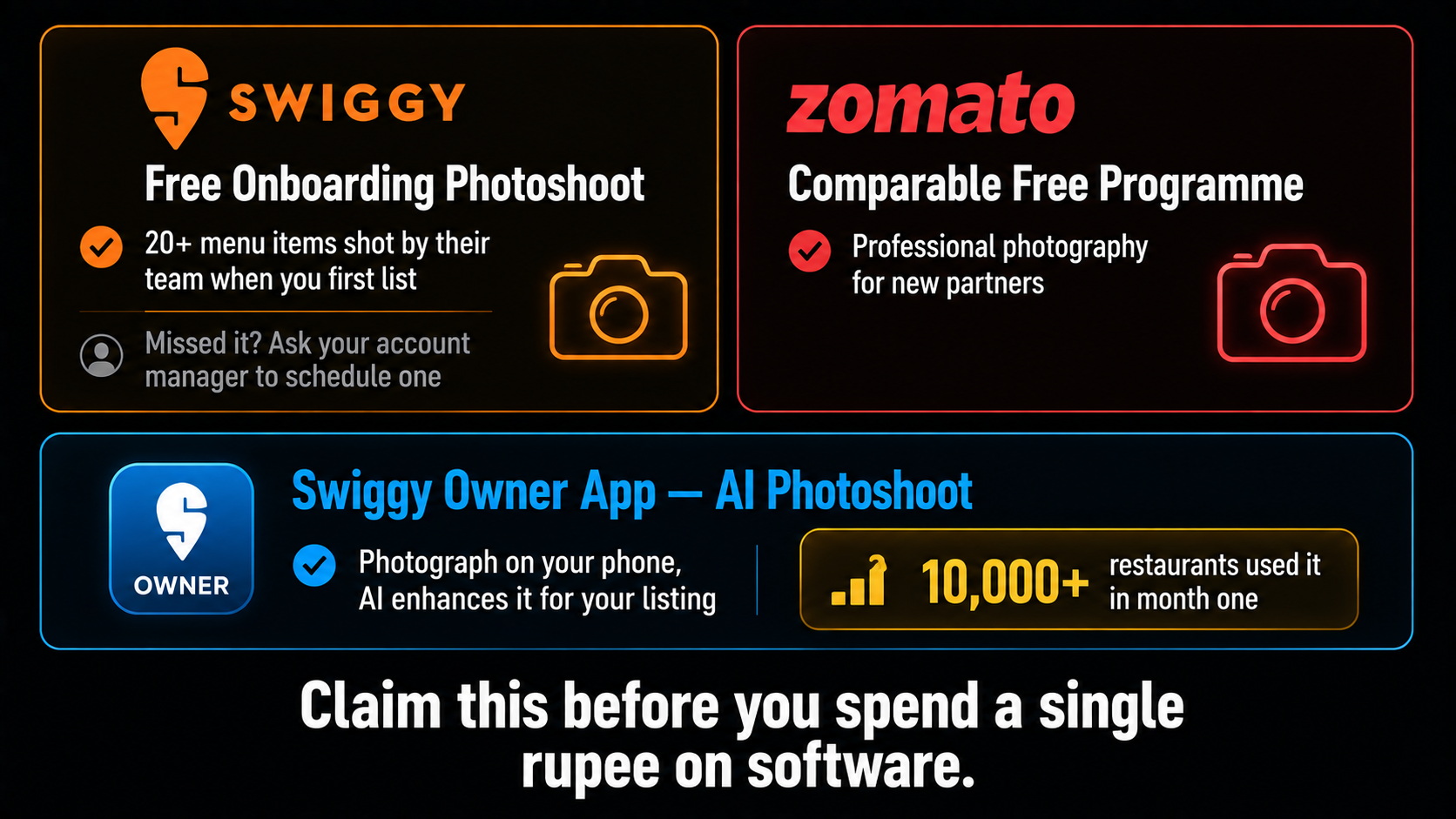
I lead with this because plenty of guides about AI for restaurants will happily sell you software for a job the delivery platforms already do at no cost. Exhaust the free options, then use paid AI for restaurants tools for what they cannot cover — your Instagram, your promo videos, your WhatsApp offers, your festive campaigns.
The Order That Actually Makes Money
With AI for restaurants, sequence matters more than tooling, because a café owner has maybe two hours a week for marketing. Spend them in this order.
| Priority | What to do | Why first |
|---|---|---|
| 1. Delivery listings | Photos for your top 10 sellers on Swiggy and Zomato | These convert directly into orders today |
| 2. Google Business Profile | Photos, accurate hours, menu, replies to reviews | It is what a search or AI recommendation reads |
| 3. Instagram | One reel per signature dish, consistent grid | Now crawled by Google and used as a food search tool |
| 4. WhatsApp offers | Promo creatives for your regulars | Cheapest repeat-order channel you have |
| 5. Menu design | Clean mobile-first menu with photos and veg labels | Affects ordering across every channel |
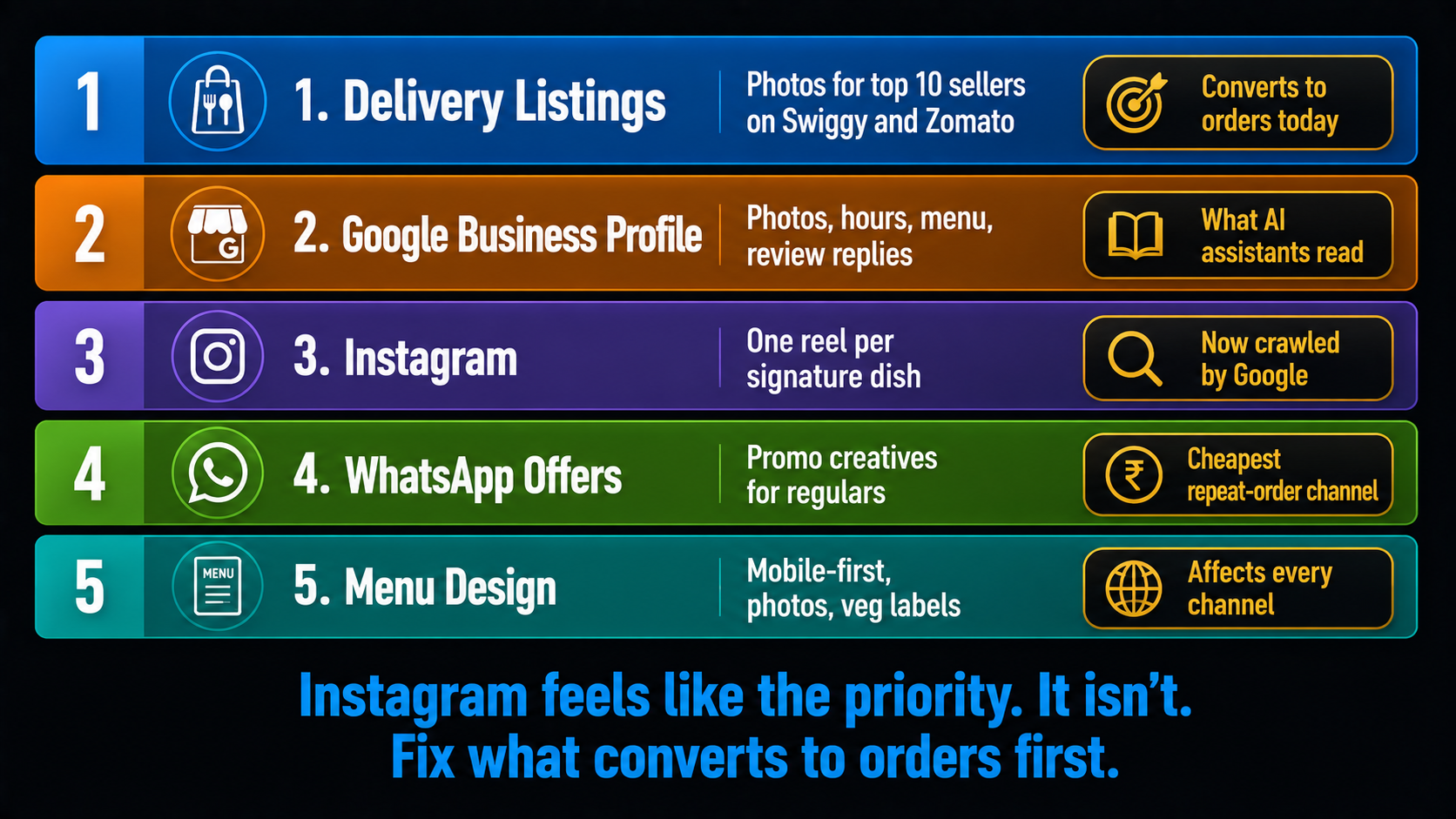
Notice that Instagram is third, not first. It feels like the priority because it is visible, but a photo on your delivery listing turns into an order the same evening. Get your top ten bestsellers looking good where people are already buying, then move outward across the other channels.
Where AI Genuinely Helps
1. Enhancing Real Dish Photos VISUALS
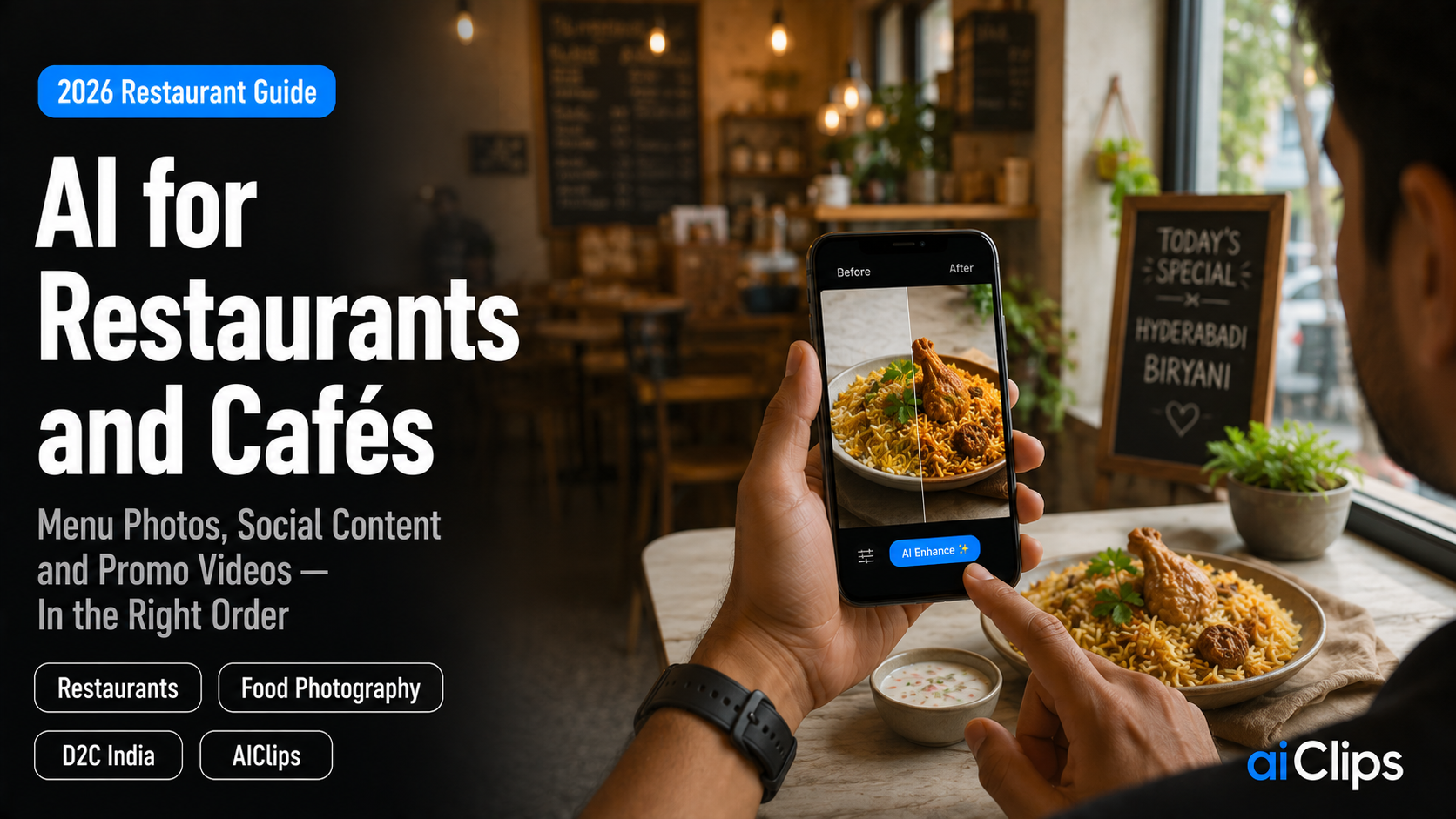
Shoot your actual food on a phone near a window, then let AI clean it up — lighting, background, colour, crop. This is the highest-value use of AI for restaurants, because good dish photos lift both delivery conversion and social reach. Ninety minutes on a closed Sunday morning can produce a month of content.
2. Promo Videos and Reels VIDEO
Short video is where restaurant discovery happens now. Turn dish photos into motion, add captions and music, and produce one reel per signature item. You do not need a videographer for a fifteen-second clip of your biryani looking good.
3. Captions and Offer Copy WRITING
Menu descriptions, Instagram captions, WhatsApp offer messages, festive announcements. AI for restaurants drafts them in seconds in your brand’s tone, in English or a regional language, and you approve. This removes the blank-page problem that kills most restaurant social accounts.
4. Reading Your Reviews Properly INSIGHT
This is the underrated use of AI for restaurants. AI can analyse hundreds of reviews and surface patterns you would never spot individually — if 35 people in a month mentioned that weekend service felt rushed, that is an operational fact, not an opinion. Sentiment tracking turns your ratings into a metric you can actually manage.
5. A Content Calendar From Your Own Data PLANNING
Some AI for restaurants tools read your menu, events, and specials, then propose a posting calendar based on what is genuinely happening at your restaurant. Hospitality-trained tools produce posts that sound like a café rather than a generic brand, which matters more than people expect.
6. Menu Design and Updates MENU
AI for restaurants includes menu generators that produce clean, mobile-first layouts with photos, prices, veg and non-veg labels, and regional-language support, exportable for Swiggy, Zomato, WhatsApp ordering, and print. Handy when you change prices more often than you would like.
The One Rule You Cannot Break
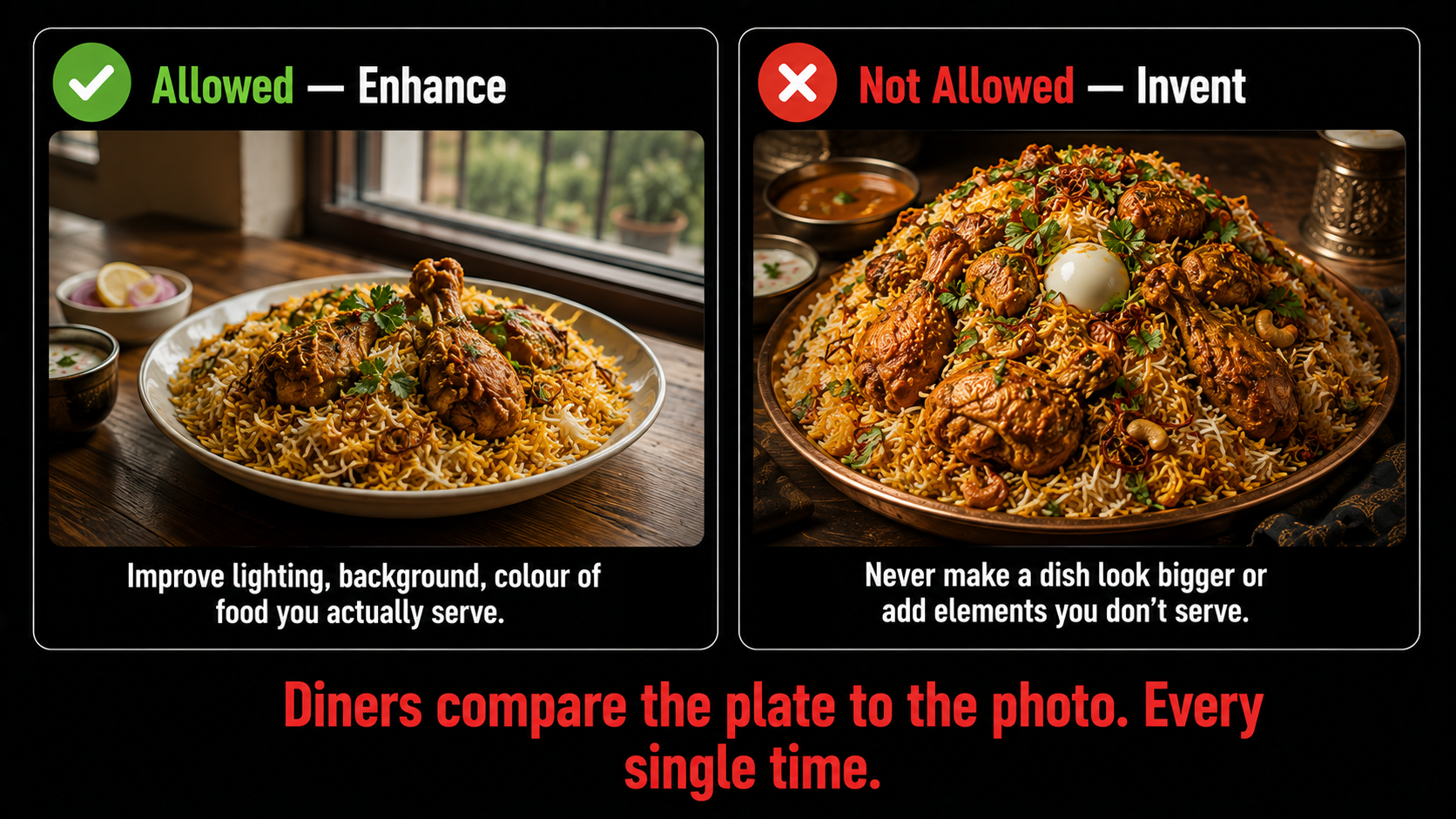
The same logic applies when you use AI for restaurants on reviews and replies. AI can help you draft a warm, professional response to a complaint, but the fix has to be real. If review analysis tells you weekend service is rushed, the answer is staffing, not better wording. No amount of AI for restaurants will paper over food that is not good, and the operators who do well with these tools are the ones who treat the insights as instructions.
Practical Photography That Costs Nothing
Since dish photos are the foundation of every AI for restaurants workflow above, it is worth saying how little you need. A phone, a window with indirect daylight, and a plain surface will out-perform a badly lit studio attempt. Shoot at the height a diner would see the plate, keep the background simple, and take several angles of each dish so you have options later.
Block ninety minutes on a closed morning, work through your top ten sellers, and you will walk out with enough raw material for a month of listings and posts. Then let AI for restaurants handle the enhancement, the cropping for each platform, and the video versions. The restaurants winning at this in 2026 are not the ones with the biggest budgets — they are the ones who showed up with a phone and a window while everyone else debated which camera to buy.
Mistakes Restaurant Owners Make
Having seen how small food businesses adopt these tools, the same handful of errors come up repeatedly. Each one is easy to sidestep.
- Paying for a tool before claiming the free shoot. The delivery platforms will photograph your menu at no cost. Use that budget on the content they do not cover.
- Starting with Instagram. It is the most visible channel but not the fastest to pay. Delivery listings turn a photo into an order the same day.
- Overselling the plate. Any image that flatters a dish beyond reality buys you a refund and a bad rating. This is the one unforgivable use of AI for restaurants.
- Posting once and stopping. Consistency beats brilliance here, and it is the whole reason AI for restaurants is worth having. A steady weekly rhythm outperforms ten posts and then two months of silence.
- Ignoring what reviews are telling you. Pattern analysis is only worth something if you act on the operational problem it surfaces.
- Depending on one aggregator. When commissions rise, a restaurant with no direct channel has no leverage. Build a WhatsApp list and an audience you own.
What AI Won’t Fix
Worth being blunt, because AI for restaurants is an over-marketed category. AI will not fix thin margins caused by rent and commissions, it will not replace your POS or your kitchen workflow, and it will not save a restaurant whose food is average. What AI for restaurants does is remove the content bottleneck that stops good small places from being discovered.
There is also a structural point behind the 2026 cost pressure. Depending entirely on one delivery aggregator is risky when commissions rise, so the operators staying healthy are the ones building direct channels — a WhatsApp list of regulars, a strong Google profile, an Instagram audience that walks in. AI for restaurants helps most with exactly those direct channels, because they run on content you own rather than reach you rent. Our food and product photography walkthrough covers the visual side in more depth.
Where AIClips Fits
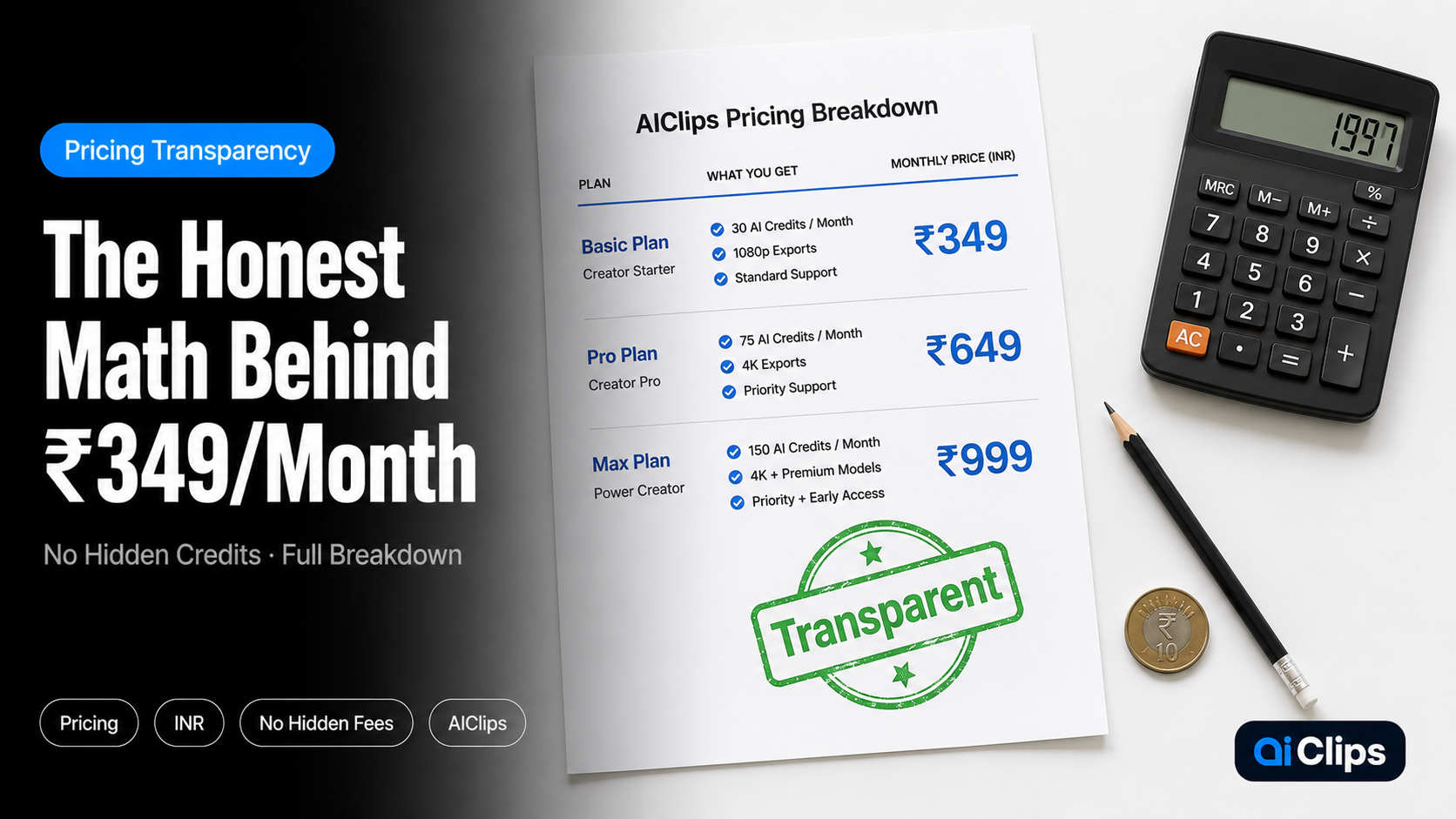
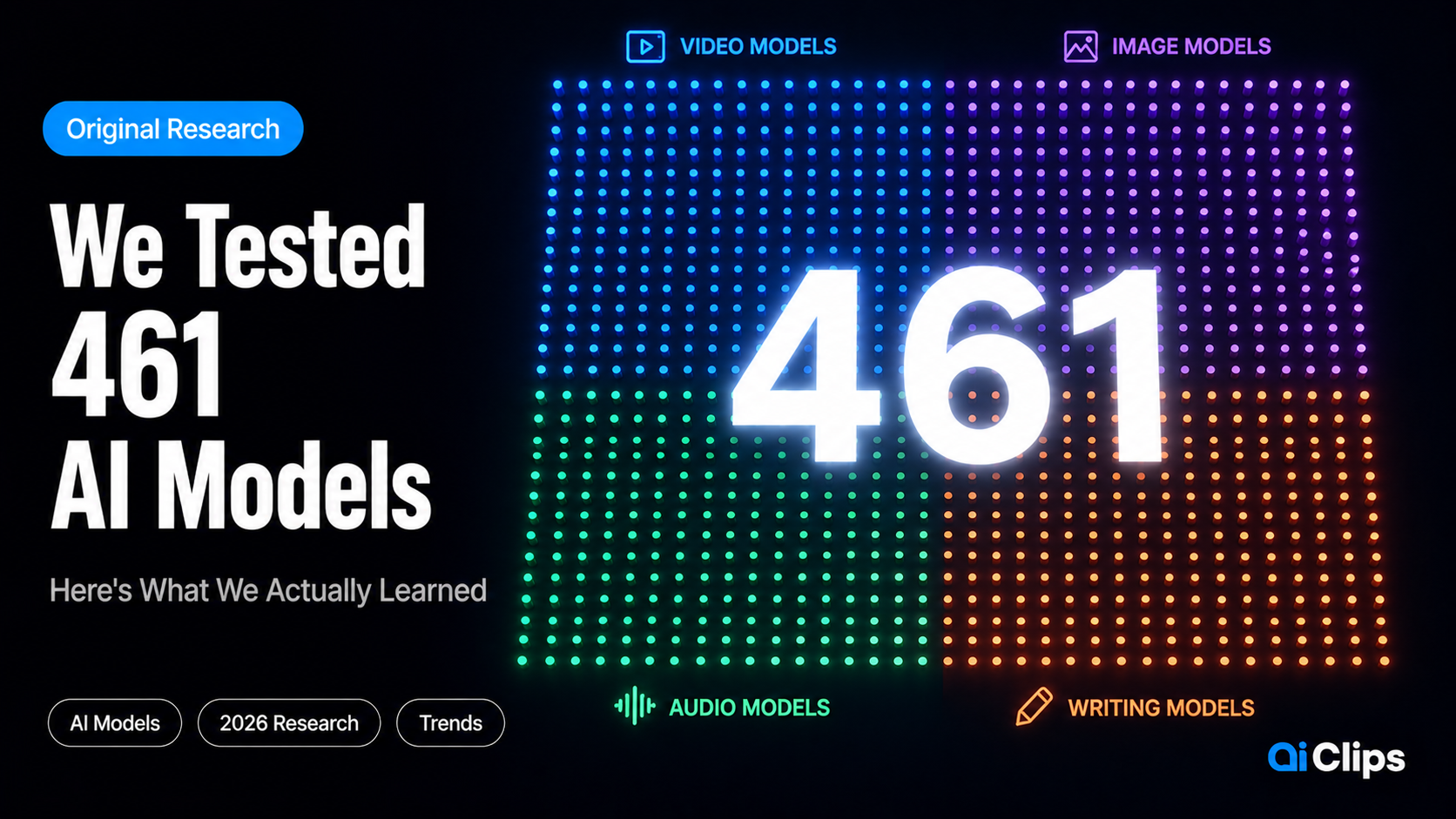
Our lane within AI for restaurants is content, and nothing beyond it. AIClips is not a POS, an ordering system, a reservation platform, a review manager, or a delivery integration — for those, use Petpooja or your platform’s own tools. What AIClips does is produce the visuals a food business runs on: enhanced dish imagery, promo videos and reels, festive offer creatives, WhatsApp campaign graphics, and regional-language video, across 461 models in one dashboard at ₹349/month with UPI. And claim your free Swiggy and Zomato photoshoot first — we would rather you spend on us for the content those programmes do not cover.
The Bottom Line
A small restaurant in 2026 is competing for attention against chains with marketing departments, on platforms that reward whoever posts the best-looking food. That used to be an unwinnable fight. The reason AI for restaurants matters is that it removes the production cost from that fight, so the deciding factor goes back to whether your food and your service are actually good.
Work it in order. Claim the free platform photoshoots. Get your top ten sellers looking excellent on Swiggy and Zomato. Build a Google profile that an AI assistant would happily recommend. Post one reel a week. Keep a WhatsApp list of regulars you own. Read what your reviews are telling you and fix it. None of that requires a budget any more, which is the genuinely good news buried under all the hype about AI for restaurants.
Frequently Asked Questions
Do Swiggy and Zomato really offer free food photography?
What should a small café do first?
Can I use AI to generate food photos?
How is AI changing how diners find restaurants?
Can AI help with customer reviews?
Does AIClips handle orders or reservations?
Make Your Food Look As Good As It Tastes
Dish visuals, reels, festive offers, and regional-language promos — 461 models in one dashboard. INR pricing, UPI, from ₹349/month.
Start on AIClips →