

Here is something that still feels slightly unreal: you can paste a blog post into a browser tab, wait a few minutes, and get back a polished two-host conversation about it, complete with banter, pauses, and the occasional “yeah, exactly.” That is an AI podcast, and in 2026 it takes minutes instead of the hours a normal episode demands. No microphone, no editing suite, no booking a co-host. This guide covers how to make one properly, the honest limits, and how to do it in Hindi and regional languages too.
I will be upfront about one thing early: the tools are astonishing and also imperfect. They hallucinate, they can drone, and they need a human check before anything goes public. Used well, though, an AI podcast is the cheapest new content channel a creator can add this year.
| What it is | A podcast where AI writes the conversational script and AI voices perform it — often two hosts discussing your source material. |
| Fastest tool | Google’s NotebookLM turns documents, PDFs, or URLs into a two-host audio episode in minutes. |
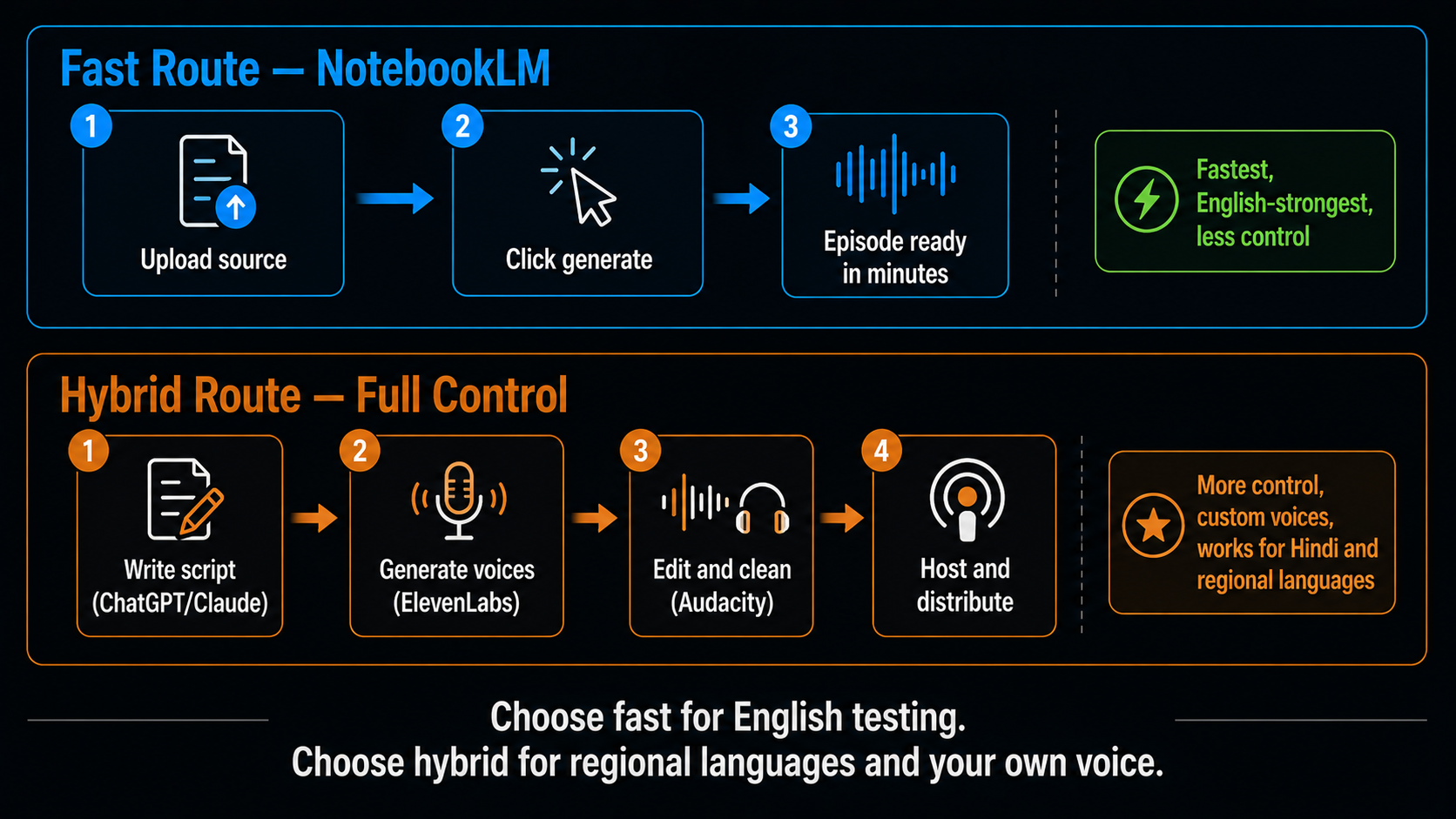
| More control | A hybrid workflow: script in ChatGPT or Claude, voices in ElevenLabs, edit in Audacity, then publish. |
| The catch | AI voices hallucinate and can sound flat. Verify facts, and label AI content in your show notes. |
| The market | Global podcasting is heading from around $31 billion in 2024 to roughly $131 billion by 2030. |
What an AI Podcast Actually Is
An AI podcast is not just a robot reading an article aloud. The good ones take your source material and turn it into a real conversation, usually between two hosts who summarise, react, disagree a little, and explain things to each other so the listener follows along. The AI writes that dialogue, then AI voices perform it, right down to the small human touches like a pause before a hard point or a casual “wait, so what you’re saying is.”
The shift that makes this work is where you start. A normal podcast starts with a microphone. An AI podcast starts with content you already have — a blog post, a research paper, your own notes, a customer FAQ. For anyone who already writes or researches, that is the whole appeal: a new audio channel that does not double your workload, because it reuses work you have already done.
Why Now Is the Moment
Audio is having a decade, not a year. The global podcast market sat around $31 billion in 2024 and is projected to reach roughly $131 billion by 2030, with listener numbers passing 600 million worldwide in 2026. That is a large and still-growing audience, and most of it is reached through the same handful of apps everyone already has open.
For an Indian creator, the timing is even better, because the tools now speak your languages. The fastest AI podcast tools support 80-plus languages, which opens Hindi, Tamil, Marathi, and more to formats that were English-only just a year ago. Podcasting in India has moved from a niche to a genuine habit, and vernacular audio is exactly where the room to grow is. If you can turn your existing content into a regional-language show, you are reaching an audience most creators still ignore.
The Fastest Way: NotebookLM
If you want the shortest path from nothing to a finished episode, Google’s NotebookLM is it. You upload your sources — Google Docs, PDFs, web links, even YouTube videos — and its Audio Overview feature generates a two-host conversation grounded strictly in what you gave it. A few minutes later you have a shareable MP3.
What is happening under the hood is smarter than it looks. NotebookLM reads your source and pulls out the key points. It writes a conversational script, then has a second AI check that script for clarity before anything is spoken. Only then does it narrate, with voices that include deliberate “disfluencies” — the ums, the pauses, the little bit of banter that makes it sound human rather than read. You can pick the format too, from a thorough deep dive to a shorter brief, and choose roughly five, ten, or twenty minutes of runtime. The free tier gives three generations a day, which is plenty to learn on.
The Hybrid Workflow: More Control
Once you outgrow the one-click approach, you split the job into stages and pick a better tool for each. This is how you get custom voices, your own cloned voice, or a clean Hindi or Tamil episode. It takes longer, but the result is properly yours.
| Stage | Do it with |
|---|---|
| Write the script | ChatGPT or Claude — draft the two-host conversation from your notes |
| Generate the voices | ElevenLabs for emotion and cloning; an Indian-voice model for regional languages |
| Edit and clean | Audacity, Adobe Podcast, or Descript for pacing, music, and noise removal |
| Host and distribute | A podcast host that pushes to Spotify, Apple, YouTube Music, and more |
The hybrid route is also how you keep your own voice in the show. Tools like ElevenLabs and Descript can clone a voice from a clean one-to-three-minute sample, after a consent check, so your AI podcast can sound like you even on episodes you never recorded. Use that power carefully, and only on your own voice.
How to Make Your AI Podcast, Step by Step
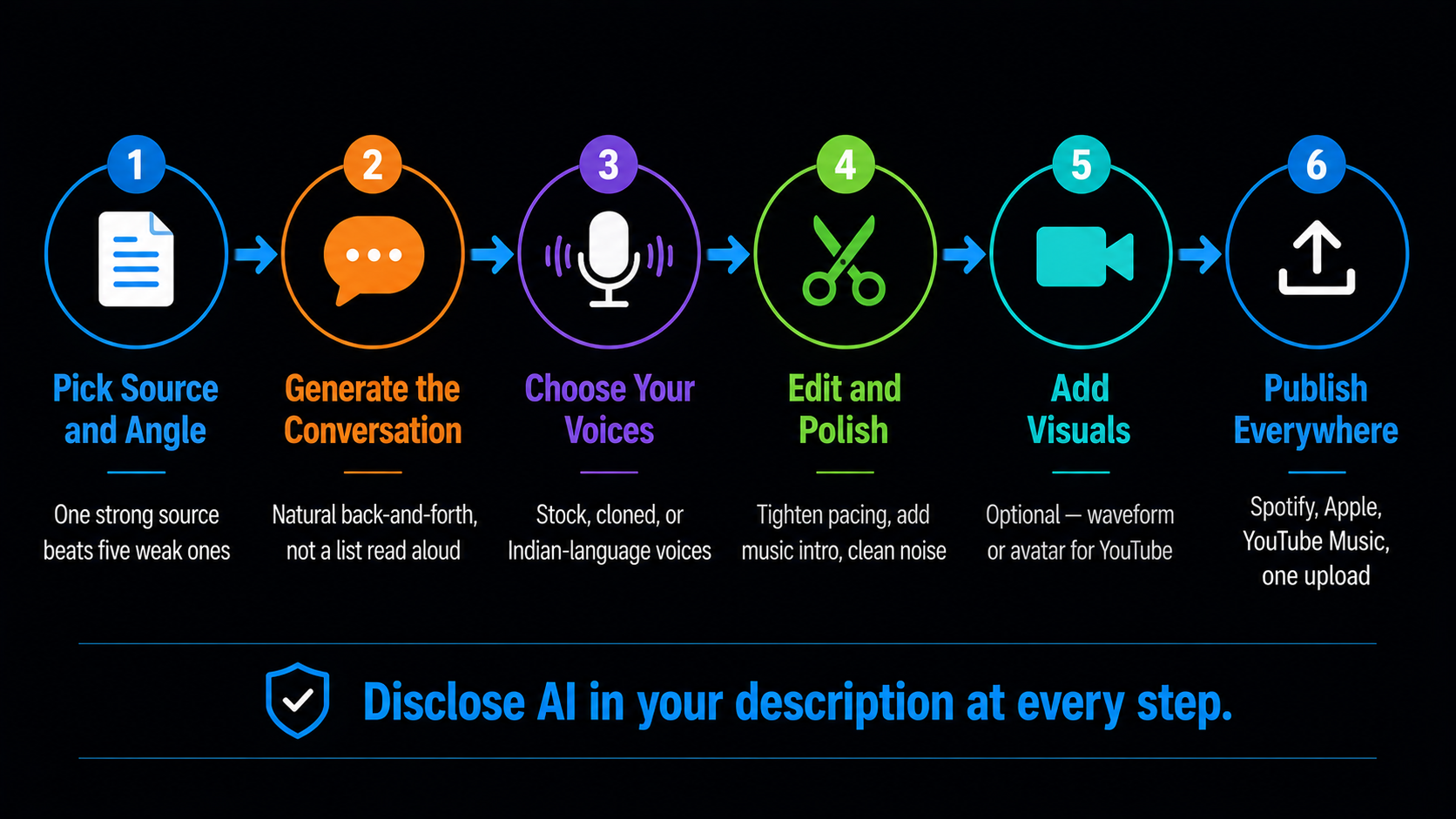
1. Pick Your Source and Angle START
Decide what the episode is about and what you are feeding the AI. A single strong source beats five weak ones. A blog post, a report, or a tight set of notes gives the hosts something real to discuss, which is what keeps an AI podcast from sounding hollow.
2. Generate the Conversation SCRIPT
Use NotebookLM for the fast route, or write the two-host script in ChatGPT or Claude for the hybrid route. If you are scripting it yourself, ask for a natural back-and-forth, not a list being read out. List-like scripts are the number-one reason an AI podcast sounds robotic.
3. Choose Your Voices VOICE
Pick your hosts. You can use stock AI voices, clone your own, or mix AI voices with your real one for a personal touch. For a Hindi or regional show, choose voices built for those languages rather than forcing an English model to fake the accent.
4. Edit and Polish REFINE
Drop the audio into an editor, tighten the pacing, remove awkward gaps, add a short music intro, and clean up any noise. Ten minutes here is what separates a raw generation from something that sounds like a real show people will subscribe to.
5. Add Visuals for a Video Podcast OPTIONAL
Video podcasts get discovered on YouTube in a way audio never will. Turn your episode into video with a waveform, host avatars, b-roll, or slides. This single step can multiply your reach, since YouTube is now one of the biggest podcast platforms.
6. Publish Everywhere DISTRIBUTE
Upload to a podcast host that distributes automatically to Spotify, Apple Podcasts, Amazon Music, and YouTube Music, and post the video version to YouTube. Publish once, appear everywhere, and always disclose the AI in your description.
Turning It into a Video Podcast
This is the part most people skip, and it is a mistake. Audio-only podcasts are hard to discover, because the big search and recommendation engines live on video. A video podcast fixes that. NotebookLM now offers Video Overviews and even cinematic ones with richer visuals, powered by Google’s newer Gemini and Veo models. Or you take your finished audio and build a simple video around it — an animated waveform, a talking avatar, or a few relevant clips.
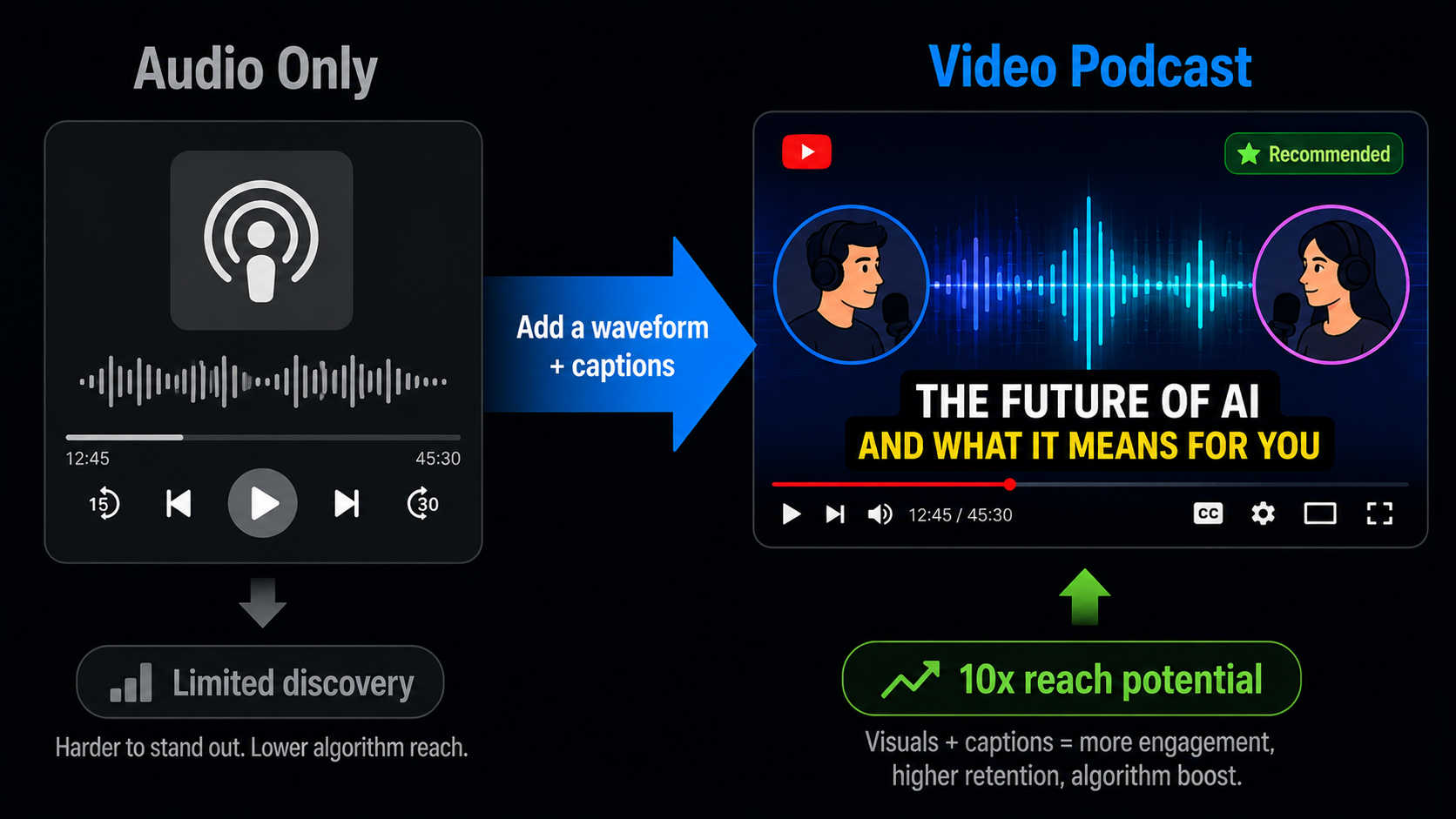
You do not need Hollywood production here. Even a clean waveform with your episode title and good captions performs on YouTube, and captions matter because a large share of viewers watch on mute. The point is to give the algorithm something to show, so your AI podcast reaches people who would never have found it in an audio app.
The Honest Limits You Must Respect
I would be doing you a disservice if I made this sound flawless. Three limits are non-negotiable, and ignoring them is how creators get burned.
None of these make AI podcasting a bad idea. They make it a tool that needs a human in charge, which is true of every good tool. Do the quality check, keep it honest, and you sidestep almost every problem people run into.
For Indian Creators Specifically
The regional-language opening is the real prize here. English AI podcasts are already crowded, but a genuinely good Hindi, Marathi, or Tamil AI podcast still stands out, because far fewer people are making them well. The catch is that the fastest tools do their best audio work in English, so for regional shows the hybrid workflow wins: write the script with an AI, then generate the voice with a model built for Indian languages so the pronunciation and rhythm sound native rather than translated.
Pair that with the habit of repurposing — one strong blog post becomes an English AI podcast, a Hindi version, and a video cut for YouTube — and a single idea suddenly serves three audiences. That kind of leverage is exactly why creators here are building on their own tools rather than waiting, a shift we dug into in our piece on the Indian AI ecosystem.
5 AI Podcast Ideas You Can Start This Week
The blank page stops more shows than any technical hurdle. So here are five formats that suit an AI podcast especially well, because they lean on the model’s strengths — summarising, explaining, and holding a two-sided conversation — rather than its weaknesses.
- The blog-to-audio show. Turn each new article you publish into an episode. It is the lowest-effort AI podcast possible, and it gives readers who prefer listening a reason to follow you.
- The news explainer. Feed the week’s developments in your niche into the tool and let two hosts break them down. Verify the facts, and you have a timely, repeatable format.
- The book or report digest. Condense a long report, a case study, or a non-fiction book into a fifteen-minute discussion. Busy listeners love a good digest, and this is where AI shines.
- The regional-language edition. Take any of the above and produce a Hindi, Tamil, or Marathi version. A vernacular AI podcast faces far less competition than an English one.
- The FAQ or how-to show. Turn your customer questions or a tutorial into a conversational episode that answers them one by one. It doubles as marketing and as genuinely useful content.
Pick one and commit to it for ten episodes before you judge whether it works. A single format done consistently beats five formats abandoned after one try, and consistency is what turns an AI podcast from an experiment into an audience.
Where AIClips Fits
Let me be clear about our role, since I am not going to oversell it. NotebookLM is Google’s tool and it is excellent for the fast route. Where AIClips helps is the parts that need custom or regional voices and a video layer. You can generate natural voiceovers, including Indian-language options, and then turn your audio into a proper video podcast with visuals — all across 461 models in one dashboard, billed in rupees at ₹349/month with UPI. So the script can come from anywhere; AIClips is where you give your AI podcast a distinctive voice and a face for YouTube. If you want the origin story of the platform, here is why we built AIClips.
Frequently Asked Questions
How long does it take to make an AI podcast?
Is it free to make an AI podcast?
Can I make an AI podcast in Hindi or regional languages?
Do I have to disclose that my podcast uses AI?
Will an AI podcast sound robotic?
Can I use my own voice in an AI podcast?
Give Your AI Podcast a Voice and a Face
Generate natural voiceovers, including Indian languages, and turn audio into a video podcast — 461 models, one dashboard. From ₹349/month.
Start on AIClips →