
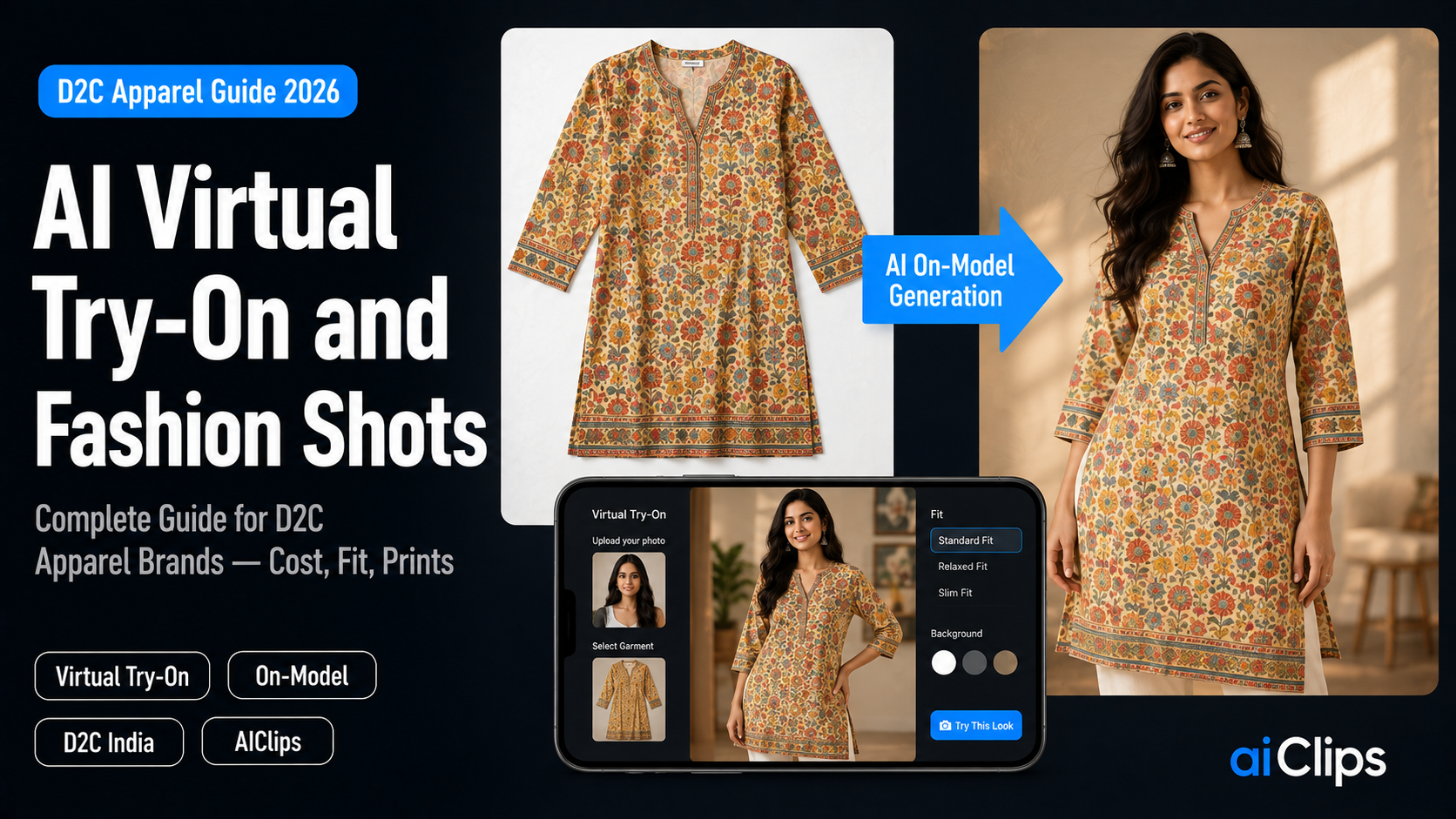

A model shoot for a 200-SKU apparel catalogue is the kind of expense that stops a small brand before it starts. Book a photographer, a studio, a model, a stylist, wait six weeks, and pay per image what many Indian brands make on a whole order. That maths has changed. AI can now generate on-model photography from a flat-lay, and virtual try-on lets shoppers see clothes on themselves before buying. This guide covers on-model generation and virtual try-on together, because they are two different products that get confused constantly, and buying the wrong one is the most common mistake in this category.
I will also be straight about where the technology still breaks, because for Indian brands specifically it breaks in an inconvenient place: intricate prints and embroidery, which is exactly what most of us are selling.
| Two different things | On-model generation makes your catalogue photos. Virtual try-on lets a shopper see a garment on their own body. |
| The cost shift | Traditional on-model photography runs roughly $150–$500 per image. AI generation costs a fraction of that. |
| Conversion impact | Brands report 20–65% higher conversion with on-model imagery versus flat-lay or ghost mannequin shots. |
| Return impact | Reported reductions of 20–40% when shoppers see realistic on-body fit before purchase. |
| The honest limit | These are visual simulations, not sizing engines. They show style, not guaranteed fit. |
Two Products That Get Confused Constantly
Before you evaluate a single virtual try-on tool, get this distinction clear, because the two categories have different inputs, different outputs, different costs, and different integration work. Confusing them is how brands end up paying for software that solves a problem they do not have.
On-model generation is brand-side. You upload a flat-lay or ghost-mannequin shot of a garment, choose a model profile, and the tool produces a photorealistic image of that garment being worn. The output goes on your product pages, your Instagram grid, and your ads. It replaces a photoshoot.
Virtual try-on is customer-facing. A shopper uploads their own photo or uses a live view, and sees the garment on themselves before deciding. It sits on your storefront as a feature and aims to reduce the uncertainty that drives returns.
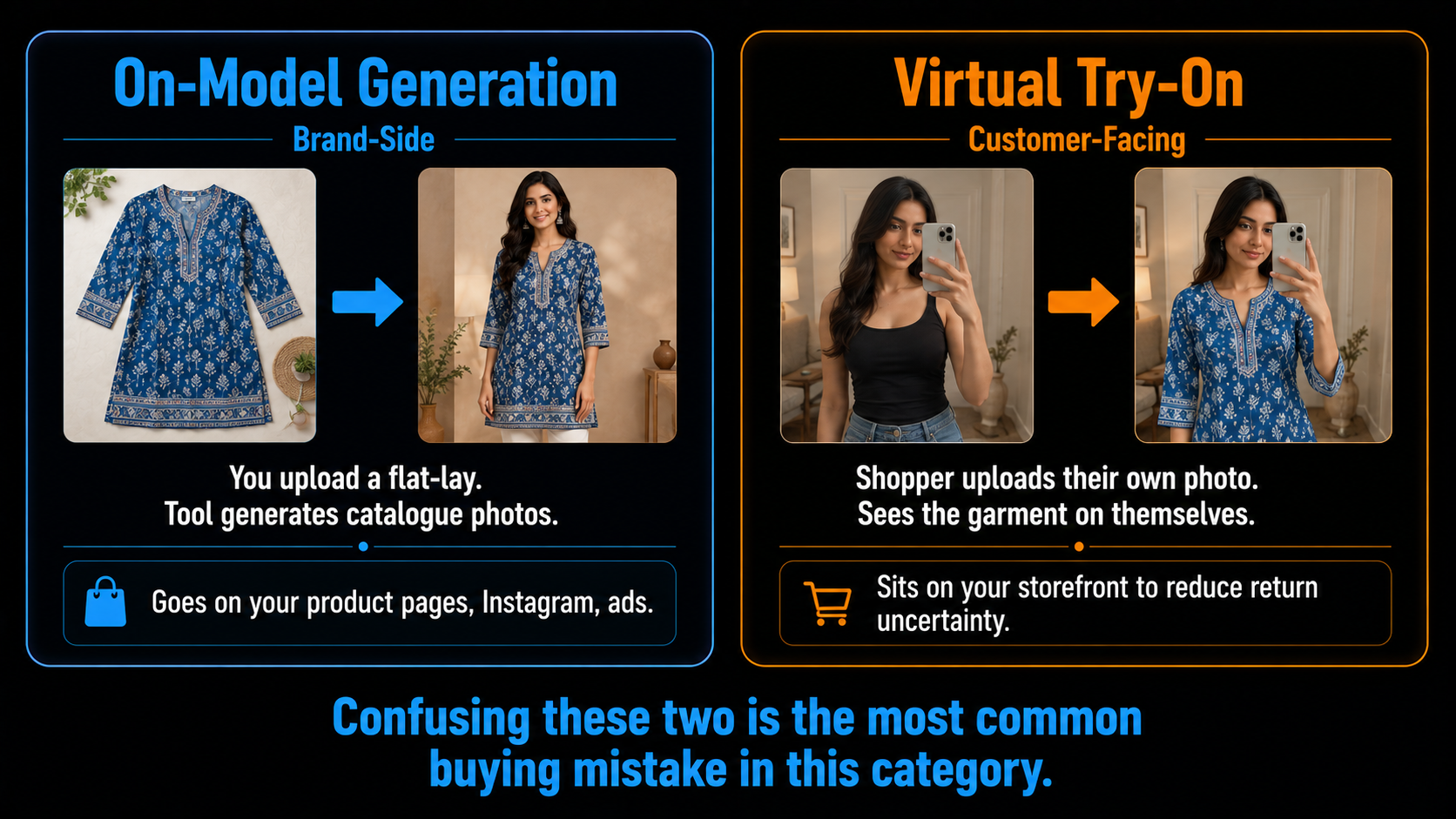
A Shopify seller with 200 SKUs and no photography budget needs the first one. A mid-market retailer fighting a 26% return rate needs the second. Many virtual try-on tools blur the line and market themselves as both, so decide which problem you are actually solving before you look at pricing.
The Numbers That Justify It
The business case for virtual try-on is unusually well documented for a technology this new, and it rests on two levers: what you spend making images, and what those images do to your conversion and returns.
| Metric | What the data shows |
|---|---|
| Photography cost | Roughly $150–$500 per traditional on-model image, versus a small fraction of that for AI generation |
| Turnaround | Zalando reported compressing production from 6–8 weeks to 3–4 days, generating a large share of editorial images with AI |
| Conversion | 20–65% higher conversion reported with on-model imagery versus flat-lay or ghost mannequin |
| Returns | 20–40% fewer returns reported when shoppers see realistic on-body fit |
| Realism | In blind tests, most shoppers could not reliably distinguish AI-generated apparel images from real ones |
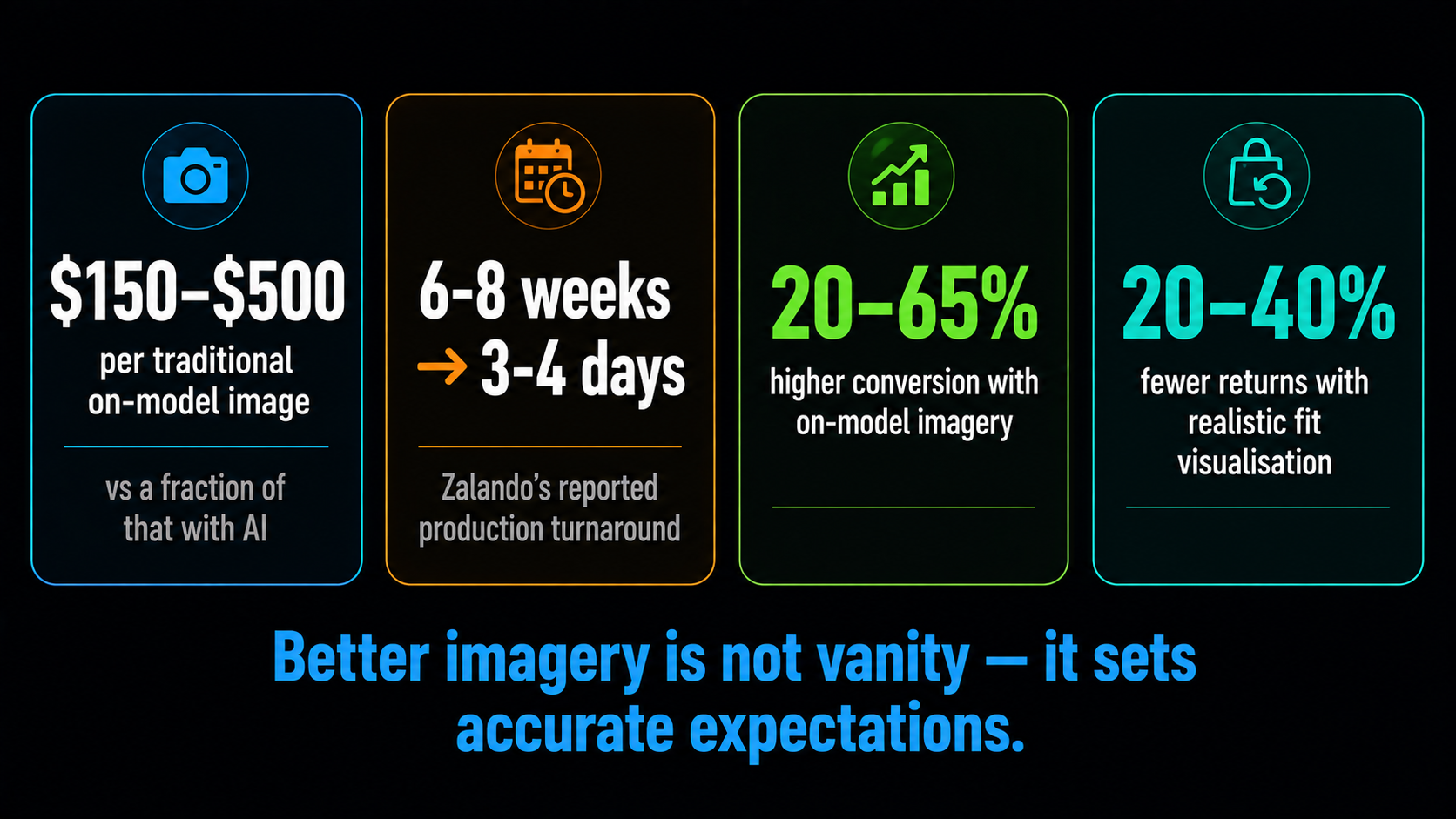
The returns figure is the one that matters most financially. Apparel accounts for the majority of ecommerce returns, poor fit and “it did not look like the photo” are the two biggest causes, and processing a return costs a meaningful share of the order’s value. Better imagery is not a vanity project — it sets accurate expectations, and accurate expectations are what keep the courier from coming back.
The Honest Limit: Simulation, Not Sizing
Where It Breaks: Patterns and Prints
Here is the virtual try-on weakness that matters most, and almost every listicle skips it. Standard diffusion models tend to treat patterns as surface noise rather than as structured information that must be preserved exactly. The result is that plaid, houndstooth, fine stripes, small embroidered logos, and detailed prints get smudged, warped, or quietly hallucinated into something that is not your product.
For a plain cotton tee, this never comes up. For an Indian apparel brand, it comes up immediately, because block prints, bandhani, zari work, embroidery, and detailed borders are the category. A generic tool optimised for speed will happily return a beautiful image of a saree whose border pattern does not match the one you are selling, and that is not a cosmetic issue — it is the exact “did not match the product image” complaint that drives returns.
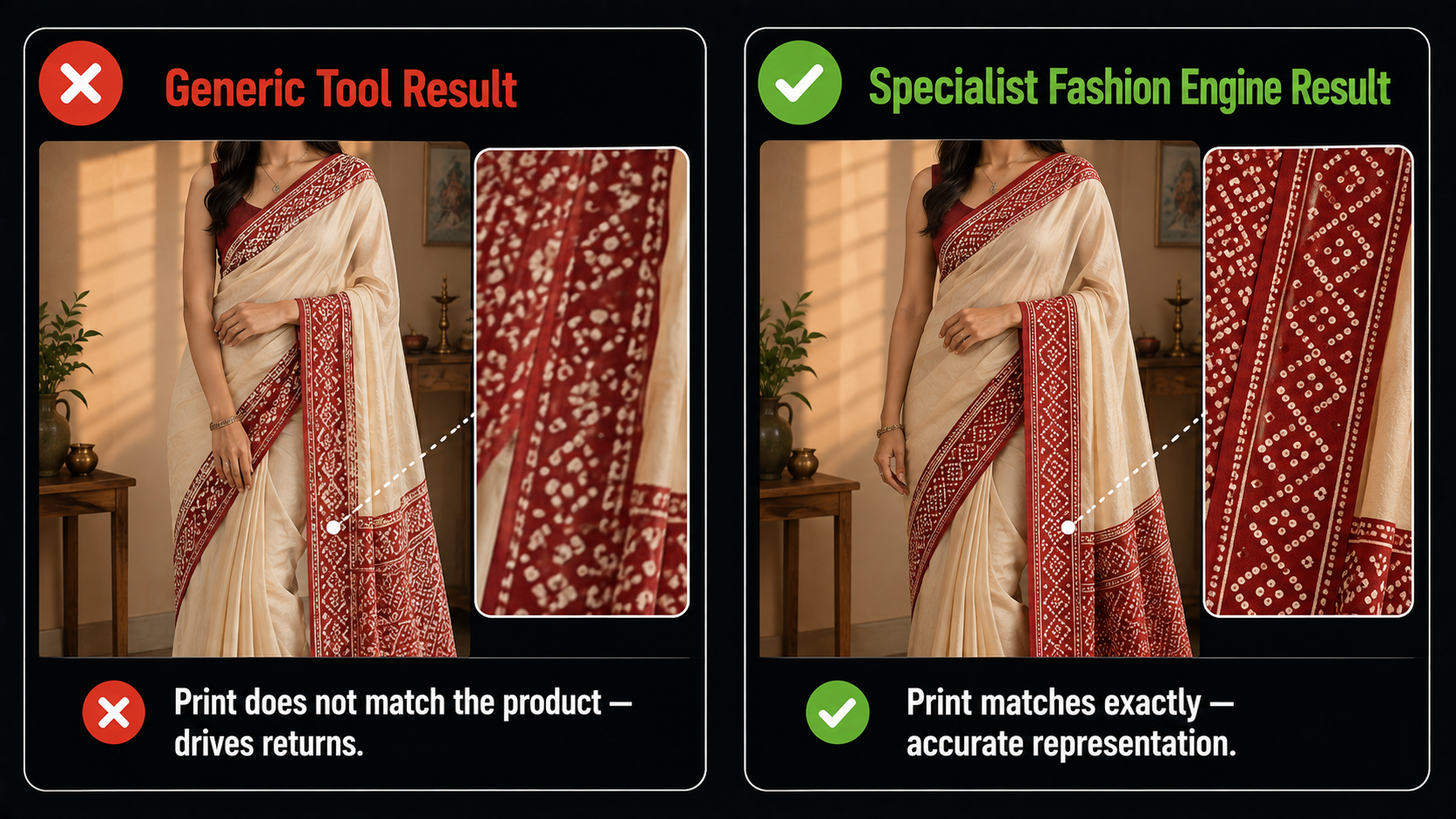
The practical response is to test any virtual try-on on your hardest garment, not your easiest. Run your most intricately printed piece through any tool you are evaluating and zoom in on the print, the collar, the sleeve joins, and any logo. Specialist fashion engines handle structured garments and sheer fabrics noticeably better than general-purpose image models, and for a heavily patterned catalogue that difference is the whole decision.
How to Roll It Out Properly
1. Start With Clean Inputs PREP
Output quality is decided by input quality. Flat-lays on white or light backgrounds are the most reliable, and ghost-mannequin shots work well too. Minimal wrinkles, clear silhouettes, even lighting, consistent angles. Wrinkled or cluttered source photos produce exactly the artefacts you are trying to avoid.
2. Pilot on 5–10 Best Sellers TEST
Do not convert the whole catalogue on day one. Take your top few SKUs, generate on-model images, and see what happens. A small pilot tells you within weeks whether this works for your products, at almost no risk.
3. QC Every Output Against the Original VERIFY
Check each generated image against the source flat-lay for colour accuracy, correct print, natural fabric fall, and artefacts at collars, cuffs, and sleeve edges. This is the step that protects you from a returns spike. Reject anything that misrepresents the garment.
4. Publish Across Every Surface DEPLOY
Push approved images to your product pages, marketplace listings, Instagram grid, and ad creative. The same asset works everywhere, which is a large part of why the economics are so favourable compared with a shoot.
5. Measure for Four Weeks MEASURE
Compare conversion rate, return rate, and cost per image against your previous catalogue. Most brands see movement within two to three weeks. Treat around a 5% conversion lift as your minimum bar — anything above that is a real result worth scaling.
6. Decide What Still Needs a Camera DECIDE
Use the pilot data to expand across the catalogue, and to identify the SKUs that still need traditional photography — usually complex fabrics, heavy embellishment, and hero campaign images. A hybrid catalogue, part generated and part photographed, is the realistic end state rather than a fully synthetic one.
Model Diversity Is a Business Decision
One quiet advantage of virtual try-on and generated imagery is that showing the same garment on different body types, ages, and skin tones stops being a budget question. With a traditional shoot, each additional model is another day rate. With generation, it is another render.
That matters commercially, not just ethically. Shoppers judge fit partly by seeing someone who looks like them wearing the garment, and a catalogue that only shows one body type gives most of your customers nothing to calibrate against. For Indian brands selling across a genuinely diverse market, this is one of the more underrated wins available, and it costs almost nothing to act on.
Disclosure and Trust
Regulators have started paying attention to virtual try-on. The EU’s AI Act treats virtual try-on as limited-risk AI with transparency obligations rather than strict controls, and the general direction across markets is toward disclosure of AI-generated and virtual try-on imagery. Beyond compliance, there is a plain commercial argument: a customer who feels misled by a photo returns the item and does not come back.
So label AI-generated imagery where required and where it is the decent thing to do, and never let a generated image flatter a garment into looking like something it is not. Accurate representation is both the compliance-safe position and the one that protects your return rate. Rules differ by market and keep evolving, so check what applies to you rather than assuming.
Mistakes That Cost Apparel Brands
The failures in this category are consistent, and every one of them is avoidable with a bit of discipline up front.
- Buying the wrong category. Paying for a customer-facing virtual try-on integration when what you needed was catalogue imagery, or the reverse. Name your problem first.
- Selling style visualisation as fit accuracy. Promising customers a virtual try-on will tell them their size sets up disappointment and returns. Be precise in your own marketing copy.
- Skipping QC to save time. One published image with a wrong print pattern can generate more returns than the whole batch saved you in photography cost.
- Evaluating on a single sample. Any tool can produce one great image. Consistency across a full batch is the only meaningful test.
- Feeding it bad inputs. Wrinkled, dim, cluttered flat-lays guarantee poor output, no matter how good the model is.
- Going all-in immediately. Converting the entire catalogue before a pilot means finding out at scale that your fabric type does not render well.
For Indian D2C Brands
The economics land hard here. A model shoot priced in the tens of thousands of rupees for a modest catalogue is out of reach for most young apparel brands, which is why so many Indian listings still use flat-lays or a founder’s friend photographed on a terrace. Generated on-model imagery and virtual try-on close that gap at a price a bootstrapped brand can absorb, and it makes seasonal refreshes affordable rather than annual.
Two cautions specific to our market, though. First, the pattern problem above is not a footnote for an ethnic-wear brand — it is the central technical question, so test on your most detailed piece before you commit. Second, marketplace listings punish mismatched imagery hard through returns and ratings, so the QC step is not optional. Our product photography walkthrough covers the non-apparel side of the same workflow.
Where AIClips Fits
Our lane here is narrower than the marketing of this category might suggest. AIClips is not a customer-facing virtual try-on widget for your storefront, and it does not do fit prediction or size recommendation — for shopper-facing try-on with sizing logic, use a dedicated platform built for that job. What AIClips does is the brand-side visual production: on-model style imagery, lifestyle scenes, background work, campaign visuals, and short video for your listings, ads, and social, across 461 models in one dashboard at ₹349/month with UPI. And the same caution applies to us as to any tool — if you sell heavily printed or embroidered garments, test on your most intricate piece and QC every output against the original before it goes live.
The Bottom Line
The photography wall that used to keep small apparel brands looking small is gone. On-model imagery that once cost a few hundred dollars a shot and six weeks of scheduling can now be generated in an afternoon, and the reported conversion and returns numbers make the business case straightforward.
What has not gone away is the need for judgement. Know whether you need catalogue generation or a customer-facing virtual try-on. Test on your most intricate garment before you commit, because printed and embroidered pieces are where these tools still stumble. QC every image against the original. And be honest with shoppers that a virtual try-on shows style rather than guaranteed fit. Do that, and you get the cost savings without inheriting a returns problem in exchange.
Frequently Asked Questions
What is the difference between virtual try-on and AI fashion models?
Does virtual try-on actually reduce returns?
Can AI handle printed and embroidered clothes?
What input photos work best?
How much does AI fashion photography cost?
Does AIClips do virtual try-on?
Produce Your Fashion Visuals on AIClips
On-model style imagery, lifestyle scenes, and video for listings and ads — 461 models, one dashboard. INR pricing, UPI, from ₹349/month.
Start on AIClips →