




You have probably seen “AI-generated” tags appearing on images and videos across your feed. Behind those tags is a fast-moving system of AI content labelling — invisible watermarks, signed metadata, and new laws that, from August 2026, make disclosure mandatory for anyone serving European users. For Indian creators, this is worth understanding now, because the tools you already use are quietly adding these labels to everything you make.
This is a plain-English explainer of AI content labelling — what C2PA, Content Credentials, and SynthID are, what the rules say, and what you should actually do about it.
| C2PA | An open standard that attaches signed, tamper-evident metadata to a file, recording who made it and whether AI was involved. Shown to users as “Content Credentials”. |
| SynthID | Google’s invisible watermark baked into the pixels themselves, so it survives edits and re-uploads better than metadata. |
| The law | EU AI Act Article 50 makes machine-readable AI marking mandatory from 2 August 2026, with penalties reaching millions of euros. |
| The catch | Most social platforms strip these labels on upload, so a missing label does not prove a file is real. |
| For creators | Disclose AI use honestly. It is becoming both a legal expectation and a trust signal. |

What Is C2PA and Content Credentials?
C2PA stands for the Coalition for Content Provenance and Authenticity. In practice, it is an open standard that attaches a cryptographically signed record — a manifest — to a file. That record states who signed the content, which tools touched it, and whether AI was involved. Any compatible viewer can read it and confirm the signature has not been tampered with. The consumer-facing name for this is Content Credentials.
The backing is serious. Adobe, Google, Microsoft, OpenAI, Meta, and the BBC are all part of the coalition. Camera makers like Leica, Sony, Nikon, and Canon have shipped support, and wire services including Reuters and the Associated Press now require signed Content Credentials on news images. The current specification, version 2.3, landed in February 2026.
What Is SynthID?
SynthID is Google’s approach, and it works differently. Instead of attaching metadata that sits alongside the file, it subtly alters the actual pixels of an image in a way invisible to the eye but detectable by a classifier. Because the signal lives inside the image, it survives ordinary editing and re-uploading far better than metadata, which tends to get stripped.
Google has already watermarked over 20 billion images this way and is extending SynthID across audio, video, and text. If you have used Google’s Nano Banana 2 image model, your output carries a SynthID watermark by default. The catch is that detection is probabilistic rather than a clean yes or no, and for now it mainly covers content made with Google’s own tools.
C2PA vs SynthID: How They Differ
| C2PA / Content Credentials | SynthID | |
|---|---|---|
| Where it lives | Signed metadata attached to the file | Inside the pixels themselves |
| Survives re-upload | Often stripped by platforms | Survives much better |
| Backed by | An industry-wide coalition | Mainly Google’s tools |
| Detection | Verifies a signature | Gives a confidence score |
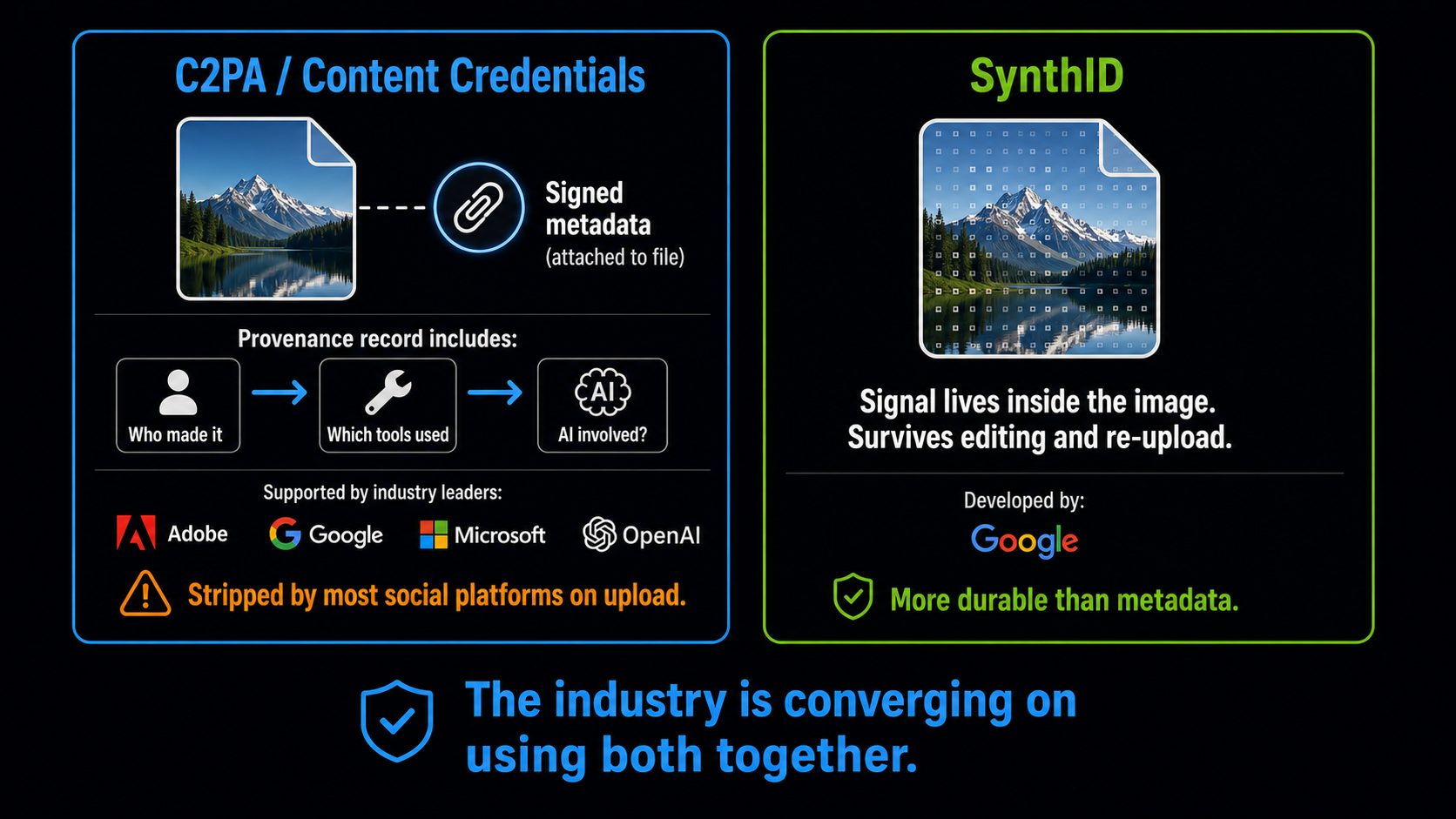
They are not rivals. The industry is converging on using both together — C2PA for the verifiable record, a watermark like SynthID for durability. OpenAI now pairs the two for supported images.
Adoption is spreading fast across the chain. TikTok has labelled over a billion videos with AI provenance data, the Pixel 10 became the first phone certified under the C2PA programme, and Google now surfaces these labels across Search and Chrome. AI content labelling is moving from a niche standard to something baked into the cameras, apps, and platforms most people already use.
The Rules Are Tightening
This is the part that turns AI content labelling from a nice-to-have into a legal obligation. The EU AI Act’s Article 50 makes machine-readable marking of AI-generated content mandatory from 2 August 2026, and it applies to anyone whose AI content reaches EU users, wherever the business is based. The EU finalised its Code of Practice on AI-generated content in June 2026, which points to signed metadata plus invisible watermarking as the way to comply. Non-compliance penalties are steep, running into millions of euros.
It is not only Europe. California’s SB 942 took effect on 1 January 2026, requiring disclosure and a free detection tool from larger AI providers. India’s IT Ministry has been developing its own AI-labelling and deepfake rules, though the national framework is still taking shape as of mid-2026.
The Honest Catch: Labels Don’t Always Survive
Here is what most coverage skips. As of 2026, most AI images shared on social media reach viewers with no credentials attached at all. Instagram, X, and WhatsApp strip C2PA metadata when you upload. The credential survives creation and download, then vanishes the moment it hits the platform billions of people actually use.
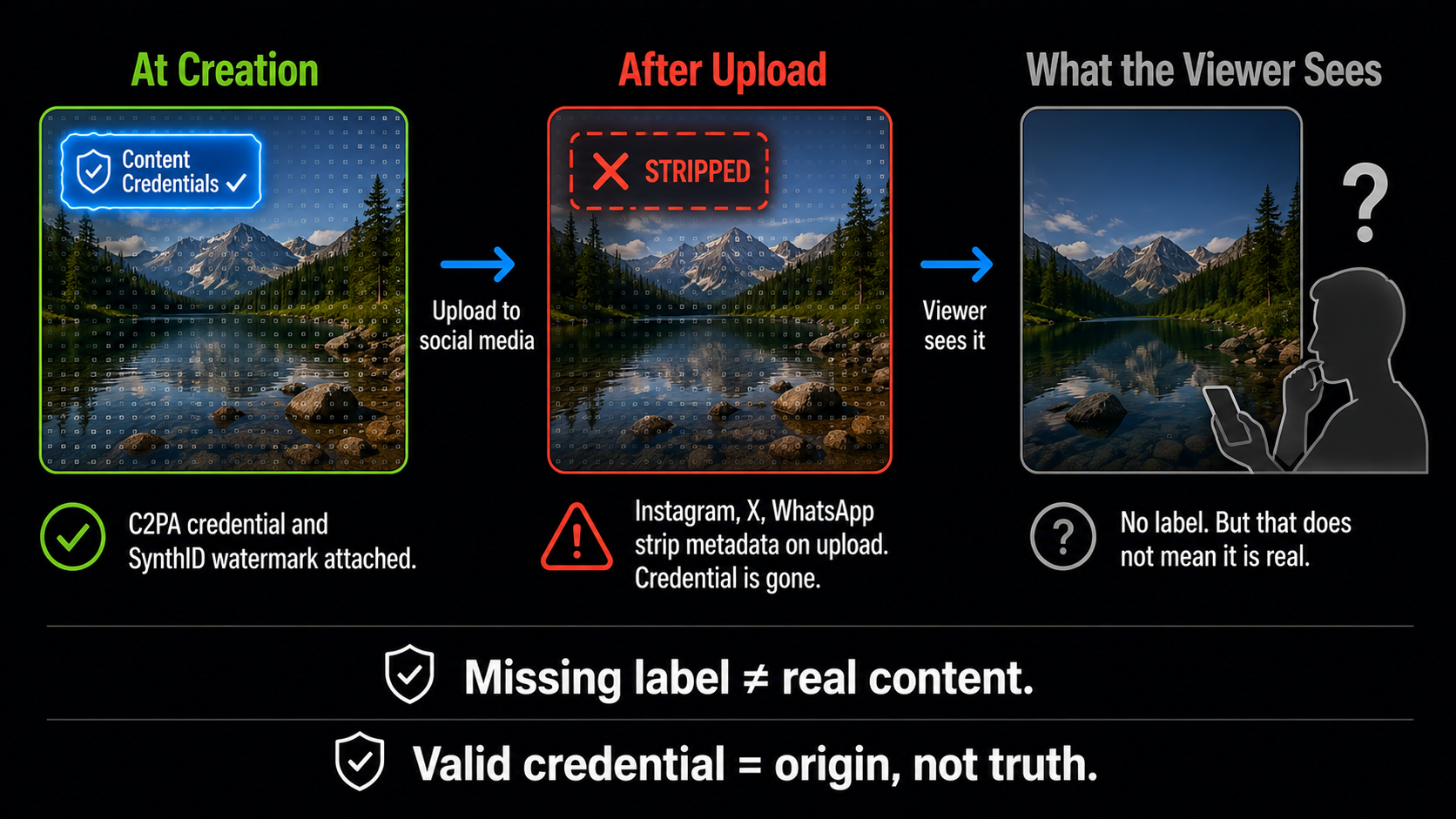
Two things follow from that, and they matter. A missing label does not mean a file is real — it may simply have lost its credential on upload. And a valid credential tells you where something came from, not whether its content is truthful. Provenance is about origin, not honesty. Treat the labels as a useful signal, not a lie detector.
What This Means for Indian Creators
You do not need to panic, but you should pay attention. The practical reality of AI content labelling is that your tools are already labelling your work. Generate an image with a major model and it likely carries a watermark or credential whether you thought about it or not. That is normal and nothing to hide.
Where AI content labelling really matters for you is disclosure. Surveys in early 2026 found that two-thirds of consumers want to know when they are looking at AI-generated content. Being upfront is increasingly both expected and, in advertising, required — India’s ASCI guidelines already call for honest, non-misleading ads. Treat AI content labelling as a trust signal rather than a threat. The creators who disclose openly will look more credible, not less, as audiences grow warier of synthetic media.
How to Disclose AI Use Properly
- Tick the platform’s AI toggle. YouTube, Meta, TikTok, and others have an “AI-generated” or “altered content” setting. Use it.
- Add a visible label where it counts. For ads and public content, a clear “Created with AI” note is the simplest form of AI content labelling, and it protects you.
- Never pass AI off as real. Do not present an AI avatar or generated result as a genuine recording or a real customer.
- Keep the credentials intact when you can, by exporting and sharing through tools that preserve them.
Frequently Asked Questions
What is C2PA in simple terms?
Is AI content labelling legally required?
Does a missing AI label mean the content is real?
Do I have to disclose AI use as an Indian creator?
Does Nano Banana 2 add a watermark?
Create AI Content the Honest Way on AIClips
Access leading AI models in one place, and disclose your work with confidence. INR pricing, UPI, from ₹349/month.
Start on AIClips →