


Email gets ignored. WhatsApp gets read, and usually within minutes of it landing. In a country where nearly everyone with a smartphone lives inside one green app, WhatsApp marketing is not just another channel — it is the channel. Add AI to it and a solo founder can run instant replies, order updates, and personalised campaigns around the clock without hiring a support team. This is the honest, practical 2026 playbook for Indian businesses: how it works, what it now costs, where AI genuinely helps, and the rules that keep you from getting blocked.
One warning before we start, because it is the whole difference between success and disaster here. WhatsApp is a personal space, and people guard it fiercely, which is what makes WhatsApp marketing so different from every other channel. Get consent and stay useful, and it is the highest-converting channel you have. Spam it, and you will be blocked and reported faster than anywhere else.
| Why it works | WhatsApp is India’s default messaging app, with open and response rates that email cannot touch. |
| App vs API | The free Business app handles basics; real marketing, broadcasts, and AI chatbots need the WhatsApp Business API via a provider. |
| The 2026 change | Meta moved to per-message pricing on 1 January 2026. India: ₹1.09 per marketing message, ₹0.145 utility, support replies free. |
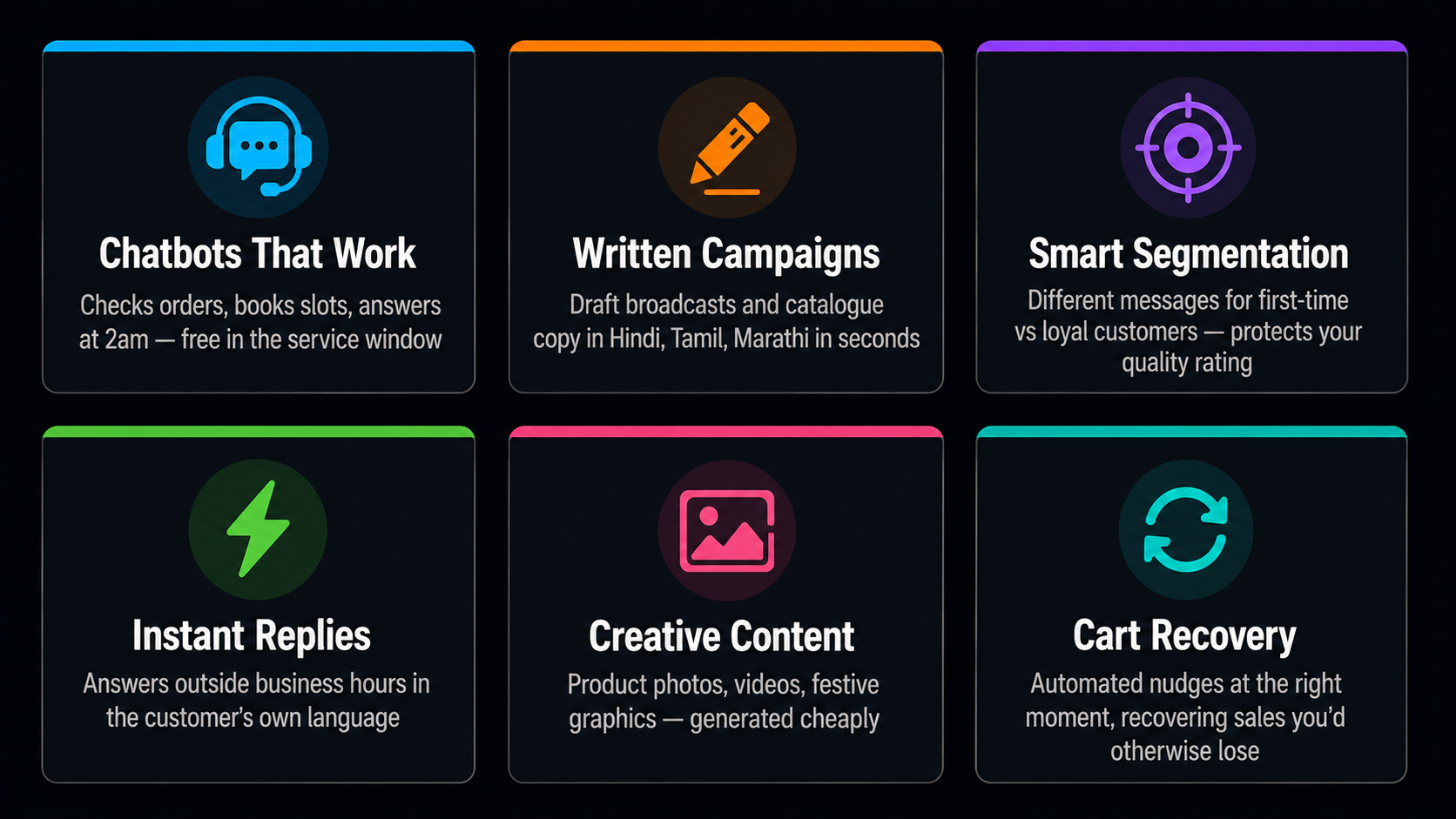
| Where AI helps | Chatbots that check orders and book slots, written campaigns, segmentation, and the creative content itself. |
| The golden rule | Opt-in consent and genuine usefulness. Spam kills your account faster here than anywhere. |
Why WhatsApp Marketing Works So Well in India
There is no real debate about where Indian customers are, which is why WhatsApp marketing works here like nowhere else. They are on WhatsApp, all day, and they treat it as their primary way to talk to friends, family, and increasingly businesses. That is why a message here behaves nothing like a promotional email that dies unopened in a Promotions tab. People actually see WhatsApp messages, and they often reply.
That intimacy is exactly why WhatsApp marketing is so powerful and so easy to ruin. The same closeness that gets your message read gets you blocked the moment you feel like a spammer. So the entire game is earning a place in that space and being worth it once you are there. Do that, and open rates, click rates, and conversions all sit far above what other channels manage. This is the rare channel where restraint is the growth strategy.
There is also a trust dividend that email never gives you. When a customer can reply to your message and get a real, fast answer, the relationship stops feeling like advertising and starts feeling like a conversation with a shop they know. That two-way trust is what turns a one-time buyer into a repeat customer, and it is why so many Indian D2C brands now treat WhatsApp as their main customer relationship channel rather than a side promotion tool.
The Free App vs the Business API
Before you spend a rupee on WhatsApp marketing, know which version you actually need, because people waste months on the wrong one. The free WhatsApp Business app is fine for a very small operation — it gives you a greeting message, an away message, labels, and a basic catalogue. What it cannot do is run real broadcasts to thousands of opted-in customers, connect to your systems, or power an AI chatbot.
Serious WhatsApp marketing runs on the WhatsApp Business API, which you access through an official provider such as AiSensy, Interakt, Gallabox, or Wati. That is where broadcasts, automation, chatbots, and CRM connections live. If you are a growing D2C brand or a business with real customer volume, the API is what you want, and choosing an official provider rather than a grey-market reseller protects your number.
What Changed in 2026: Per-Message Pricing
This is the update every business doing WhatsApp marketing needs to understand, because it changes how you should plan campaigns. On 1 January 2026, Meta moved from charging per conversation to charging per message delivered. You now pay for each template message, which is more transparent but rewards smarter usage.
| Message type | India rate (2026) | Use it for |
|---|---|---|
| Marketing | ₹1.09 per message | Offers, promotions, launches, festive campaigns |
| Utility | ₹0.145 per message | Order confirmations, shipping, payment updates |
| Authentication | ₹0.145 per message | OTPs and login codes |
| Service | Free | Replies within the 24-hour customer window |
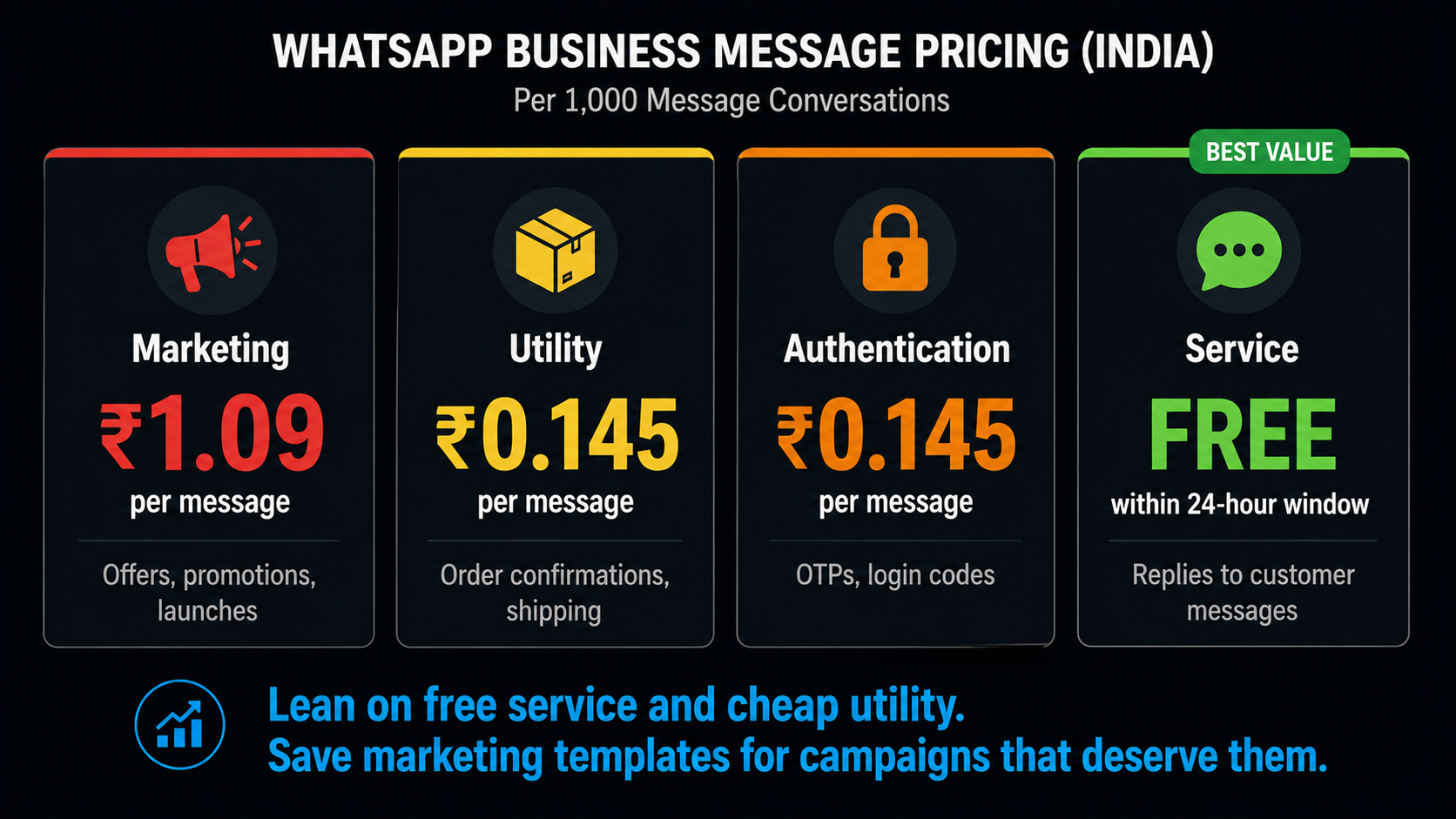
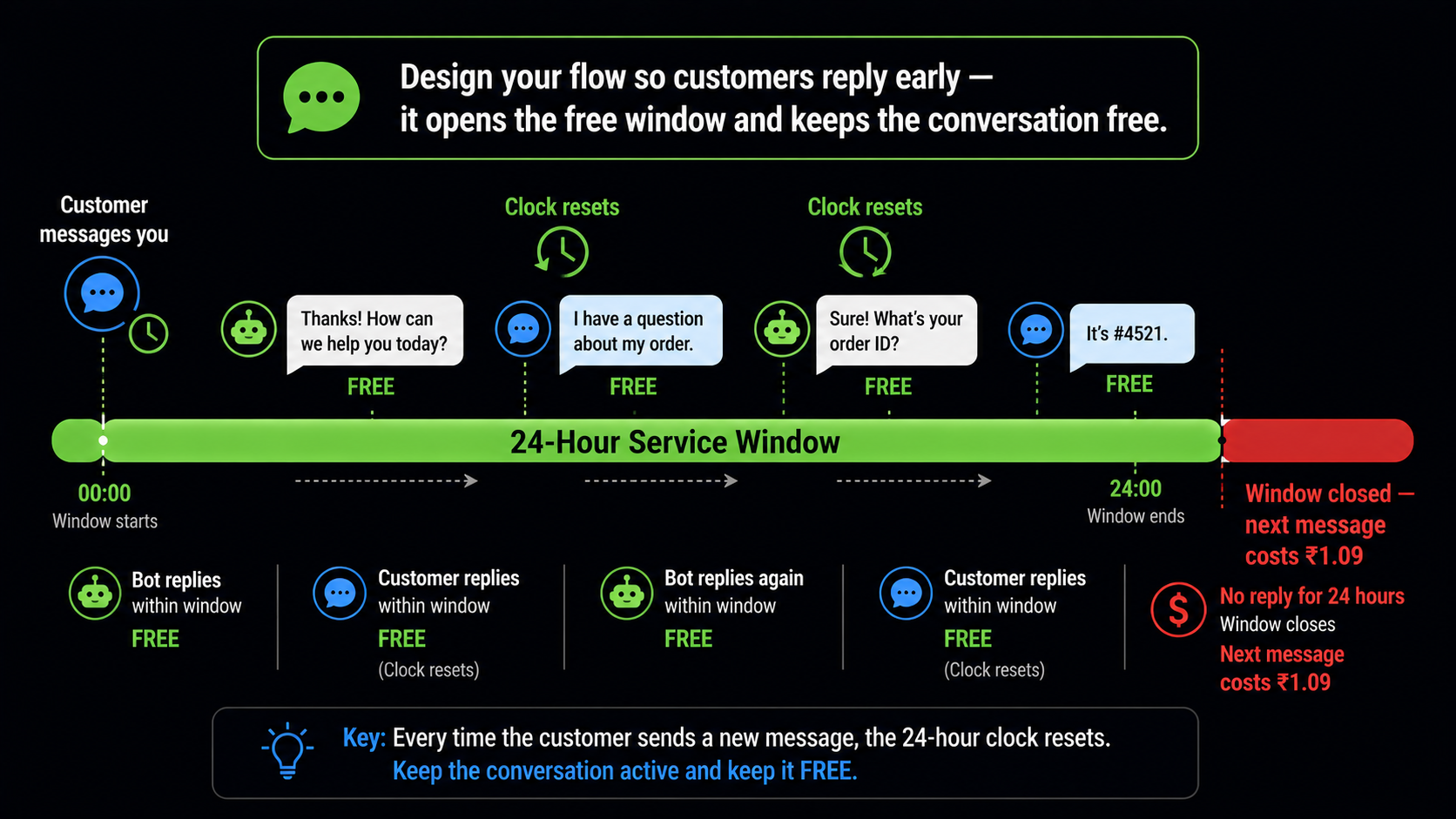
Two details matter enormously for your bill. First, when a customer messages you, a 24-hour service window opens, and every reply you send inside it is free — each new incoming message resets the clock. Second, the rate is set by the customer’s country code, so messaging Indian numbers gets India’s low rate. The strategy that falls out of this is clear: lean on cheap utility messages and the free service window wherever you can, and save the pricier marketing template for campaigns that genuinely deserve it. Smart WhatsApp marketing in 2026 is as much about message category as message content.
Where AI Actually Helps
Here is where WhatsApp marketing stops being a broadcast megaphone and becomes a genuine sales and service engine. These are the places AI earns its keep.
1. Chatbots That Do Real Work SUPPORT
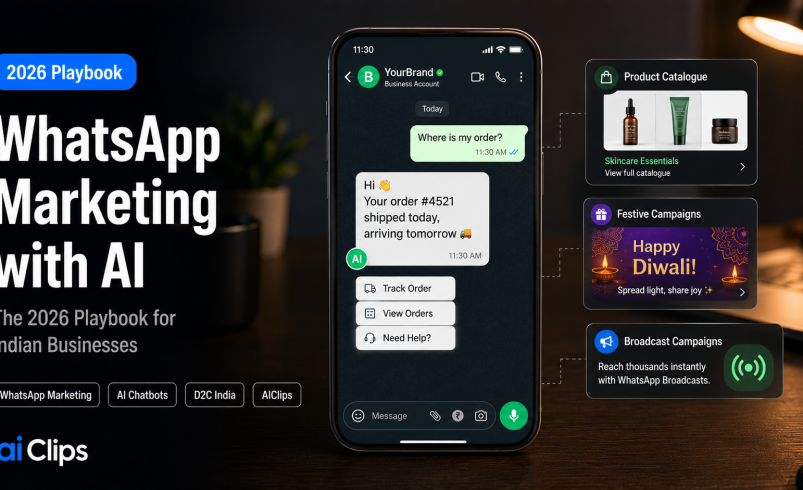
The 2026 AI chatbot is not a dumb FAQ tree. Connected to your systems, it can check an order’s status, pull tracking, update a record, or book an appointment, and answer instantly at 2am. Because these support replies happen inside the free 24-hour window, that whole conversation costs you nothing per message. The one non-negotiable: it must be able to hand off to a human and see order history, or it becomes a frustration machine.
2. Written Campaigns and Catalogue Copy CONTENT
AI drafts your broadcast messages, product descriptions, and catalogue copy in seconds, in your brand voice. Instead of staring at a blank message box, you generate five versions of a festive offer and pick the best. It also writes the same campaign in Hindi, Tamil, or Marathi, which lands far better with regional customers.
3. Smart Segmentation and Personalisation TARGETING
Blasting one message to everyone is the fastest way to get muted, and it is the most common WhatsApp marketing mistake of all. AI helps you segment your list by behaviour and history, and personalise what each group receives, so a first-time buyer and a loyal regular do not get the identical pitch. Relevant messages protect your quality rating; generic ones erode it.
4. Instant Replies in Any Language SPEED
Speed wins sales, and in WhatsApp marketing most buyers message outside business hours. An AI assistant answers common questions immediately, in the customer’s own language, and only escalates to you when it genuinely needs to. You stop losing the leads that used to go cold overnight.
5. The Creative Content Itself VISUALS
A WhatsApp marketing campaign is not just text. Product images, short videos, festive graphics, and catalogue visuals do the heavy lifting, and AI now generates all of them cheaply. This is the part AIClips handles, and we will come back to it.
6. Abandoned Cart and Re-engagement RECOVERY
Some of the highest returns in WhatsApp marketing come from automated nudges — a gentle reminder about a cart someone left, a check-in after a purchase, a win-back for a lapsed customer. AI triggers these at the right moment based on behaviour, recovering sales you would otherwise never see.
The India Playbook: Use Cases That Convert
Theory is nice, but here are the specific WhatsApp marketing plays that actually move money for Indian businesses, several of which are unique to how commerce works here.
- COD confirmation. A quick “confirm your cash-on-delivery order” message cuts fake and impulse orders, directly reducing costly return-to-origin losses. This one is almost pure profit for Indian e-commerce.
- Order and shipping updates. Cheap utility messages that customers genuinely want, which also reduce “where is my order” support load.
- Abandoned cart recovery. A timely nudge with the product image recovers a meaningful share of lost sales.
- Festive broadcasts. Opt-in campaigns around Diwali, Rakhi, and regional festivals, when buying intent peaks. Pair these with our product shot workflow for the visuals.
- Catalogue sharing. Send your product catalogue directly inside the chat so customers browse and buy without leaving WhatsApp.
- Regional-language everything. The same campaign in a customer’s own language consistently outperforms an English-only blast.
The Rules You Cannot Ignore
Common WhatsApp Marketing Mistakes
Most WhatsApp marketing that fails does so for the same handful of reasons. Check yourself against these before you scale.
- Treating it as broadcast-only. If you only blast promotions and never build two-way flows or catalogue journeys, you are paying API fees for a glorified SMS. The magic is in the conversation.
- A chatbot with no human handoff. A bot that cannot escalate or see order history frustrates customers more than no bot at all. Context is everything.
- No opt-in. Messaging people who never agreed is the quickest route to a dead account.
- Using marketing templates when utility would do. Sending a shipping update as a marketing message wastes money, since utility is far cheaper. Match the template to the job.
- Ignoring the quality rating. Chasing reach with spammy sends quietly destroys the account you are trying to grow.
How to Get Started with WhatsApp Marketing
If all of this sounds like a lot, the actual starting path is short. You do not need everything on day one — you need a compliant foundation and one campaign that works. Here is the order that saves you the most pain.
- Pick an official provider. Choose a Meta-verified WhatsApp Business API provider rather than a reseller, so your number and quality rating are protected from day one.
- Build an opt-in list honestly. Collect consent through your website, checkout, and existing customers. A small opted-in list beats a huge bought one, which will only get you banned.
- Set up the free wins first. Turn on order confirmations, shipping updates, and an AI chatbot for support. These are cheap or free, immediately useful, and warm up your account with the right kind of messages.
- Run one good campaign. Send a single, well-targeted, opted-in broadcast with strong visuals rather than blasting everyone. Learn what your audience responds to before you scale.
- Measure and refine. Watch your quality rating, your reply rate, and your conversions, then double down on what worked. Good WhatsApp marketing compounds when you build on real data.
That sequence gets a small business into WhatsApp marketing safely, without the expensive mistakes most beginners make by starting with a giant unsolicited broadcast. Foundation first, scale second. The businesses that win on this channel are almost never the loudest ones; they are the ones customers are quietly glad to hear from.
Where AIClips Fits
Let me be precise about our role, because it matters and I am not going to blur it. AIClips is not a WhatsApp marketing sending platform — for broadcasts, chatbots, and automation you use a proper Business API provider like the ones named above. What AIClips does is create the content that makes those campaigns actually convert: product images, short promo videos, festive graphics, catalogue visuals, and regional-language video, all across 461 models in one dashboard, billed in rupees at ₹349/month with UPI. So your provider handles the pipes; AIClips fills them with visuals worth opening. For the image side specifically, our AI image generator guide is the natural next read.
Frequently Asked Questions
Do I need the WhatsApp Business API for marketing?
How much does WhatsApp marketing cost in India in 2026?
Is WhatsApp marketing legal in India?
How does AI help with WhatsApp marketing?
Will I get banned for sending too many messages?
Can AIClips send my WhatsApp campaigns?
Create WhatsApp Campaign Content on AIClips
Product images, promo videos, festive graphics, and regional visuals — 461 models in one dashboard. INR pricing, UPI, from ₹349/month.
Start on AIClips →