

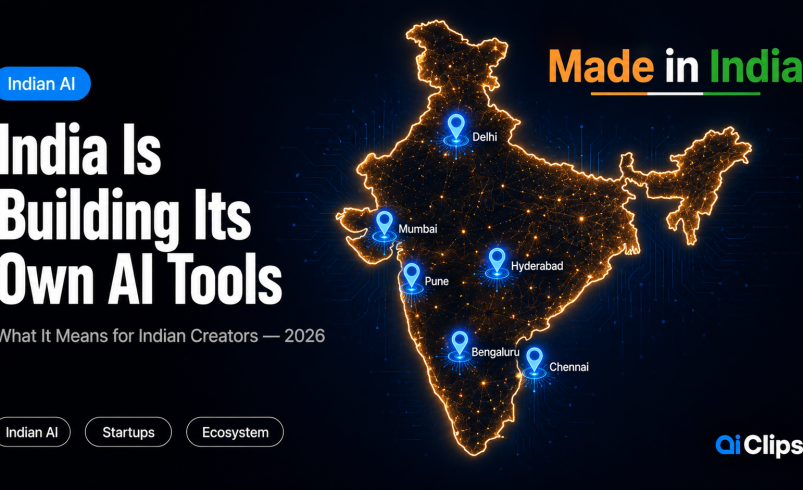

The Indian AI industry crossed a threshold in 2026 that is easy to miss if you are only watching the headline numbers. India now has 1,700+ AI-focused companies, $2.9 billion in venture funding across its top players, and — for the first time — government-backed sovereign AI infrastructure running entirely on Indian cloud. This is not catch-up. It is a distinct approach to AI that the rest of the world does not have.
For Indian content creators, this matters in a way that the global AI conversation typically misses. The tools being built in Bengaluru, Hyderabad, and Noida in 2026 are not derivatives of what is being built in San Francisco. They are solving problems that American AI labs have no financial incentive to solve: 22 Indian languages, 550 million non-English speakers who want to access the internet in their mother tongue, and a creator economy that needs AI tools priced for Indian incomes.
This is an overview of the india ai ecosystem in 2026 — what is being built, where it is ahead, where it is still catching up, and how tools like AIClips fit into a shift that is larger than any individual product.
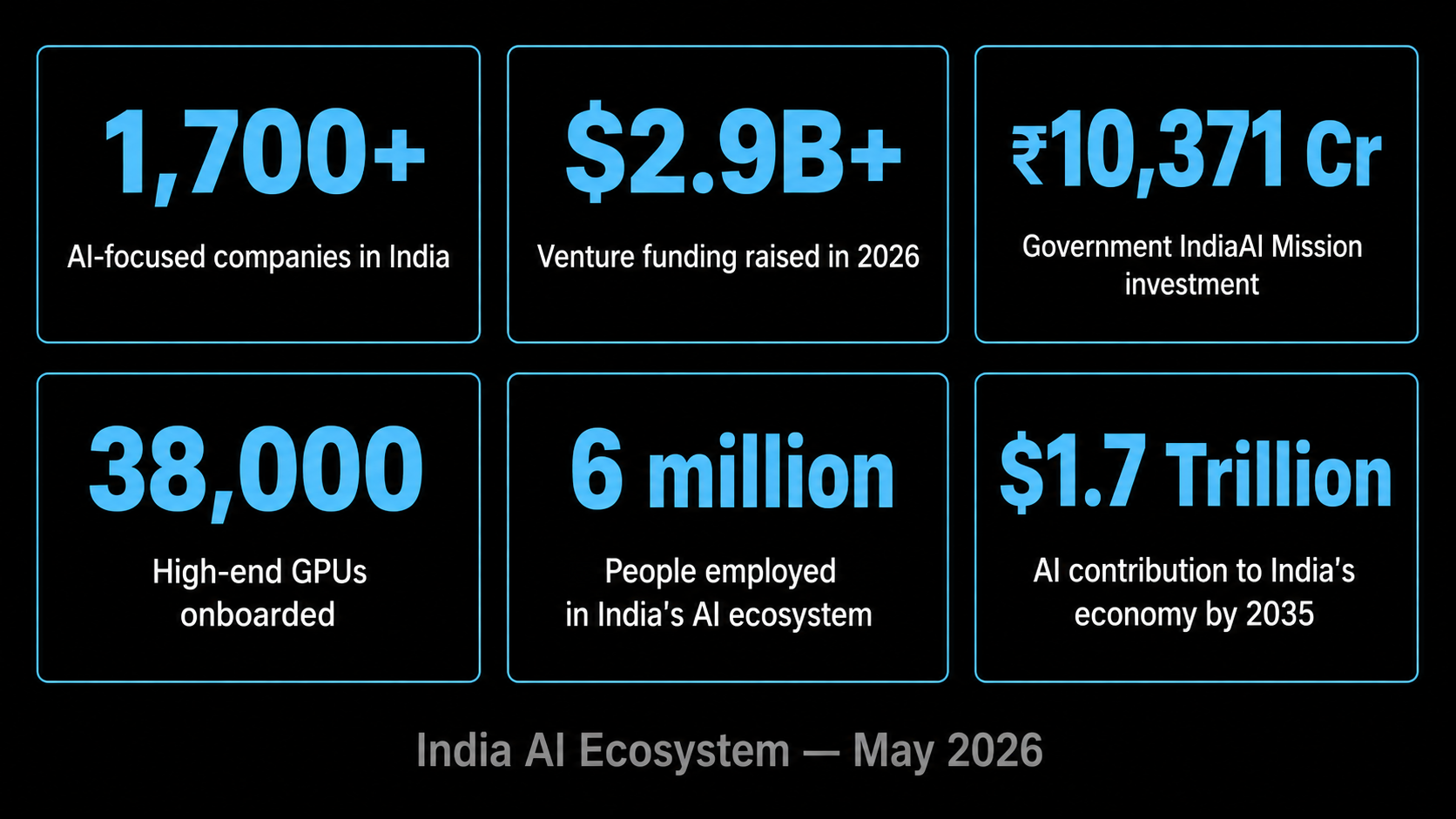
| AI companies in India | 1,700+ AI-focused companies; 4,500+ total AI startups |
| Venture funding (top players) | $2.9B+ raised across leading Indian AI companies in 2026 |
| Government investment | ₹10,371.92 crore ($1.24B) via IndiaAI Mission over 5 years (approved March 2024) |
| GPU infrastructure | 38,000 high-end GPUs + 1,050 TPUs onboarded under IndiaAI Mission |
| Workforce | 6 million people employed in India’s AI ecosystem |
| Economic projection | AI expected to contribute $1.7 trillion to India’s economy by 2035 |
| India’s global rank | Top 3 startup ecosystems globally as of January 2026 |
The 2026 Indian AI Ecosystem — What Changed
The india ai ecosystem in 2026 looks fundamentally different from what it was in 2022 for three concrete reasons: government has become an active infrastructure builder, private capital has consolidated around a few serious players, and the use case has shifted from “AI for India” to “AI from India.”
The distinction matters. “AI for India” is what happens when American companies localise their products — add Hindi language support, lower the price tier, run some ads featuring Indian creators. “AI from India” is when Indians build the core infrastructure, train the models on Indian data, deploy on Indian compute, and own the intellectual property.
India is now firmly in the second phase. The shift is visible at every layer: government infrastructure (Bhashini, AIKosh, IndiaAI Mission), foundational models (Sarvam, Krutrim, BharatGen), cloud infrastructure (Yotta Shakti Cloud, Neysa), and creator tools (AIClips and the growing category of India-first AI applications).
India hosted the first-ever global AI summit in the Global South at the India AI Impact Summit 2026 in New Delhi, with 15–20 Heads of Government, 50+ international ministers, and the launch of the Democratizing AI Resources Working Group co-chaired by India, Egypt, and Kenya. That positioning — India as a voice for the Global South in AI governance — would have been unimaginable five years ago.
Government Infrastructure — Bhashini and Beyond
The most underappreciated infrastructure investment in the indian ai industry is Bhashini — the government’s Digital Public Infrastructure for language AI that most Indians have never heard of but most already benefit from.
Bhashini was launched in 2022 under the National Language Translation Mission. By early 2026, it supports 36+ Indian languages through AI-powered speech recognition, machine translation, text-to-speech, speech-to-speech translation, OCR, and transliteration — all delivered as open APIs that any startup, government department, or enterprise can use for free or at subsidised cost.
The numbers are not small. Bhashini now operates entirely on Indian cloud and GPU infrastructure, ensuring that language datasets, AI models, and citizen interactions remain within India’s jurisdiction. The migration involved moving over 200 terabytes of data and 3.5 billion files to Yotta’s Shakti Cloud. Since its launch in July 2022, Bhashini has crossed 1.2 million downloads, integrates over 350 AI models, and serves more than 450 active customers.
SabhaSaar — a Bhashini application that converts Gram Sabha meeting recordings into multilingual digital records — has processed over 15.6 crore interactions with 5 lakh daily engagements. That is AI working at India’s population scale in a way no American company has attempted and few could replicate without the government DPI layer underneath it.
Beyond Bhashini, AIKosh — India’s national AI dataset platform — hosts 7,541 datasets and 273 AI models across 20 sectors as of February 2026. This is the raw material layer. Indian startups building on Indian language data no longer need to scrape the internet and hope for the best. The data infrastructure is being built as a national resource.
The IndiaAI Mission’s ₹10,371 crore outlay covers compute access (38,000 GPUs, 40+ petaflops of HPC capacity), data availability, and model development support. Twelve startups — including Sarvam AI, Gnani AI, BharatGen (IIT Bombay), and Fractal Analytics — were selected for foundational model development funding. This is not a subsidy programme. It is a strategic infrastructure investment modelled on how countries like South Korea and China built semiconductor capability: government builds the infrastructure, private sector builds the products.
The New Indian AI Startups
The ai startups india landscape in 2026 is more concentrated than the headline numbers suggest. Most of the indian ai 2026 activity in this category happens around a handful of well-funded companies. Most of the significant activity happens around a handful of well-funded companies. Here are the ones building things that matter for Indian creators specifically.
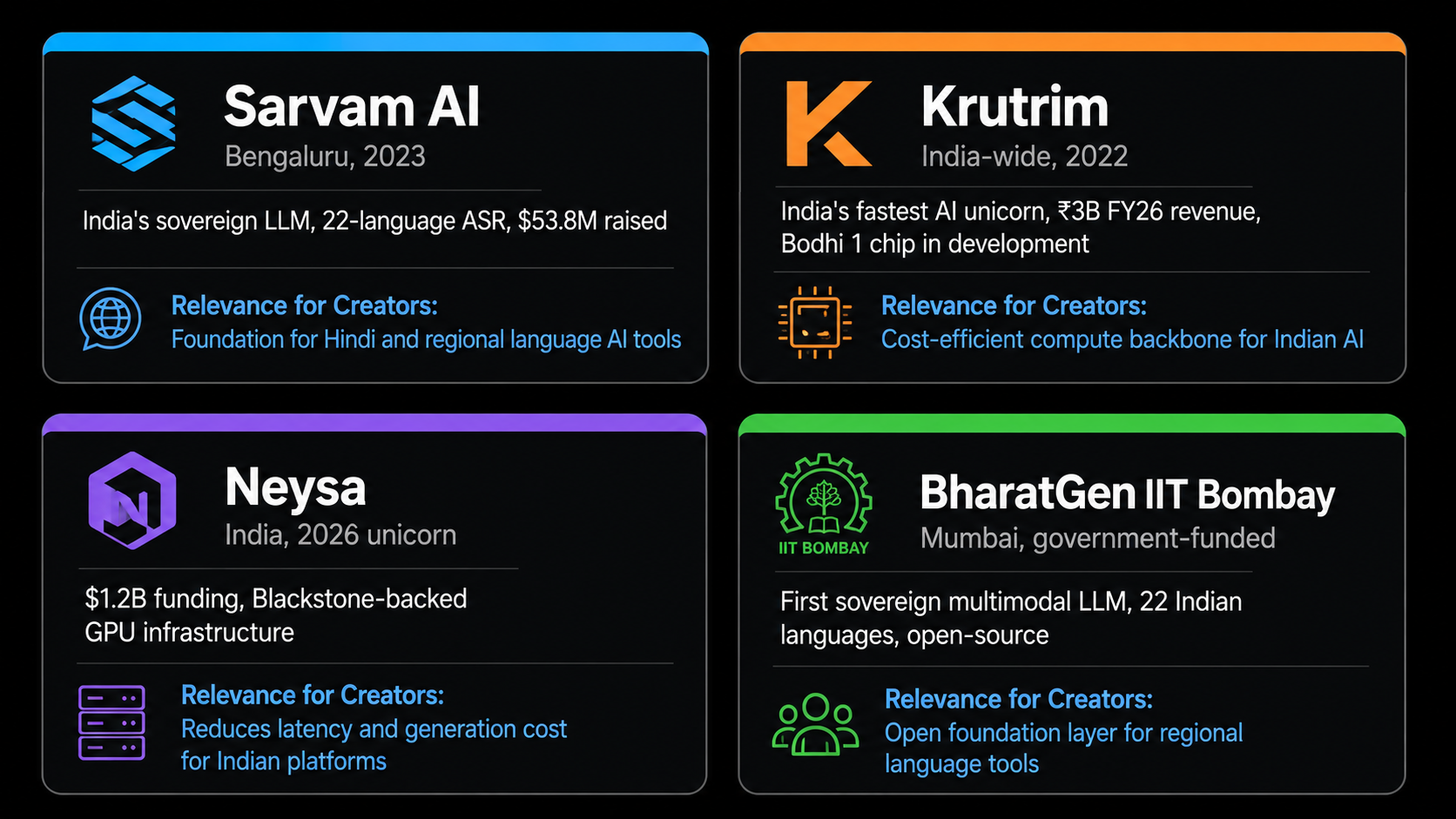
Sarvam AI Bengaluru · Founded 2023
Sarvam is India’s most important AI company in 2026 by most measures. Government-selected to build India’s first sovereign LLM under the IndiaAI Mission. Backed by Lightspeed, Peak XV Partners, and Khosla Ventures with $53.8M raised. Their Sarvam-105B model is the current benchmark for Indian language AI — deployed in production for banking and public services.
The February 2026 launch streak was remarkable in its scope: Vision OCR scoring 84.3% on olmOCR-Bench (beating Gemini 3 Pro at 80.2%), Bulbul V3 voice AI with 35+ voices across 11 Indian languages, and Sarvam Audio ASR covering 22 Indian languages. This is not research. These are production-grade tools reaching real users at scale.
Relevance for creators: Sarvam’s language models are the foundation layer that makes Hindi and regional language AI tools work better across the entire Indian ai industry.
Krutrim India-wide · Founded 2022
Founded by Bhavish Aggarwal (Ola, Ola Electric), Krutrim became India’s fastest AI unicorn in January 2024. In 2026, the company reported ₹3 billion in revenue for FY2026 — a threefold increase year-over-year — and its first annual net profit with margins exceeding 10%. That is a real business, not a valuation story.
The strategic pivot from LLMs to cloud infrastructure reflects an honest self-assessment of where Indian AI currently has a genuine competitive advantage: cost-efficient compute for Indian data, not frontier model research. Krutrim Cloud serves 25+ enterprise customers across telecom, finance, and healthcare. Their Bodhi 1 indigenous AI chip is in development — the first serious attempt at Indian AI silicon.
Relevance for creators: Krutrim’s cloud infrastructure is part of the compute backbone that makes Indian AI tools cost-effective to run at scale.
Neysa India · Unicorn 2026
Neysa became India’s second AI unicorn of 2026 following a $1.2 billion financing round led by Blackstone. It focuses on AI infrastructure — GPU clusters, cloud services, and enterprise AI deployment. The Blackstone backing signals that global institutional capital now considers Indian AI infrastructure a serious asset class, not a speculative bet.
Relevance for creators: Infrastructure investment that will eventually reduce the cost of running AI models in India, reducing latency and improving generation speeds for Indian-hosted platforms.
BharatGen (IIT Bombay) Mumbai · Government-funded
India’s first government-funded multimodal large language model supporting 22 Indian languages. Built on domestic datasets by IIT Bombay, BharatGen is designed to reflect India’s cultural diversity across text-to-text and text-to-speech generation. It represents the open-source, academic side of the Indian AI movement — not a commercial product, but a foundational resource that commercial tools can build on.
Relevance for creators: The open-source model layer that will eventually improve regional language AI tools across the Indian ai ecosystem without requiring commercial API access.
Why Indian AI Tools Matter for Indian Creators
The indian ai tools question for creators is not philosophical. It is practical. Here is what building tools in India, for India, actually changes.
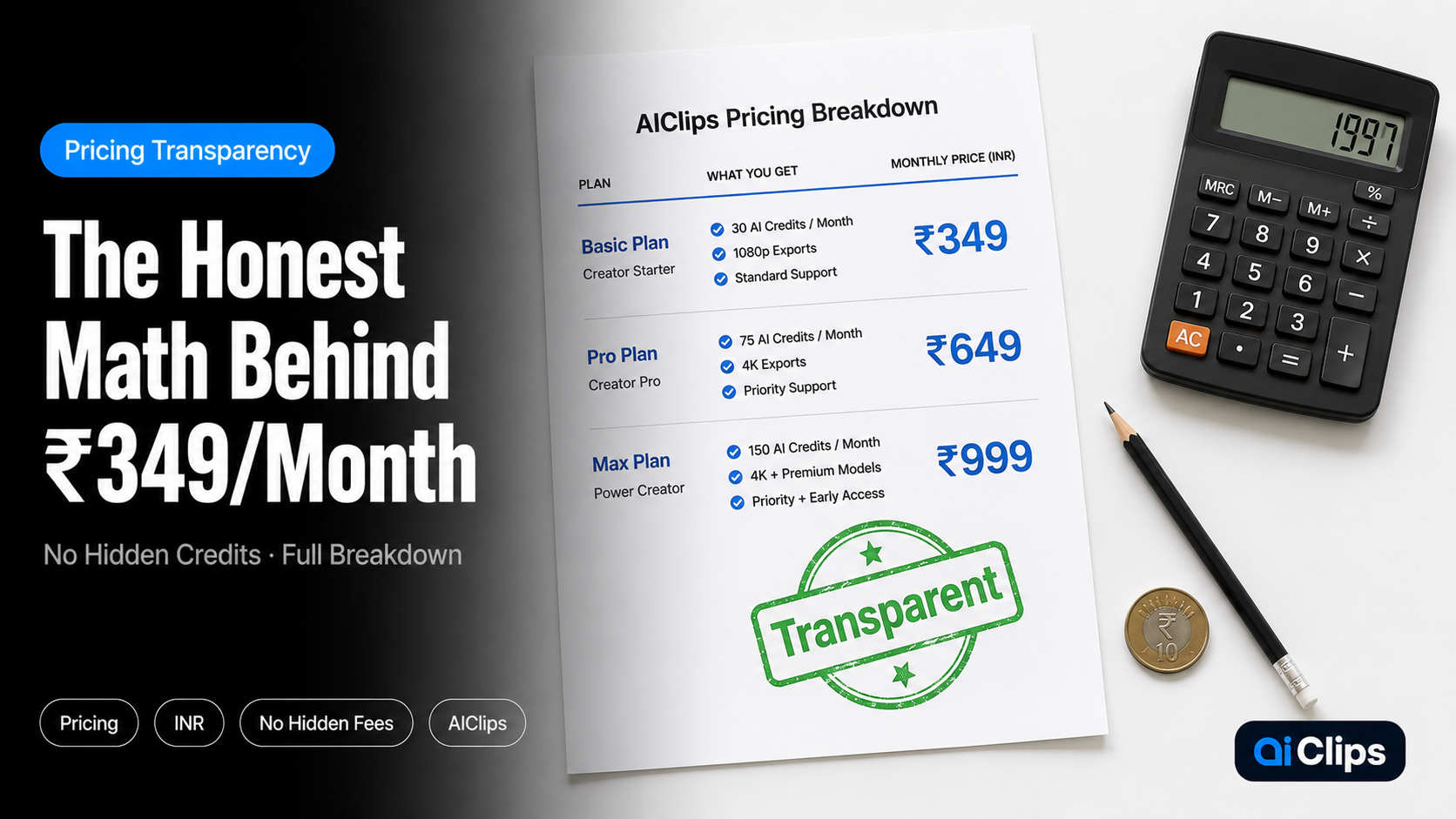
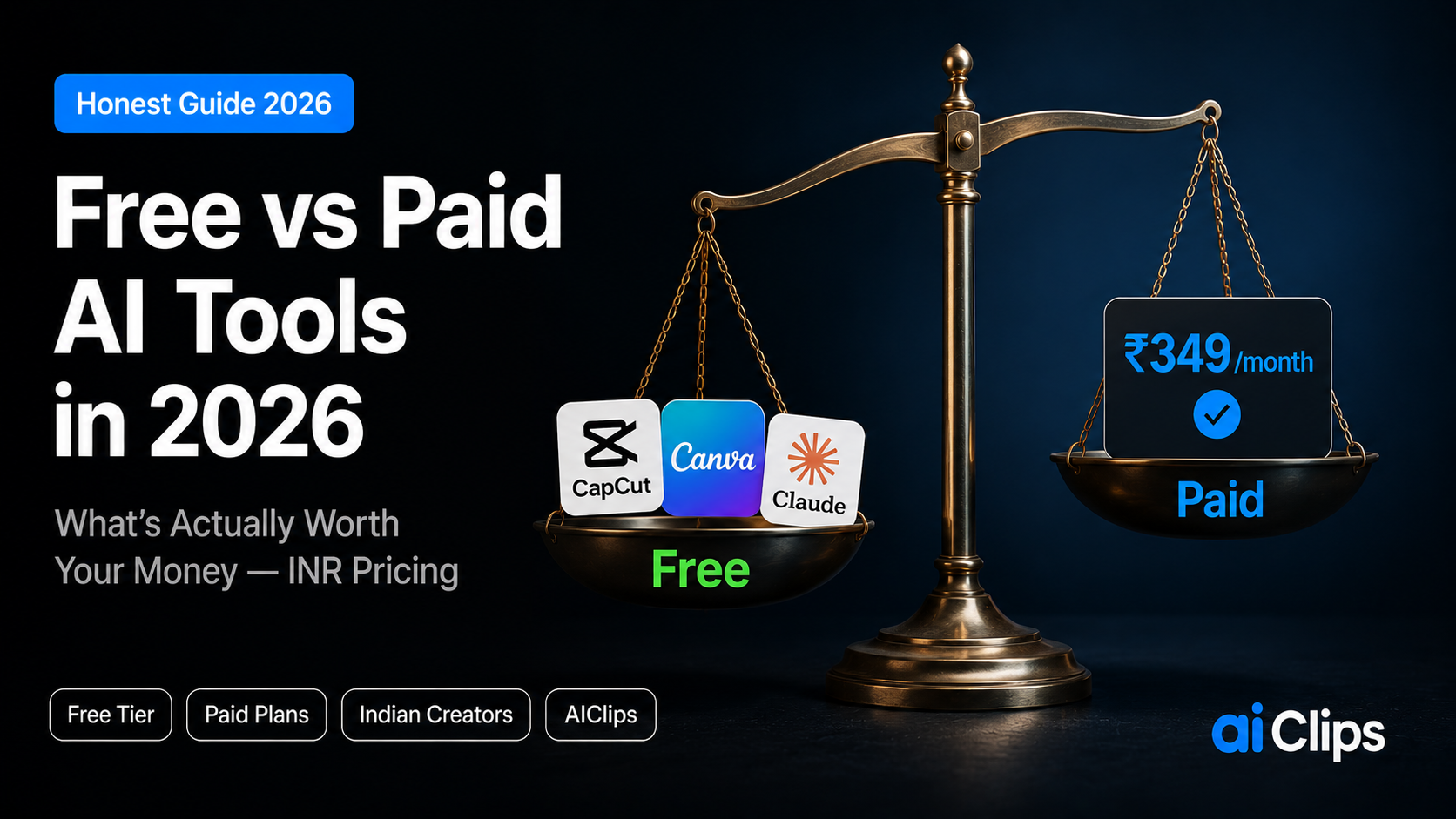
Pricing in rupees, not dollars. Every dollar-priced AI tool charges Indian users 18% OIDAR GST on top of the USD cost. At ₹96.30 per dollar, Midjourney Basic at $10/month becomes ₹1,136/month for an Indian user. A tool priced in rupees at ₹349/month — like AIClips — is not only cheaper by the exchange rate. It is cheaper by the full foreign exchange + GST overhead that all USD tools carry for Indian buyers.
Training data that understands India. A model trained predominantly on Western internet data does not know what a jharokha window looks like, how a Banarasi saree drapes, or how to render a Varanasi ghat accurately. This is not a niche problem. It is the central problem for any Indian creator using AI to generate visual content about India. Indian-trained models solve this at the source, not with post-generation corrections.
Language infrastructure that actually works. Sarvam’s Bulbul V3 supports 35+ Indian voices across 11 languages. Bhashini provides ASR for 22 Scheduled languages as a public API. These are not features. They are infrastructure — the difference between a tool that handles Hindi as a supported language and one that understands Hindi as a native capability. For creators making content in Marathi, Telugu, or Bengali, the difference is audible in every sentence.
Data sovereignty and legal clarity. When Indian creators generate content using Indian-built tools trained on Indian data, the copyright and data residency questions are significantly cleaner than when content is generated by US-based tools under terms of service governed by California law. This matters more for commercial creators and agencies than for individual creators, but it is a real issue that Indian-built tools address structurally.
Where Indian AI Is Ahead Globally
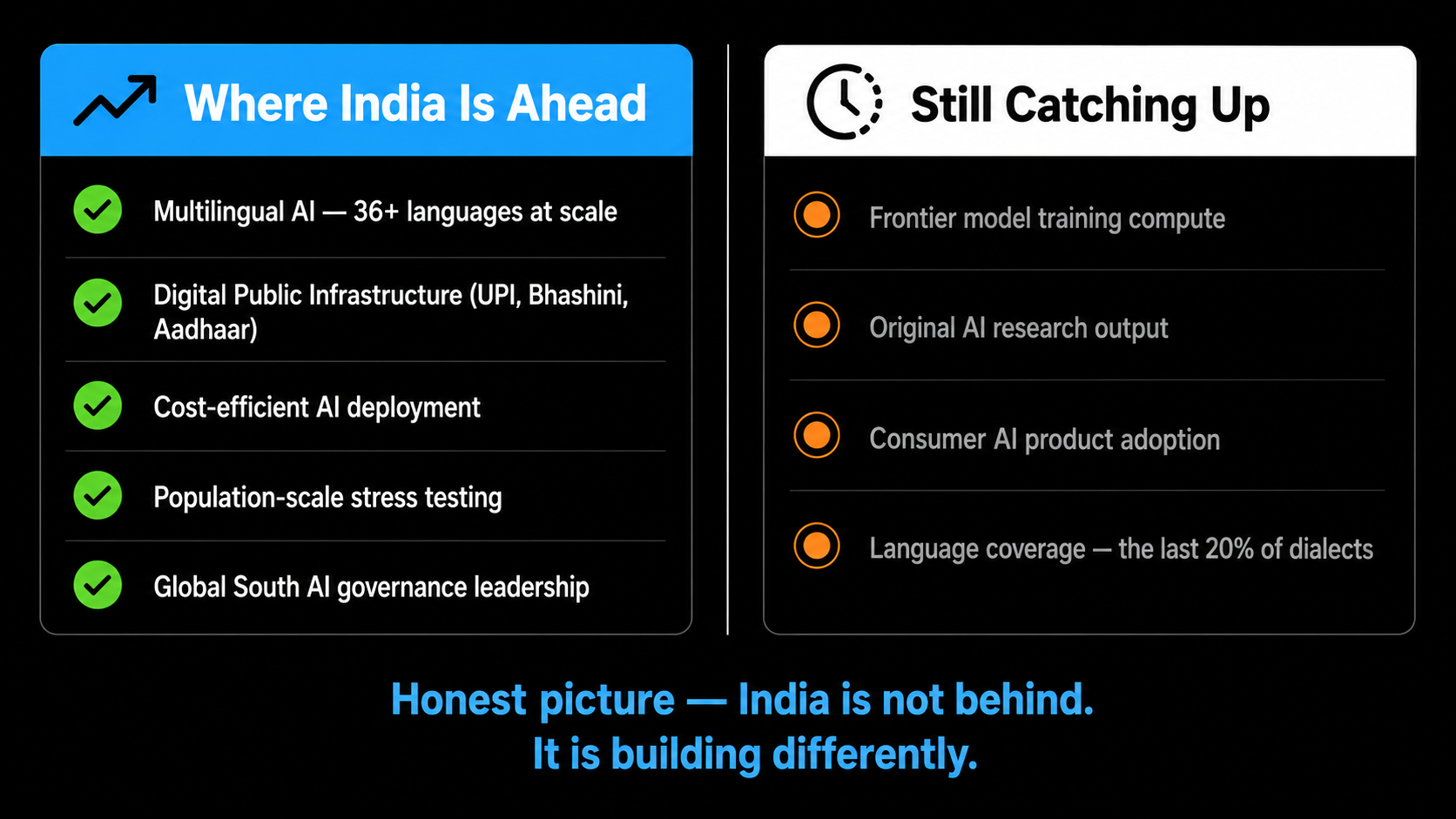
The indian ai 2026 narrative often defaults to “India is catching up.” That framing undersells what the india ai ecosystem has actually built. That framing is accurate in some dimensions and misleading in others. In several specific areas, India is genuinely ahead of what the global AI industry has built.
Multilingual AI at scale. No country has deployed multilingual AI infrastructure across as many distinct languages at the population scale India operates at. Bhashini’s 36+ language coverage, Sarvam’s 22-language ASR, and BharatGen’s 22-language multimodal model have no direct equivalent anywhere. The US has deployed AI at scale; it has done so in English. India’s challenge — and achievement — is doing this across languages with entirely different scripts, phoneme systems, and grammatical structures simultaneously.
Digital Public Infrastructure as AI distribution layer. India’s DPI stack — Aadhaar for identity, UPI for payments, Bhashini for language — provides an AI distribution layer that most countries do not have. When a government service integrates Bhashini’s translation API, it instantly reaches citizens in 36 languages. When a startup plugs into the DPI stack, it inherits national-scale distribution. This is a structural advantage that took 15 years to build and cannot be replicated in 18 months.
Cost-efficient AI deployment. Indian AI companies operate at cost structures that make global deployment economics look expensive. Sarvam’s models are specifically optimised for Indian infrastructure constraints — lower compute costs, higher efficiency per parameter for Indian language tasks. The Krutrim pivot to cloud infrastructure reflects a genuine insight: India can compete globally on AI cost efficiency even if it cannot yet compete on frontier model research.
Population-scale stress testing. Bhashini was deployed at Maha Kumbh 2025 — the world’s largest human gathering, with 400+ million visitors over 45 days. That is a stress test for AI infrastructure that no lab in San Francisco will ever run. The learnings from deploying AI at Indian population scale are genuinely valuable and not replicable elsewhere.
Where Indian AI Is Still Catching Up
Honest analysis requires acknowledging where the gaps remain. The indian ai industry has real structural challenges that a complete picture of indian ai 2026 must include. that cheerleading does not resolve.
Frontier model training compute. Training GPT-5-scale models requires compute infrastructure that India does not yet have in the quantities needed. The IndiaAI Mission’s 38,000 GPUs is significant progress — but OpenAI trained GPT-4 on an estimated 25,000+ A100s, and the frontier has moved further since. India’s compute gap is real and will not close quickly.
Original research output. India produces world-class AI engineers — many of them now leading labs at Google, Meta, and OpenAI. The country’s share of original AI research published and cited globally remains lower than its share of AI engineering talent. Brain drain is a structural challenge; the IndiaAI Mission’s 500 PhD scholarship programme is a decade-long investment, not a 2026 solution.
Consumer AI adoption vs enterprise. Krutrim’s 90% revenue from Ola group companies in FY25 (moving to external customers in FY26) reflects a broader pattern: Indian AI companies have found stronger traction in enterprise and government than in consumer products. ChatGPT, Claude, and Gemini dominate consumer AI usage in India. Building consumer AI products that compete with American platforms on user experience remains a challenge for the Indian ecosystem.
The language long tail. Bhashini and Sarvam cover 22 Scheduled languages well. India has 121 languages with more than 10,000 speakers and hundreds of tribal languages. The last 20–30% of linguistic coverage is significantly harder than the first 80% — smaller datasets, fewer native-language AI researchers, less commercial incentive.
AIClips’ Place in This Ecosystem
AIClips operates at a different layer of the india ai ecosystem than Sarvam or Krutrim. Those companies are building infrastructure. AIClips is building the creator-facing applications that sit on top of that infrastructure — making global AI models accessible to Indian creators at Indian prices, with Indian payment methods, and with the cultural understanding that Indian content requires.
The connection to the wider movement is real and practical. When Sarvam improves its Hindi TTS models, that improvement flows through to Indian voiceover tools. When Bhashini’s language APIs improve, regional language content creation tools improve. When IndiaAI Mission compute becomes more accessible, the cost of running Indian AI tools decreases. The ecosystem is interdependent in ways that are not obvious from the outside but are very visible from the platform layer.
What AIClips specifically adds to the ecosystem: access. Most of the infrastructure investments described in this article benefit enterprise customers and government services. The 80 million Indian creators who need to make their next Reel, record their next voiceover, or generate their next product photo — they need tools at ₹349/month that work on a phone with a standard data connection. That is the creator layer of the Indian AI movement, and it is as important as the infrastructure layer even if it attracts less attention.
The indian ai tools built at this creator layer are as important to the indian ai 2026 story as the foundational models getting the headlines. For the full breakdown of AI tools built for Indian creators specifically, read the Best AI Tools for Indian Content Creators guide. For the regional language perspective on what this means in practice, the Regional Language AI Video guide covers the on-the-ground workflow.
What’s Next for Indian AI
The signals visible in the ai startups india space right now — and in the broader india ai ecosystem — point in several specific directions for the rest of 2026 and into 2027.
Indigenous AI silicon. Krutrim’s Bodhi 1 chip — expected in late 2026 — is India’s first serious attempt at domestic AI hardware. If it reaches production at a competitive specification, it changes the economics of Indian AI compute in a structural way. India currently depends entirely on NVIDIA GPUs and global chip supply chains for its AI infrastructure. Domestic silicon — even at a generation behind the frontier — reduces that dependency significantly.
Regional language AI reaching commercial viability. Sarvam’s Bulbul V3 with 35+ voices and Bhashini’s expanding language coverage are both approaching the quality threshold where regional language AI tools become commercially self-sustaining rather than requiring subsidised infrastructure. When that threshold is crossed, the incentive for private investment in regional language AI shifts dramatically — and the quality of tools available to regional creators improves rapidly.
Creator-focused Indian AI tools scaling up. The creator economy layer of the Indian AI ecosystem — tools built specifically for Indian content formats, Indian platforms, Indian audiences, and Indian prices — is still early. AIClips, InVideo, and a handful of other Indian-built creator tools represent the beginning of this category, not its maturity. The market conditions — 80 million creators, growing smartphone penetration, exploding short-form video consumption — are clearly there. The product category will grow to match them.
Global South positioning. India’s hosting of the India AI Impact Summit 2026 as the first global AI summit in the Global South, and its co-chairing of the Democratizing AI Resources Working Group with Egypt and Kenya, signals an intent to shape global AI governance from a non-Western perspective. The long-term implication for the indian ai industry: standards set with India’s input will be more favourable to multilingual, cost-efficient, emerging-market AI than standards set without it.
Frequently Asked Questions
What are the biggest Indian AI companies in 2026?
What is Bhashini and how does it help Indian creators?
Is India building its own AI models or just using global ones?
Why are Indian AI tools better for Indian creators than global tools?
How does AIClips fit into the Indian AI ecosystem?
Support Indian AI — Start Creating on AIClips
Made for Indian creators. INR pricing. Hindi, Marathi, Tamil, and regional language support. Starts at ₹349/month.
Start on AIClips →