
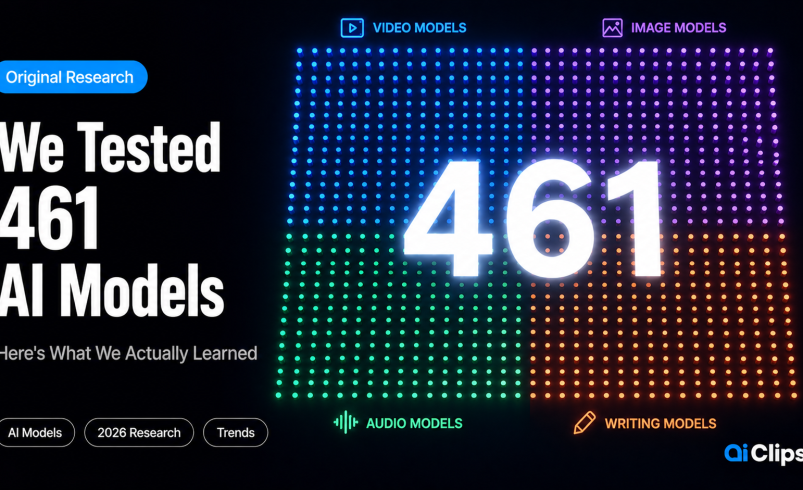

The ai models trends of 2026 are not what most people predicted. We have been adding, testing, and removing AI models from the AIClips platform since launch. When we crossed 461 models in our catalogue — video, image, audio, 3D, and writing tools — we started noticing patterns across categories that individual model reviews do not capture. This is our honest account of what those patterns look like from the inside.
We are not neutral observers in the strictest sense — we run a platform that makes money when creators use these tools. But we also have no financial relationship with any individual AI lab. We earn when creators generate, regardless of which model they choose. That puts us in a genuinely unusual position: we need all the models to be good, and we have no incentive to oversell any one of them.
This ai industry analysis 2026 is what we actually observed across 461 models — the patterns, the surprises, the failures, and where we think this is going.
| Total models tested | 461 ai models at time of writing. Now 600+ and growing. This ai model testing 2026 data comes from real platform usage, not controlled lab conditions. |
| Categories covered | Video generation (T2V, I2V, effects), Image generation (T2I, I2I, editing), Audio (TTS, music, SFX, voice cloning), 3D generation, Writing tools |
| Testing approach | Each model runs against a standard set of prompts before going live. The ai models trends we document here reflect patterns across thousands of real creator generations. |
| What we do not claim | This ai industry analysis 2026 is based on platform data and internal testing — not a controlled research study. Patterns, not proofs. |
How We Got to 461 Models — The Journey
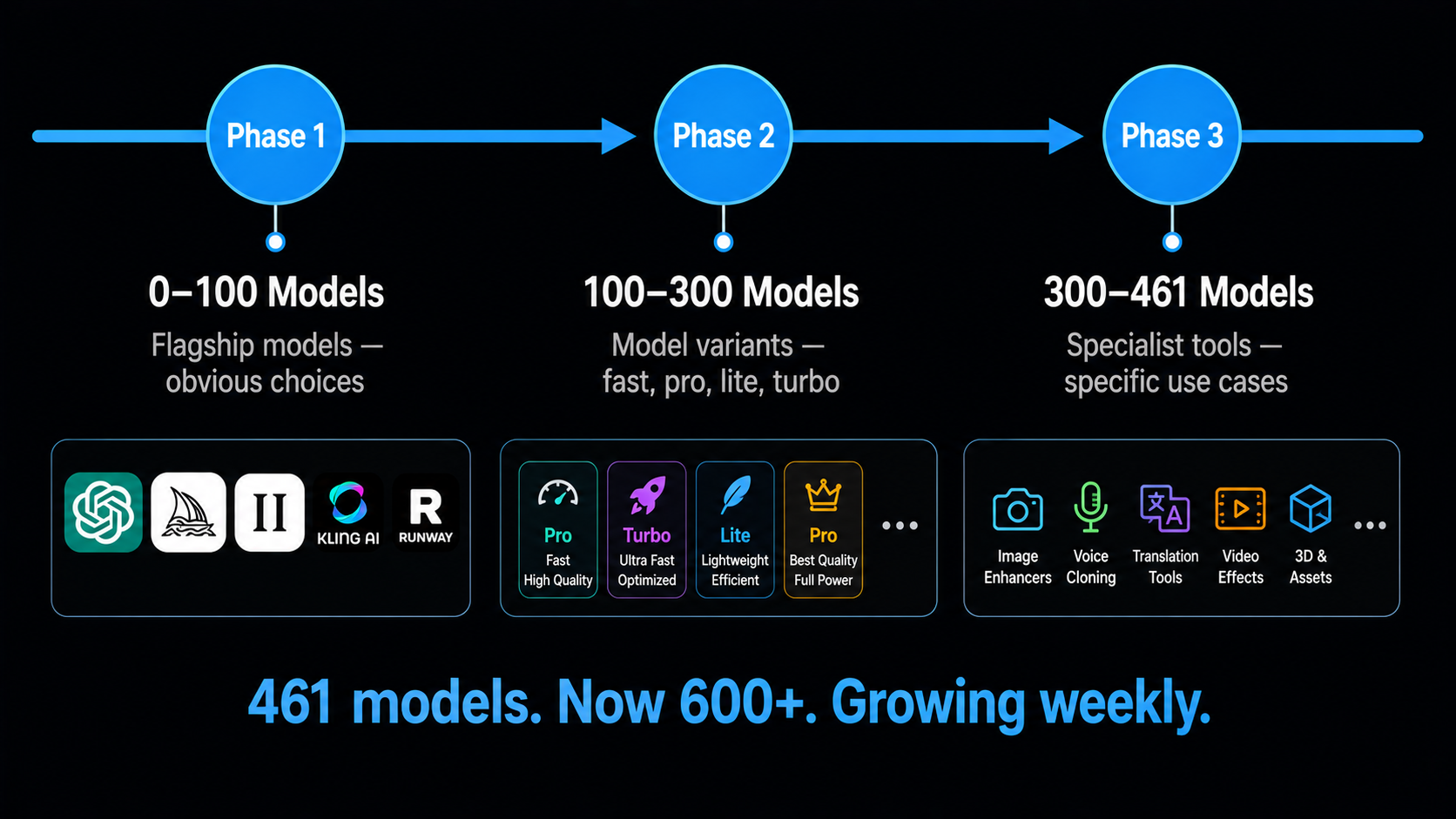
When AIClips launched, we had around 40 models. The expansion to 461 ai models happened in roughly three phases, and each phase taught us something different about the ai model landscape and how it was evolving.
Phase 1 (0–100 models): We added the obvious ones first — the flagship models everyone was already talking about. Midjourney-era image quality, Runway for video, ElevenLabs for voice. At this stage, model selection was relatively simple. The differences between tools were so large that almost any model in a category was meaningfully different from the others.
Phase 2 (100–300 models): This is where the ai model landscape got complicated. The major labs started releasing multiple variants of the same core model — fast, standard, pro, turbo, lite. We added all of them, which required us to think carefully about how to explain the difference between, say, Kling 1.5 Standard and Kling 1.6 Pro to a creator who just wants to make a Reel. The answer was not obvious. The quality differences between some variants were measurable in controlled tests but invisible in practice at social media resolutions.
Phase 3 (300–461 models): This is when the non-obvious models started arriving. Specialist tools for specific use cases — Dia TTS for multi-speaker dialogue, Happy Horse for character consistency, Infinity Star for landscape cinematics, Wan Effects for viral transformation effects. Each one solved a problem none of the flagship models solved well. Adding them required us to become genuinely knowledgeable about each specific use case, not just the general category.
What we learned from the journey: the first 100 models taught us what AI tools can do. The next 361 taught us when to use each one.
Patterns We Noticed Across Video Models
Video is the largest category on the platform and the one that changed most dramatically in the first half of 2026. The ai models trends in this category are the most visible to creators and the most consequential for content quality. Here are the patterns that surprised us.
Native Audio Became Table Stakes Almost Overnight
Eighteen months ago, every AI video model produced silent output. By February 2026, four of the six major models — Kling 3.0, Sora 2, Veo 3.1, and Seedance 1.5 Pro — generated synchronized audio natively. The speed of this shift was genuinely surprising. We had expected audio integration to be a 2027 development. It arrived in 2026 Q1.
The quality gap between models on audio is now larger than the quality gap on visuals for certain content types. Veo 3.1’s spatial audio is so far ahead of the pack that for any content where audio-visual sync matters — documentary-style footage, product demos, nature content — Veo is the obvious choice even if the visual quality is slightly below Kling 3.0 on photorealism metrics.
The Quality Floor Lifted — The Quality Ceiling Barely Moved
Every major model release in 2026 H1 produced better results on benchmark tests than its predecessor. But our internal testing revealed something the benchmarks did not: the improvement was overwhelmingly at the bottom of the quality range, not the top.
The worst output from a modern model is significantly better than the worst output from a 2024 model. The best output from a modern model is only marginally better than the best output from a 2024 model — at social media display resolutions. This means that for most creators producing content for Instagram and YouTube at 1080p, the upgrade from Seedance 1.5 to Seedance 2.0 was most valuable not in making great prompts look better, but in making mediocre prompts look acceptable.
Top 5 Models Handle 80% of Use Cases — The Rest Fill Specific Gaps
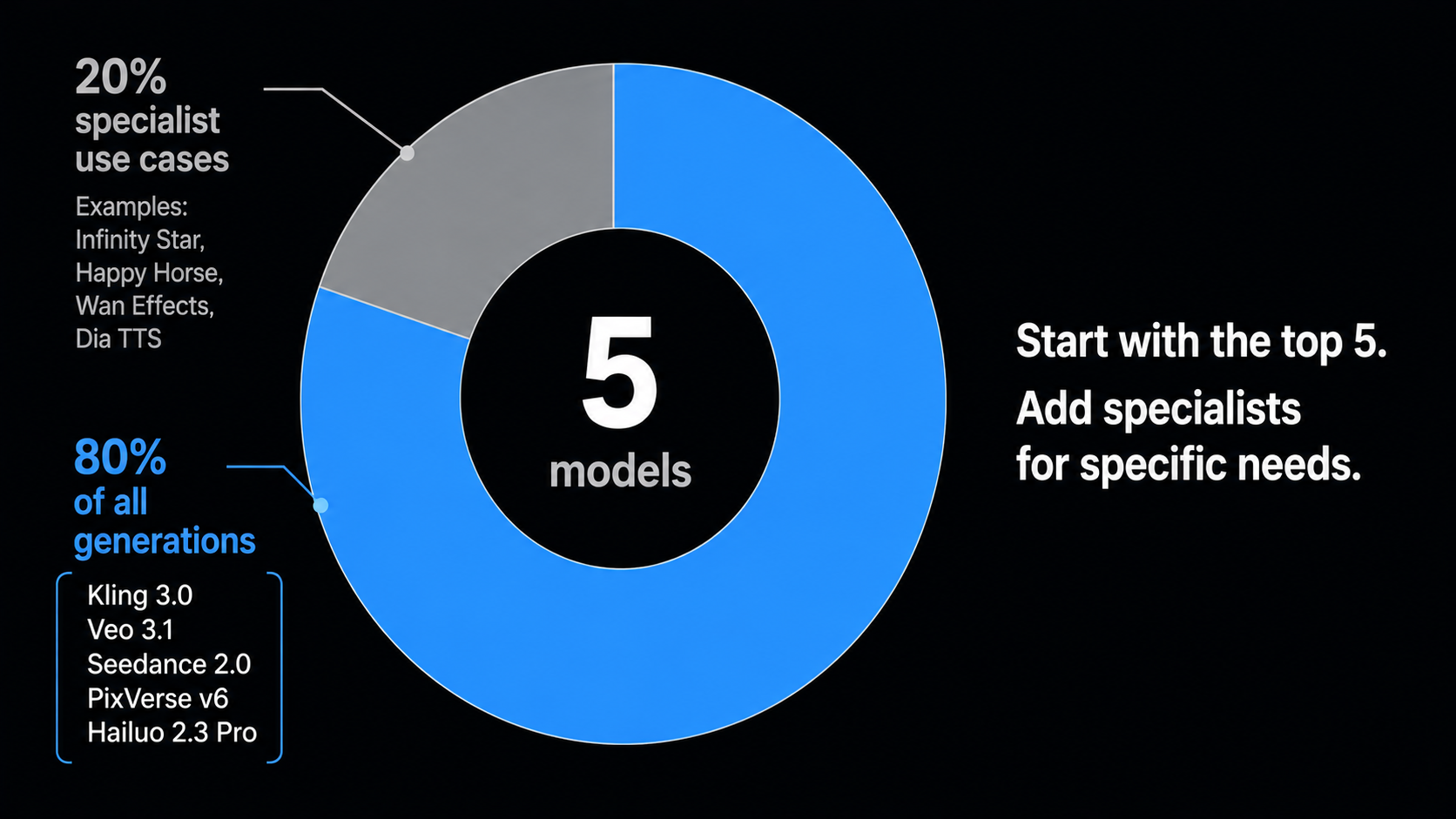
Looking at actual generation data on our platform, five video models handle the majority of all generations: Kling 3.0, Veo 3.1, Seedance 2.0, Pixverse v6, and Hailuo 2.3 Pro. The other 40+ video models we carry serve real use cases — but specific ones. Infinity Star for landscape cinematics. Happy Horse for character consistency across shots. Wan Effects for viral transformation content.
A creator who uses only the top 5 will cover 80% of their needs. The remaining 20% is where the specialist models earn their place. The mistake we see creators make is either using only one model for everything (leaving quality on the table for specific use cases) or trying to use a different model for every generation (spending more time choosing tools than creating content).
Cultural Context Remains the Biggest Unaddressed Gap
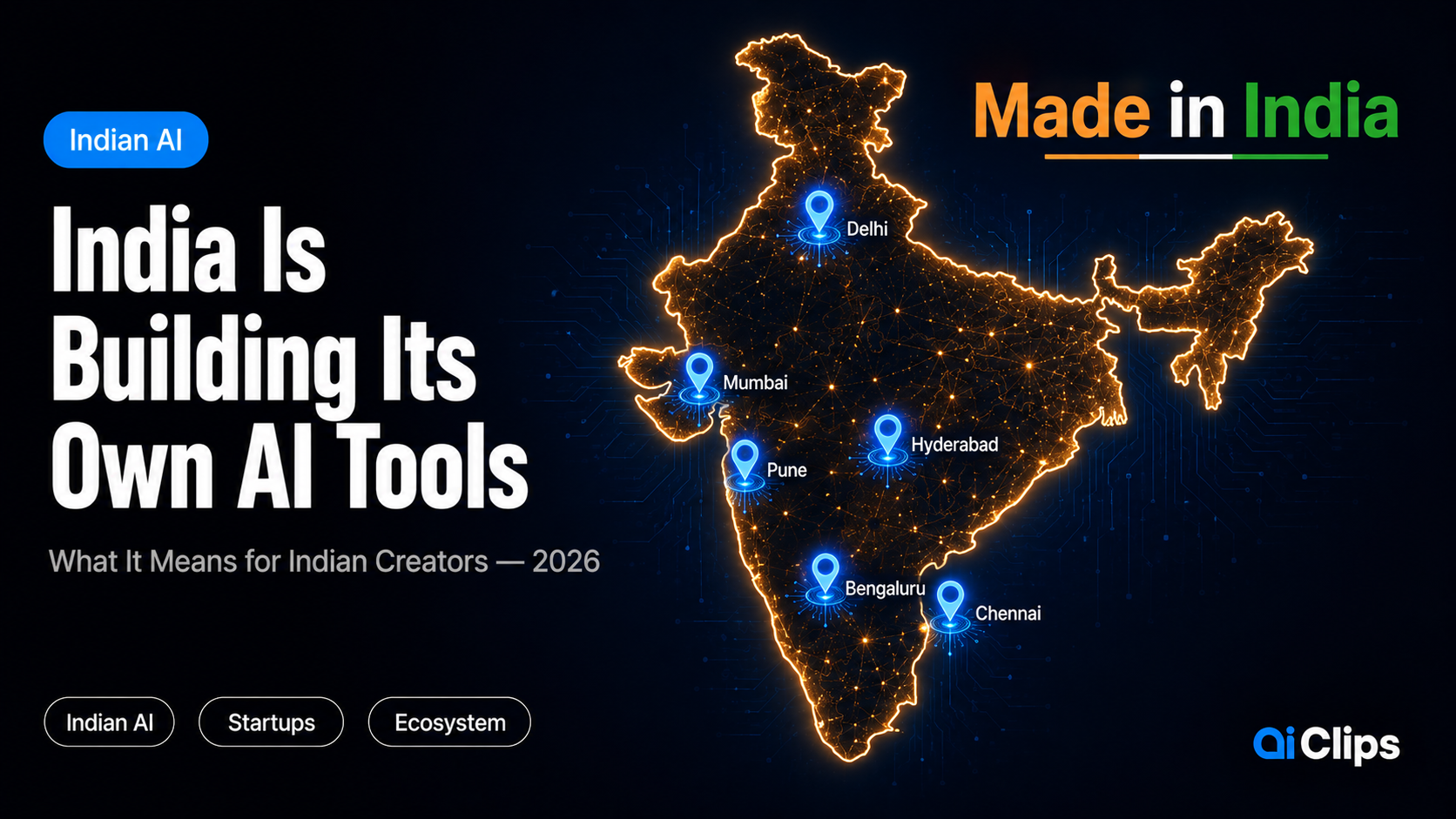
We added Seedance 2.0 because it handles Indian cultural contexts — traditional clothing, architectural styles, cultural settings — more accurately than any other model we tested. No Western-developed model comes close on this dimension. This is not a small aesthetic preference. For a creator making content about India for Indian audiences, a model that cannot accurately render a saree, a jharokha window, or a Varanasi ghat setting produces output that reads as foreign to its intended audience.
The gap has not closed. If anything, it widened in 2026 H1 as Western models focused on photorealism benchmarks that are culturally neutral by design. The training data problem is real and the major labs are not prioritizing it.
Patterns Across Image Models
The ai model landscape for image generation shifted in a different direction from video — less about cinematic quality and more about practical utility. The ai models trends here are defined by cost compression and the emergence of specialist editing models as a distinct category.
The most practical insight from our image model testing: HiDream I1 Fast at 1 credit per image and Flux 2 at 20 credits per image are not 20 times different in output quality for social media formats. For an Instagram story rendered at 1080 x 1920px, the quality differential is much smaller than the credit differential suggests.
The premium models earn their price at print resolution, for portraits requiring fine detail, and for prompts with complex multi-element compositions. For volume social media generation — quick thumbnails, background textures, batch product images — HiDream and Luma Photon Flash (2 credits) produce output that serves the use case at a fraction of the cost.
The practical implication: route your prompt by use case, not by habit. Do not default to Flux 2 for every image generation. Use HiDream for volume, Flux 2 for precision, Nano Banana 2 for anything with Indian cultural specifics.
Text Rendering Finally Crossed the Usability Threshold
For three years, “text in images” was the reliable way to spot AI-generated content. The characters looked like letters, but read nothing. Ideogram V3 and GPT Image 2 changed this in 2026. Both models now render readable text — including Hindi and English mixed typography — accurately enough for production use in thumbnails, social media graphics, and poster designs.
We added Ideogram V3 specifically because it solved a problem every Indian social media designer faces: generating graphics with Hindi and English text in the same image without a separate design software step. The improvement was not incremental — it was categorical. Before these models, text in AI images required a Canva post-processing step. Now it is generation-ready in most cases.
Edit Models Are a Separate Category Now
When we launched, “image generation” and “image editing” were the same category — you either generated from text or you did not. By mid-2026, editing models have become a distinct category with different strengths and workflows. Nano Banana 2 Edit, GPT Image 2 Edit, Wan v2.7 Edit, Seedream v5 Lite Edit — these are not weaker generation models. They are purpose-built tools for precise, context-aware image modification.
Creators who understand this distinction work faster. For brand work where you have a product image and want to change the background, lighting, or scene context, an edit model produces better results in one step than a generation model running multiple iterations.
The Audio Model Surprise — TTS Quality Jumped
If you asked us which category improved most dramatically in our ai model testing 2026, the answer is not video. It is not image generation. It is text-to-speech. This is one of the most significant ai models trends we observed across the 461 ai models on the platform.
The TTS quality jump between 2024 and 2026 is the most under-discussed development in the ai model landscape. ElevenLabs Turbo v2.5 produces Hindi voiceover that — when properly formatted — is functionally indistinguishable from a human voice artist to most listeners in a social media context. This was not true eighteen months ago. The improvement is specific: prosody, schwa deletion handling in Hindi, natural pause patterns, and emotional range all improved simultaneously in a way that makes the output feel genuinely spoken rather than synthesized.
The second surprise: Dia TTS. We added it because it does something no other model on the platform does — multi-speaker dialogue with natural emotional nuance. Two characters in a conversation, each with distinct voices, each responding with contextually appropriate emotional tone. For creators making documentary-style content, podcast-style audio, or dramatic audio content, this is a category-changing capability.
The third: voice cloning matured from gimmick to production tool. Lux TTS with a 60-second reference audio now produces a clone that holds up to scrutiny on long-form narration. A year ago, cloned voices degraded noticeably on longer texts. That problem is largely solved on the models we carry now.
3D Model Category — Still Early
We carry three 3D generation models: Trellis 2, Hunyuan 3D Rapid, and Sam-3 3D Body. The honest ai industry analysis 2026 assessment of this category: 3D generation is where video generation was in 2023. The ai model landscape for 3D is still in its early formation phase.
Trellis 2 is the strongest of the three. For simple, well-defined objects with clean geometry — a product, a basic character prop, an architectural element — the output is impressive. For complex objects with fine detail, organic shapes, or intricate textures, the UV mapping falls apart and the output requires significant cleanup that defeats the purpose of the generation workflow.
Sam-3 3D Body handles human body reconstruction from images with reasonable accuracy for the trunk and limbs. Hands and facial detail are still the failure points. Hunyuan 3D Rapid is fast but sacrifices geometric accuracy for speed in ways that make it most useful as a concept sketch tool rather than a production asset.
We will continue adding 3D models as the category matures. Our prediction: 3D generation will hit a similar usability threshold to where video was in early 2025 — not perfect, but production-viable for specific use cases — by early 2027.
Models We Removed — And Why
We do not talk about this often, but we have removed approximately 40 models from the platform since launch. Understanding why is part of any honest ai industry analysis 2026 — the 461 ai models we tested are not all the models we ever added. The reasons for removal fall into four categories.
| Removal Reason | How Common | Example Pattern |
|---|---|---|
| Consistent quality failure | Most common reason (~50% of removals) | Models that benchmarked well but consistently produced unusable output on real creator prompts — especially prompts with cultural specifics, non-Western subjects, or complex scene descriptions |
| Superseded by successor | ~25% of removals | When Seedance 2.0 launched, several earlier Seedance variants were retired. When Kling 3.0 launched, Kling 1.0 and 1.5 Standard were removed from active billing |
| Terms of service violation risks | ~15% of removals | Models whose training data provenance became legally contested, or models from providers whose ToS created risks for creators using the output commercially |
| Infrastructure / cost issues | ~10% of removals | Models that were technically capable but prohibitively expensive at the credit pricing that would make them viable for Indian creators at our price point |
The models we removed for consistent quality failure were the most instructive. Several of them had impressive benchmark scores and strong press coverage. In practice, they performed well on the specific prompt types used in benchmark testing and poorly on the variety of prompts real creators actually use. Benchmark performance and real-world performance diverge more than the AI industry typically acknowledges.
3 Surprising Failures in the ai model landscape
Specific findings we did not expect — naming these without naming the specific models, because the point is the pattern rather than the critique.
High-benchmark models that failed on Indian prompts. We tested several models that topped global benchmarks with very poor results when we ran Indian-specific prompts — cultural settings, traditional clothing, regional foods. The benchmarks do not include Indian cultural content in their test sets in any meaningful proportion. A model can rank #1 globally and fail consistently on the use cases that matter most to our audience.
Expensive models that underperformed budget alternatives. In two categories — image generation at social formats and short-form TTS — we found budget models (priced at 1–3 credits) producing output that was functionally equivalent to models priced at 20x more for the specific output formats we tested. This finding directly changed our credit pricing philosophy. We try to price models at a rate that reflects their actual utility for typical creator use cases, not their technical sophistication.
Models that degraded at longer outputs. Several TTS models that produced excellent output on 3–5 sentence samples showed noticeable quality degradation on longer scripts — 200+ words. The voice consistency drifted, the pacing became mechanical, and the naturalness the model demonstrated on short samples did not hold. We flagged these models in our internal documentation and cap recommended use lengths accordingly.
AI Models Trends 2026: Where the Landscape Is Heading
These observations come directly from our ai model testing 2026 data and the model releases arriving on the platform right now. As part of this ai industry analysis 2026, here is what the signals suggest for the rest of the year in the ai model landscape.
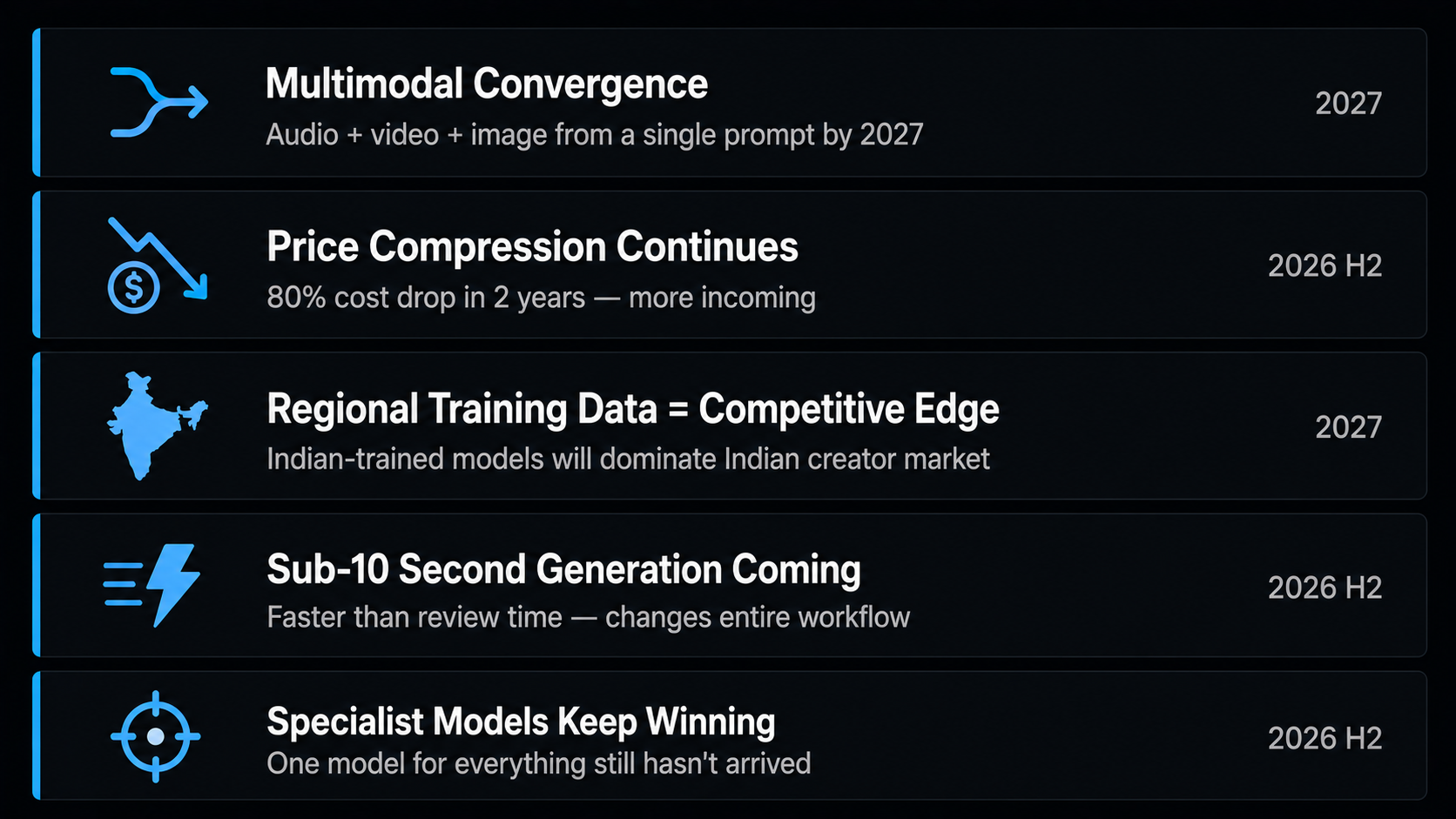
Multimodal convergence is accelerating. The clean separation between image models, video models, and audio models is collapsing at the architecture level. Seedance 2.0’s unified audio-video generation is an early example. Within the next model generation, we expect synchronized audio-visual generation from a single text prompt to be standard rather than notable across multiple providers. The implication for platforms like ours: “video model” and “audio model” may not be meaningful distinct categories by 2027.
Price compression is not slowing down. HiDream I1 Fast at 1 credit per image was unthinkable 18 months ago. The credit cost of production-quality content generation has dropped by roughly 80% in two years. We expect this compression to continue, which means the economic argument for using AI tools will continue strengthening even as the quality argument already wins on its own.
Regional language and cultural training data will become a competitive differentiator. Every major lab is converging on similar architectural approaches. The differentiator will increasingly be training data quality and diversity. For Indian creators, this means models trained on more diverse South Asian datasets will produce significantly better results on Indian content — and labs that invest in this will earn a disproportionate share of the Indian creator market.
Real-time generation is coming faster than expected. Generation times on our platform in 2024 averaged 45–90 seconds for most video models. Current fast-tier models on the platform generate at 20–40 seconds. We are seeing early signals that sub-10 second generation for short video clips is achievable by end of 2026. When generation becomes faster than review time, the entire creator workflow changes.
Specialist models will keep mattering. Despite the convergence trend, the specialist models — Dia TTS for multi-speaker dialogue, Happy Horse for character consistency, Wan Effects for viral transformations — continue to outperform general-purpose models on their specific use cases by large margins. The “one model for everything” scenario that AI demos suggest has not materialized in practice, and we do not expect it to in 2026.
What This Means for Creators Right Now
If you are a creator using AI tools in 2026, the practical takeaways from this ai industry analysis 2026 and our ai models trends data are these:
Route by use case, not by habit. The biggest efficiency gain available to most creators is not switching to a “better” model — it is learning which model handles each specific type of generation best and routing prompts accordingly. A creator who uses HiDream for quick thumbnails, Flux 2 for brand portraits, Seedance 2.0 for Indian cultural content, and Veo 3.1 for product demos will produce better output at lower cost than a creator who uses the same flagship model for everything.
The audio gap matters more than most creators realize. If you are producing video content with AI and your audio is still an afterthought — separately generated, poorly synced, robotic TTS — you are leaving the biggest quality gap in your production on the table. ElevenLabs Turbo v2.5 for voiceover and Lyria 2 for background music solve this for the cost of a few credits per video.
Test fast, generate slow. Always run fast/lite variants of any model before committing to the full-credit standard version. On our platform, Seedance 2.0 Fast at 315 credits and Seedance 2.0 Standard at 400 credits produce similar results on simple prompts. The standard version earns its extra credits on complex multi-element scenes, not on simple one-subject generations. Know when you need the premium.
3D is worth watching but not worth depending on yet. If you are making content that could benefit from 3D assets — gaming, architecture, product design — keep an eye on Trellis 2 and the 3D category generally. But do not build a production workflow around 3D generation in 2026. The quality consistency is not there yet.
We will publish updates to this ai models trends analysis every quarter as the ai model landscape shifts. The 461 ai models we documented here will look different by Q4 2026 — some removed, more added, the patterns updated by new ai model testing 2026 data. That is both the challenge and the interesting part of running a platform at this moment in AI development.
How often does AIClips add new AI models?
How do you decide which models to add or remove?
Which AI video model does AIClips recommend most?
What is the cheapest way to generate content on AIClips?
Explore All 600+ Models on AIClips
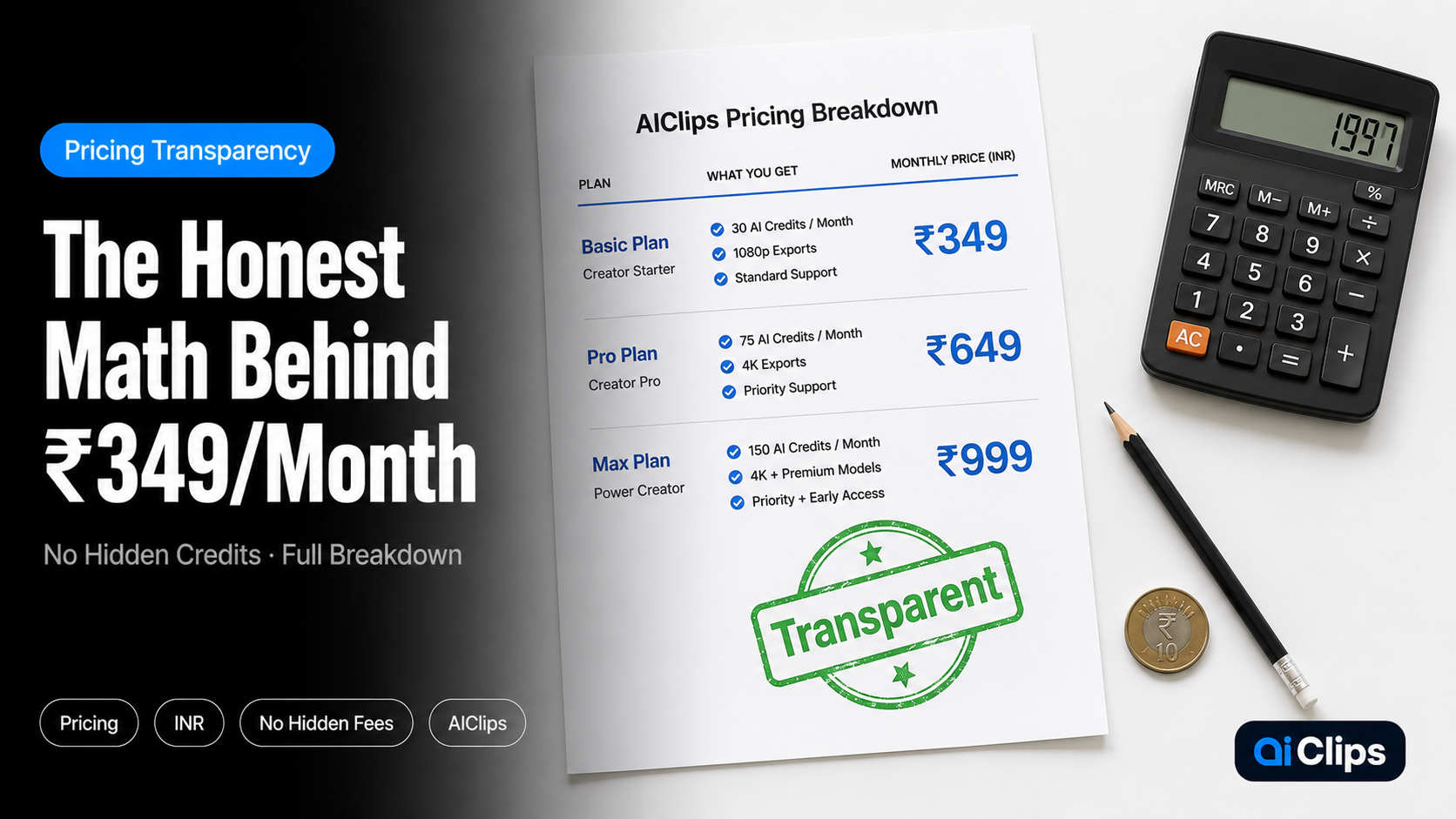
Video, image, audio, 3D — all in one platform. Starts at ₹349/month. Currently 50% OFF on annual plans.
Browse All AI Models →