
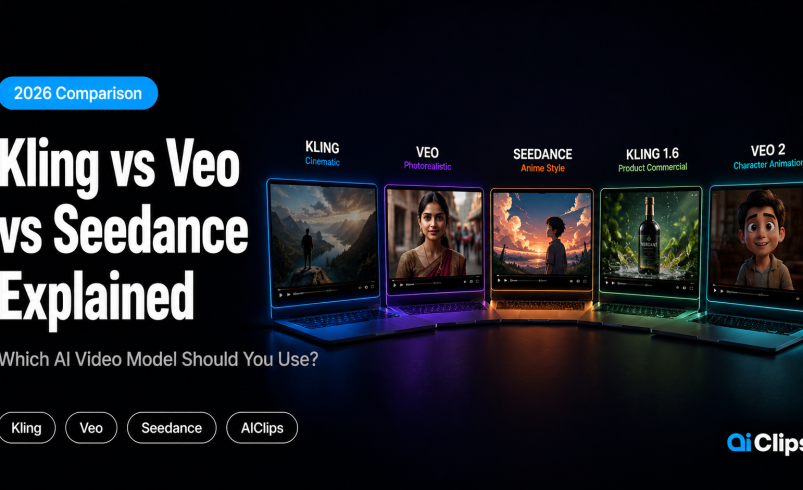

Picking the wrong AI video model is one of the most expensive mistakes a creator can make — not in money, but in wasted time. This kling vs veo and AI video models comparison covers the five models that actually matter in 2026: Kling 3.0, Veo 3.1, Seedance 2.0, PixVerse v6, and Happy Horse. What each one does well, where each one fails, and which to use for what.
All five models in this kling vs veo and AI video models comparison are available on AIClips. You do not need five separate subscriptions to test them. The point of this guide is to save you the trial-and-error of running the same prompt across every model until something works.
| Best motion and physics | Kling 3.0 — the only model with native 4K/60fps, best at complex human movement |
| Best photorealism | Veo 3.1 — tops Google’s MovieGenBench for text-video alignment and visual quality |
| Best cinematic + Indian content | Seedance 2.0 — 12-file multimodal input, best for cultural context and cinematic storytelling |
| Best anime and stylized | PixVerse v6 — purpose-built for stylized and anime output |
| Best character consistency | Happy Horse — Alibaba’s model, strongest for keeping characters the same across shots |
| No single winner | The best creators in 2026 use 2–3 models for different scene types, not one model for everything |
Why Model Choice Matters More Than Most Creators Think
In late 2024, AI video quality varied so dramatically between models that the choice was obvious — use whichever one produced footage that did not look broken.
2026 is different. All five major models can produce footage that looks genuinely good. The differences now are in the specifics: how well a model handles motion blur, whether it generates consistent faces across frames, how naturally it produces audio, whether it can handle Indian cultural context without producing obvious errors.
Running the wrong model on the wrong task wastes credits and time. Kling 3.0 on an anime character scene will produce a photorealistic anime character — which might not be what you wanted. Veo 3.1 on a Bollywood-style dramatic close-up will produce technically perfect footage that has no particular cultural identity.
The gap between the right model and the wrong model for a specific task is roughly the difference between one take and twelve takes. This guide exists so you spend credits on the right model from the start.
Full Specs — AI Video Models Comparison Table
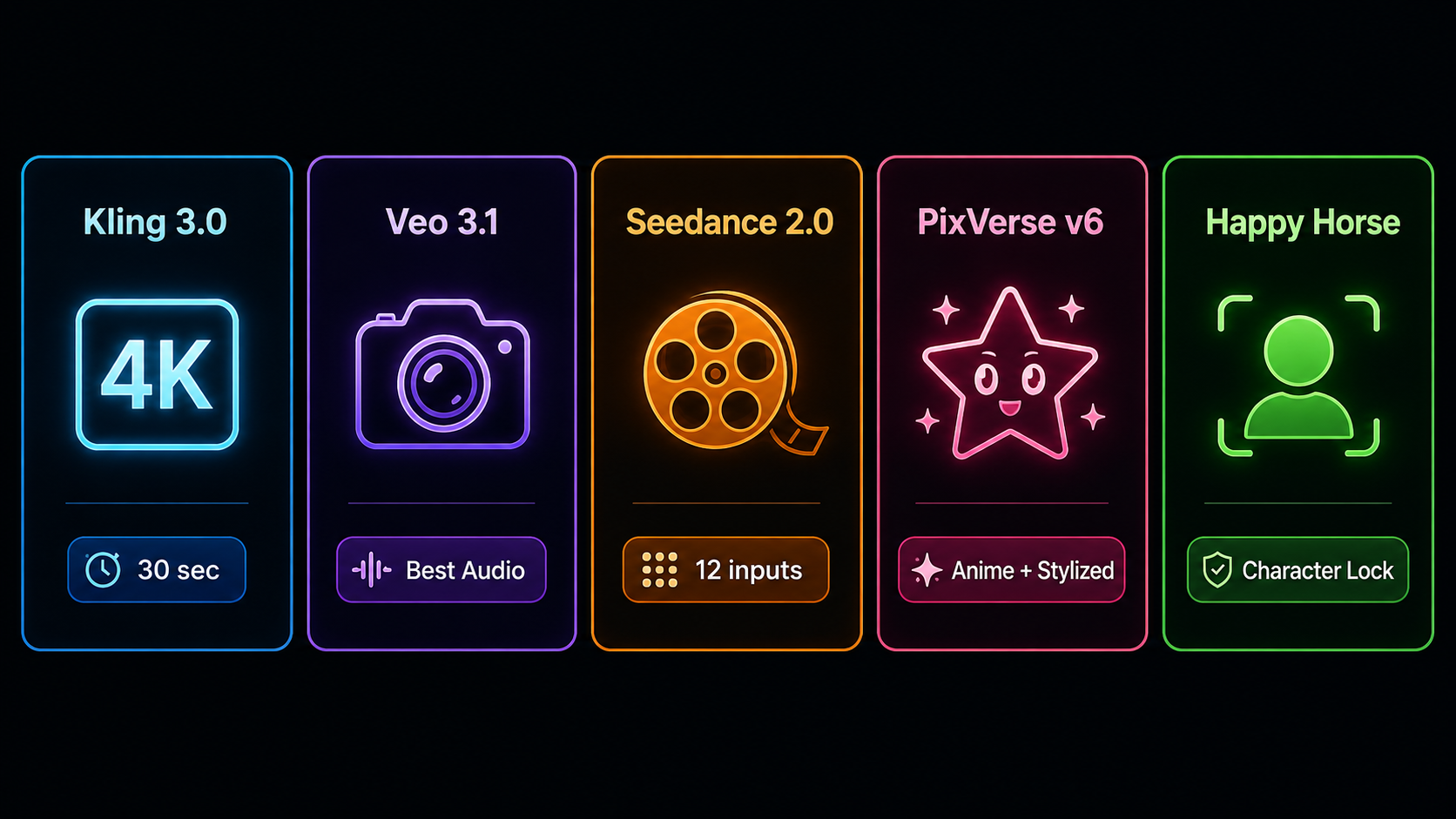
| Model | Max Resolution | Max Duration | Native Audio | Best For | On AIClips |
|---|---|---|---|---|---|
| Kling 3.0 | 4K / 60fps | 30 seconds | ✓ Yes | Motion, physics, high-resolution output | ✓ Available |
| Veo 3.1 | 4K | 8 seconds | ✓ Yes | Photorealism, audio-visual alignment | ✓ Available |
| Seedance 2.0 | 1080p | 15 seconds | ✓ Yes | Cinematic storytelling, Indian context, multimodal | ✓ Available |
| PixVerse v6 | 1080p | 8 seconds | ✓ Yes | Anime, stylized, viral effects | ✓ Available |
| Happy Horse | 1080p | 10 seconds | ✓ Yes | Character consistency across shots | ✓ Available |
Kling 3.0
Best for motion and physicsKling 3.0 launched February 4, 2026 — four days before Seedance 2.0 — and it came with one claim no other model could match: native 4K output at 60 frames per second. That is still true in May 2026. If you need the highest resolution AI video available, Kling 3.0 is the only option.
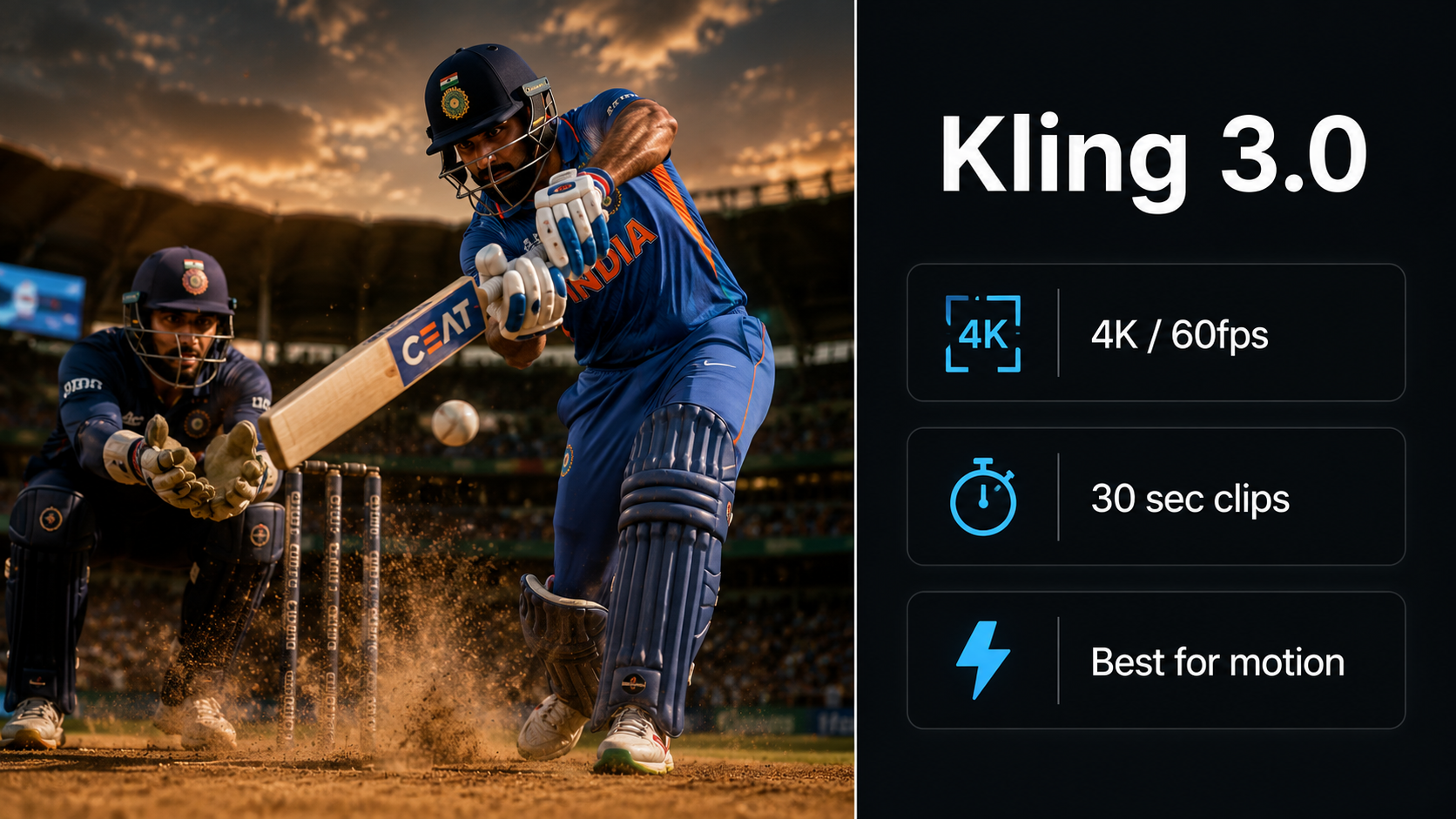
Beyond resolution, Kling 3.0 is the strongest model for complex physical interactions. Multiple people in a scene, objects colliding, fast movement, sports footage — Kling handles these more reliably than any other model in this comparison. The motion smoothing is genuinely impressive, particularly on human subjects walking, running, or gesturing naturally.
The 30-second clip length is also significant. When kling vs veo comes up in this context, Veo’s 8-second limit means you need four times as many generation runs to cover the same content. For long-form videos that require sustained character consistency across many cuts, Kling’s 30-second capability keeps the stitch count low.
Where it falls short: Indian cultural context. Kling 3.0 produces technically accurate depictions of Indian settings, but lacks the natural understanding of Indian aesthetics that Seedance 2.0 has. “A woman in a salwar by a train window” on Kling 3.0 produces a correct-looking image. On Seedance 2.0 it produces something that looks like it was directed by someone who has actually seen Indian cinema.
- Max resolution: 4K / 60fps — only model at this spec
- Max clip length: 30 seconds per generation
- Native audio: Yes
- Credits on AIClips: Varies by variant (v3, v2.5, v1.6 all available)
Use Kling 3.0 for: Action sequences, sports content, high-resolution brand videos, multi-person scenes, any content where resolution matters more than cultural specificity.
Veo 3.1
Best for photorealismGoogle DeepMind’s Veo 3.1 tops the MovieGenBench for text-to-video overall preference, visual quality, and audio-video alignment across 527 test prompts. In independent testing, the audio quality is genuinely the most surprising thing about it — the spatial audio, ambient sound, and audio-visual sync are the best of any model available right now.
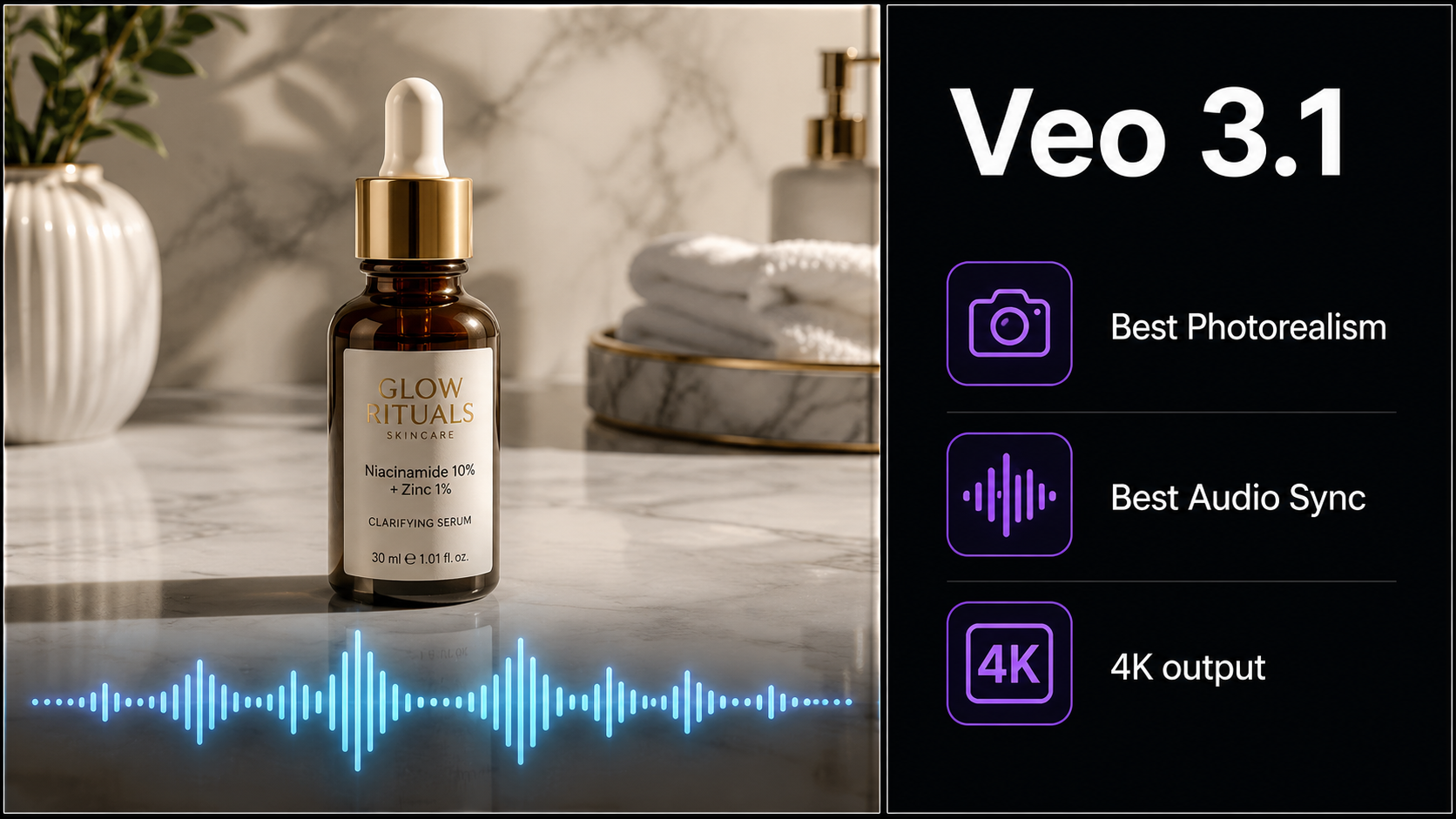
Where Veo 3.1 stands out in the kling vs veo debate is documentary-style photorealism. If you are producing content that needs to look like real footage — news-style video, documentary narration, product demonstrations in realistic environments — Veo 3.1 produces the most credible-looking output. The skin texture on faces, the way light behaves on surfaces, the movement of fabric — all handled more naturally than in other models.
The 8-second limit is the real constraint. This is the biggest reason Veo 3.1 does not dominate every category. For a 60-second Reel, you are looking at generating 7–8 separate clips and editing them together. That means seven opportunities for consistency drift — the same person looking slightly different in each clip. Veo 3.1 handles this reasonably well if your prompts are consistent, but it is more work than Kling’s 30-second clips or Seedance 2.0’s 15-second clips.
- Max resolution: 4K
- Max clip length: 8 seconds
- Native audio: Yes — best audio quality of any model
- Credits on AIClips: Veo 3.1 and Veo 3.1 Lite both available
Use Veo 3.1 for: Photorealistic product demos, documentary-style narration, brand content where visual quality is the top priority, any scene where audio-visual sync matters.
Seedance 2.0
Best for cinematic content and Indian creatorsSeedance 2.0 is the model I reach for most often when making content for Indian audiences. The cultural understanding is real — not just a recognition of visual elements, but an understanding of composition, tone, and mood that makes Indian settings look authentic rather than approximated.
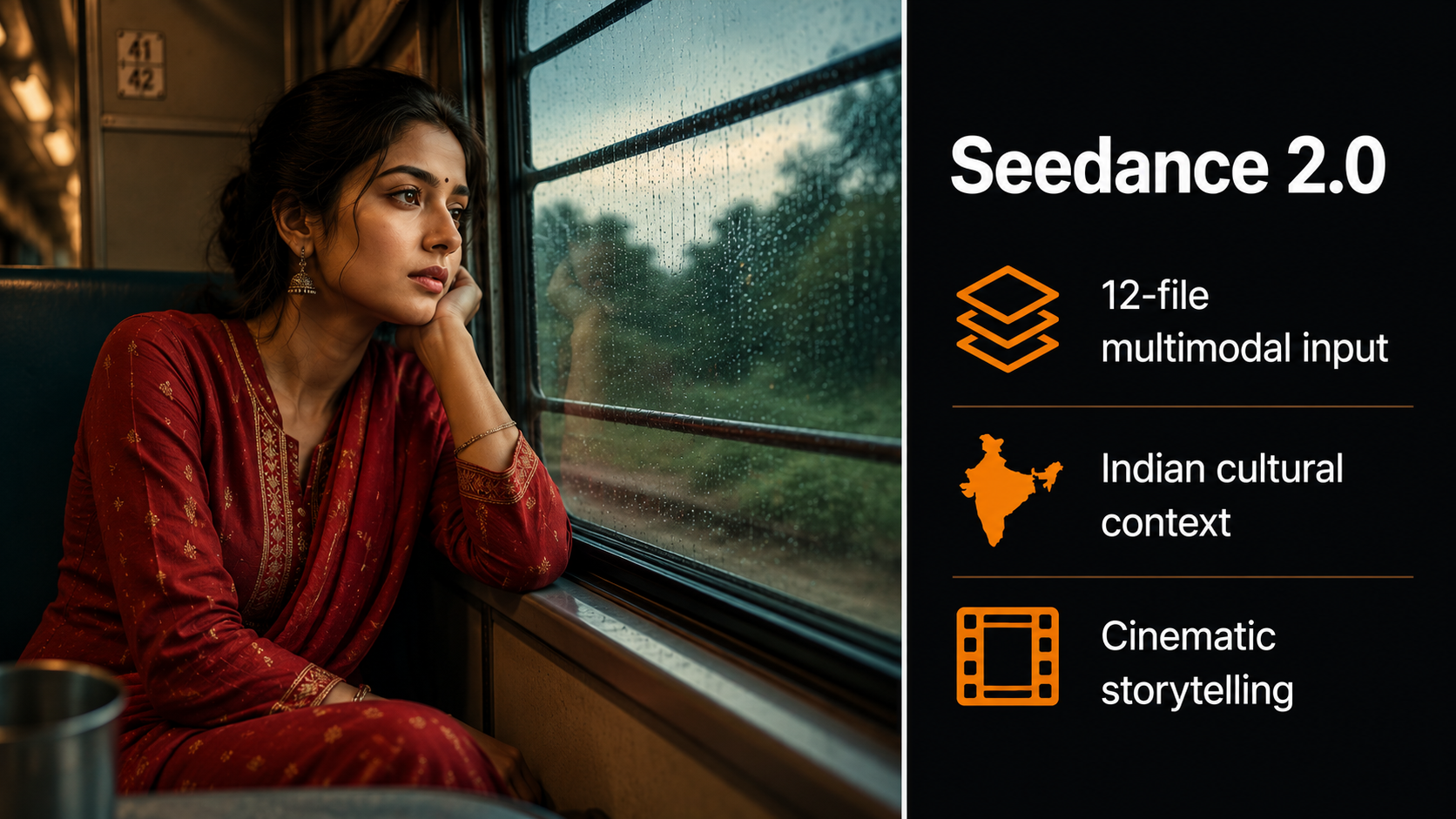
The technical edge is the 12-file multimodal input. You can upload 9 reference images, 3 video clips, and 3 audio files in a single generation. No other model in this ai video models comparison comes close to that input flexibility. For brand work where visual consistency matters — your product, your character, your specific setting — Seedance 2.0 lets you pin multiple visual anchors simultaneously.
In seedance vs kling tests on the same Indian-cultural prompts, Seedance consistently produces output that looks more directed. Kling produces technically accurate footage. Seedance produces footage that looks like someone made a creative decision about how the scene should feel, not just what it should contain.
The limitation: 1080p maximum resolution. If you need 4K output, Seedance 2.0 is not the answer. And the generation time is slower than Kling 3.0 — roughly 60–120 seconds versus Kling’s faster standard processing. For a creator running dozens of concept tests, that adds up.
- Max resolution: 1080p
- Max clip length: 15 seconds
- Native audio: Yes — unified audio-video architecture
- Credits on AIClips: 400 (Standard), 315 (Fast)
- Multimodal inputs: Up to 9 images + 3 video + 3 audio simultaneously
Use Seedance 2.0 for: Indian-context content, cinematic storytelling, brand videos with specific visual references, Reels where the emotional tone of the scene matters more than raw resolution. Full tutorial in the Seedance 2.0 step-by-step guide.
PixVerse v6
Best for anime and stylized outputPixVerse v6 does one thing better than any other model in this comparison: it produces anime and heavily stylized footage that actually looks good. Run an anime-style prompt through Kling 3.0 or Veo 3.1 and you get realistic footage with anime-adjacent lighting. Run the same prompt through PixVerse v6 and you get footage that looks like it came from an actual anime production.
Beyond anime, PixVerse is the model for viral effect content — face morphing, style transfer, surreal visual effects that do not have a real-world counterpart to be realistic about. If your content strategy involves social media effects and stylized aesthetics rather than cinematic realism, PixVerse is worth testing before the others.
Where it falls short: Real-world scenes. PixVerse produces uncanny output when you ask it for photorealistic footage of real people in real environments. It is built for stylization, not realism. Use it in the right context and the output is excellent. Use it in the wrong context and the output looks like a video game cutscene.
- Max resolution: 1080p
- Max clip length: 8 seconds
- Native audio: Yes
- Available on AIClips: PixVerse v6, v6 I2V, v6 Extend, C1
Use PixVerse v6 for: Anime content, illustrated-style Reels, stylized brand aesthetics, viral effect videos, gaming content.
Happy Horse
Best for character consistencyHappy Horse is Alibaba’s AI video model and the least well-known of the five on this list. The reason to know about it is specific: if you are building content around a recurring character — a mascot, a presenter, a fictional host — Happy Horse holds that character’s appearance more consistently across shots than any other model available right now.
Most AI video models drift. Run the same character prompt five times and you get five slightly different-looking people. Happy Horse’s Reference-to-Video mode accepts a character reference image and generates video where that specific face, that specific outfit, that specific visual identity stays locked across the full clip and across multiple generations.
It is not the most versatile model and does not produce the most cinematic output. But for the specific problem of character consistency in long-form or series content, it solves something the other models do not.
- Max resolution: 1080p
- Max clip length: 10 seconds
- Native audio: Yes
- Available on AIClips: Happy Horse T2V, I2V, Reference-to-Video, Video Edit
Use Happy Horse for: Recurring characters across multiple videos, mascot content, fictional series, any content where visual consistency of a specific character matters.
Decision Matrix — Which AI Video Model to Use When
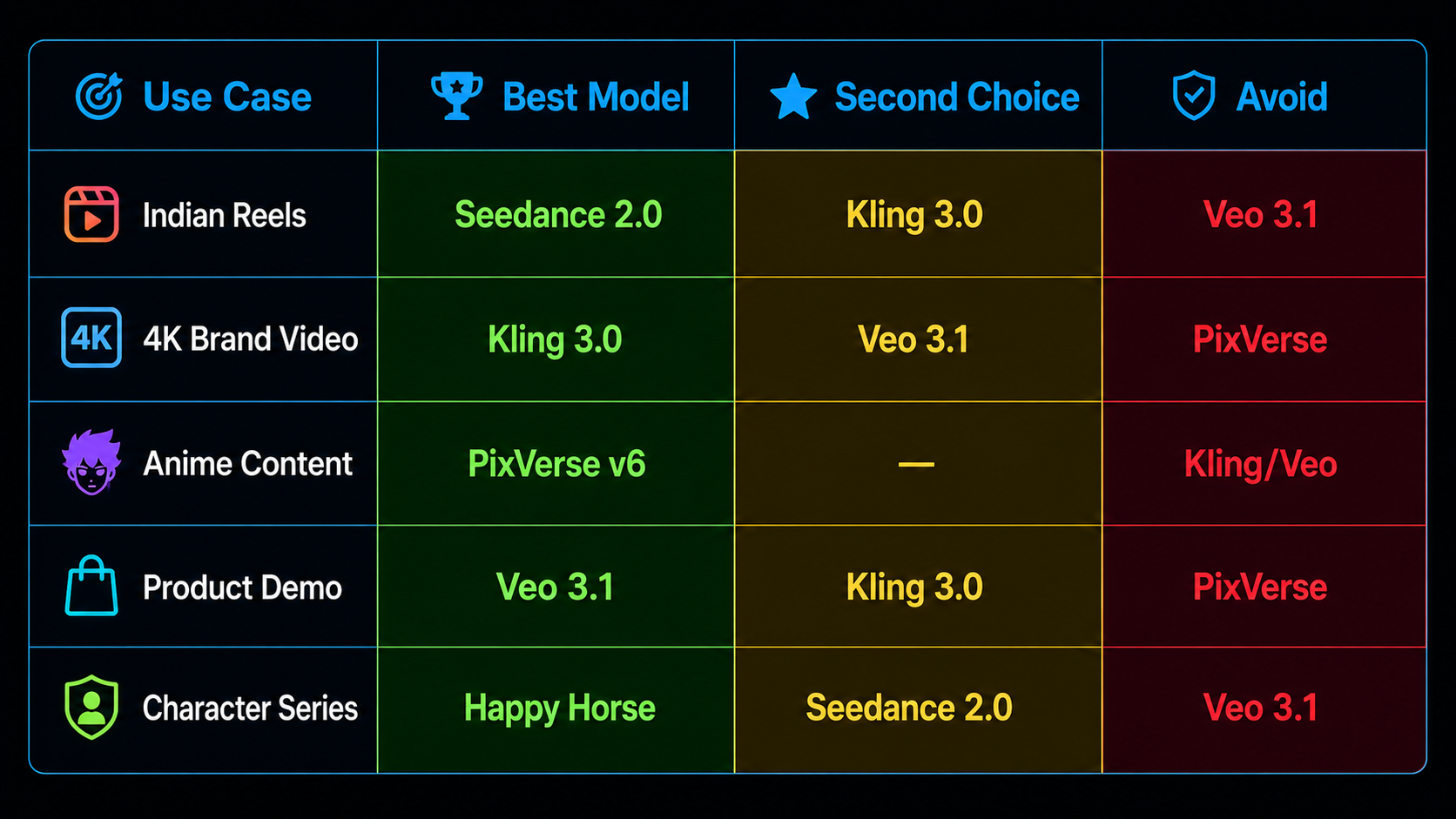
| What You Are Making | Best Model | Second Choice | Avoid |
|---|---|---|---|
| Indian cultural content, Reels | Seedance 2.0 | Kling 3.0 | Veo 3.1 (no cultural context) |
| High-resolution brand video | Kling 3.0 (4K) | Veo 3.1 (4K) | PixVerse (stylized, not realistic) |
| Sports or action sequences | Kling 3.0 | Seedance 2.0 | Veo 3.1 (8-sec limit frustrating) |
| Product demo — photorealistic | Veo 3.1 | Kling 3.0 | PixVerse |
| Anime or stylized content | PixVerse v6 | — | Kling, Veo, Seedance (wrong aesthetic) |
| Recurring character series | Happy Horse | Seedance 2.0 | Veo 3.1 (drifts across short clips) |
| Documentary-style narration | Veo 3.1 | Kling 3.0 | PixVerse |
| Budget concept testing | Kling Fast or Seedance Fast | Wan 2.2 (open-source) | Veo 3.1 (too expensive for testing) |
Kling vs Veo — The Direct Comparison
This is the matchup most creators are actually searching for, so here is the direct answer.
Choose Kling 3.0 when: you need 4K output, you are filming multi-person or action scenes, you need clips longer than 8 seconds, or you want the best cost-per-clip value at production scale.
Choose Veo 3.1 when: audio-visual quality is the top priority, you are producing documentary or realistic footage where photographic accuracy matters more than cinematic aesthetics, or you need the best text-to-video prompt adherence.
In the kling vs veo debate, there is no universal winner. Kling 3.0 wins on resolution, clip length, and cost. Veo 3.1 wins on photorealism and audio quality. Most production workflows use both — Veo 3.1 for close-up product and face shots, Kling 3.0 for wide shots and action.
What About Seedance vs Kling?
The seedance vs kling question is more nuanced than kling vs veo because these models are not really competing for the same jobs.
Kling 3.0 is a resolution and motion model. Seedance 2.0 is a cinematic and input-flexibility model. They are better thought of as complementary than competing.
Where they do overlap — Indian-context footage, emotional character scenes, 1080p social content — Seedance 2.0 consistently produces output that looks more intentionally directed. Kling produces technically superior footage in terms of sharpness and motion smoothness. Whether “technically superior” or “intentionally directed” matters more depends entirely on the specific content you are making.
Frequently Asked Questions — AI Video Models Comparison
Which is the best AI video model in 2026?
Kling vs Veo — which should I use?
How is Seedance 2.0 different from Kling 3.0?
Can I use all these models on AIClips without separate subscriptions?
Which AI video model is cheapest on AIClips?
Is Happy Horse worth using if I am not making character-based content?
Test All 5 Models on AIClips
Kling 3.0, Veo 3.1, Seedance 2.0, PixVerse v6, and Happy Horse — all available from ₹349/month. No separate subscriptions.
Open AIClips Video Generator →