


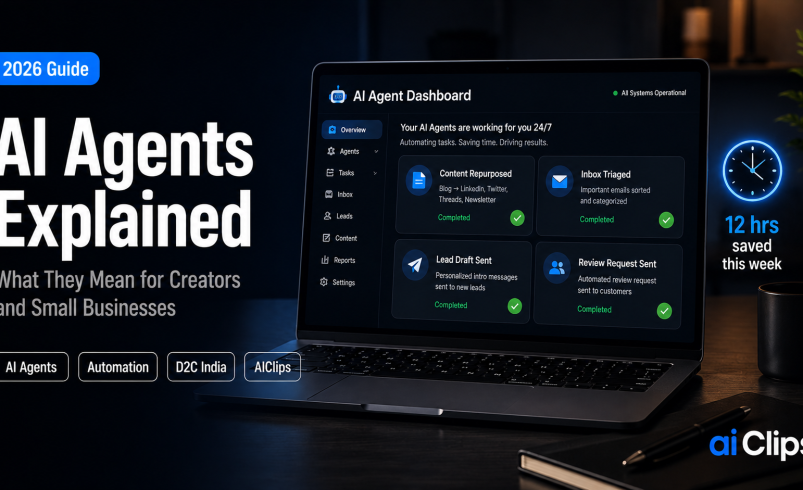

You have heard “AI agents” everywhere this year, usually wrapped in enough hype to make it sound like science fiction. It is not. AI agents are simply software that watches for something to happen, decides what to do, and does it — without you stepping in each time. This guide cuts through the noise: what they actually are, seven practical uses for creators and small businesses, what they still cannot do, and how to start.
No engineering degree required. By the end you will know exactly where an agent could save you hours every week, and where it would just create more work.
| What it is | Software you give a goal and some rules. It plans the steps, uses your tools, takes the actions, and hands you the result to approve. |
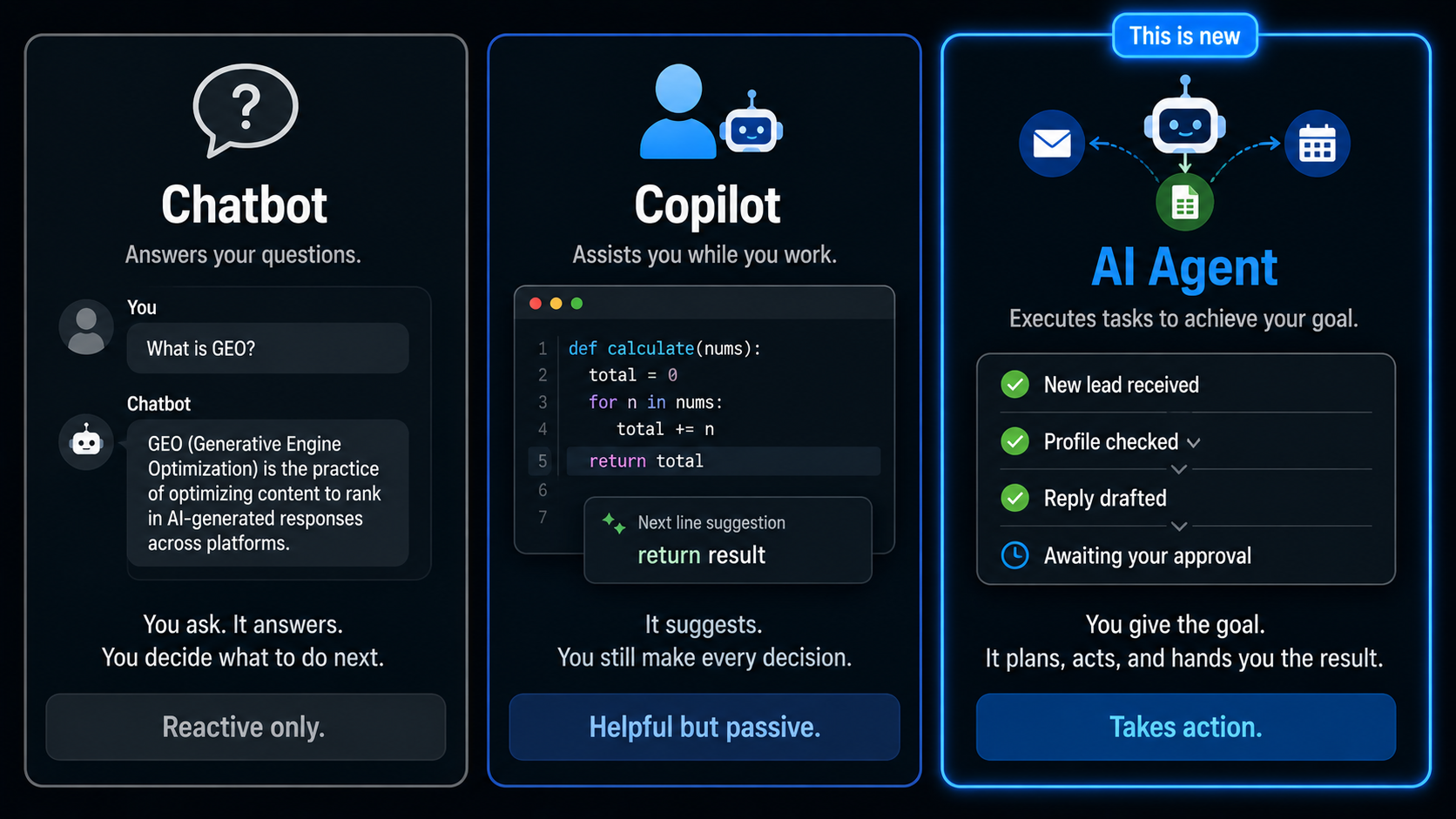
| Not a chatbot | A chatbot answers a question. A copilot helps while you decide. An agent goes further and actually does the task. |
| Why now | No-code builders, AI model costs down 90%+ since 2024, and mature integrations made agents practical for small teams. |
| The payoff | A few well-scoped agents commonly free 10–15 hours a week within a month. |
| The rule | Start with one task, keep a human checkpoint, prove it works, then expand. |
What Is an AI Agent?
An AI agent is software that takes action on your behalf, not just text on a screen. You give it a goal and some rules, and it figures out the steps, runs them across your connected tools, and produces a result ready for you to review or send.
The easiest way to understand AI agents is by comparison. When you ask ChatGPT a question and it answers, that is a chatbot — you ask, it replies, done. When a coding assistant suggests the next line while you type, that is a copilot — it helps, but you make every decision. An agent goes one step further: you say “when a new lead fills the contact form, check if they fit our customer profile and draft a reply,” and it does the whole thing, then waits for your approval.
Why 2026 Is the Year This Got Real
AI agents are not new as an idea. What changed is access. Three things converged at once. No-code platforms now let non-technical people build agents by dragging and dropping. AI model costs have dropped more than 90% since early 2024, so running an agent costs pennies. And integrations matured, so agents can plug into the tools you already use — your inbox, your spreadsheets, Instagram, your store.
The numbers show the shift. Gartner projects 40% of small and mid-size businesses will run at least one AI agent by the end of 2026, up from roughly 8% at the start of 2025. The average small business already uses around five AI tools. This is not a future trend you can wait on. It is happening now.
7 Practical Uses for Creators and Small Businesses
Forget the enterprise jargon. Here is where AI agents actually earn their keep for a creator or a small team, and roughly what each saves.
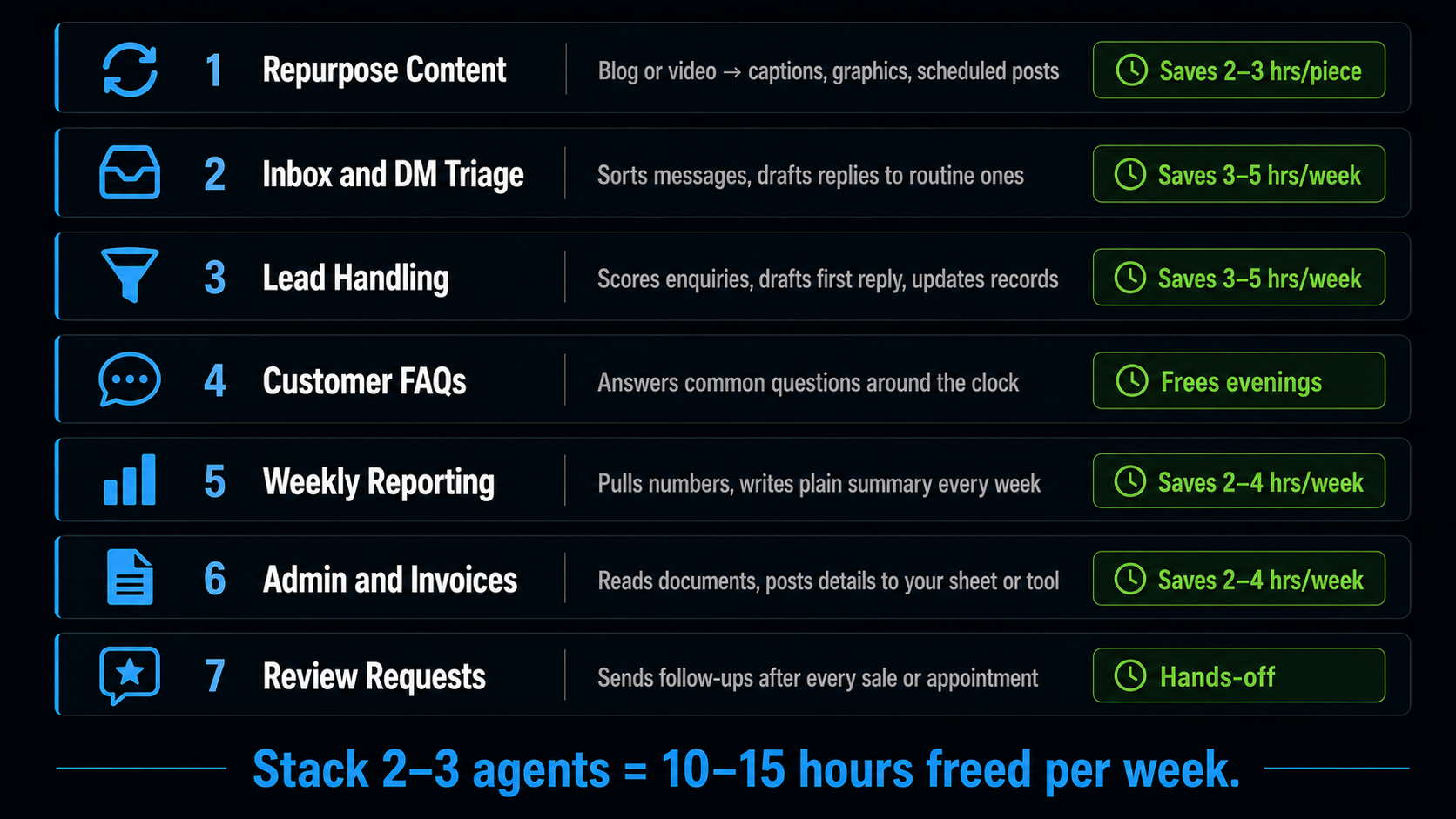
| Use case | What the agent does | Time saved |
|---|---|---|
| Repurpose content | Turns one blog or video into platform-specific captions, graphics, and scheduled posts | 2–3 hrs / piece |
| Inbox & DM triage | Sorts messages by type and urgency, drafts replies to routine ones | 3–5 hrs / week |
| Lead handling | Scores enquiries against your criteria, drafts a first reply, updates your records | 3–5 hrs / week |
| Customer FAQs | Answers common questions and booking requests around the clock | Frees evenings |
| Weekly reporting | Pulls your numbers and writes a plain summary every week | 2–4 hrs / week |
| Admin & invoices | Reads documents and posts the details into your sheet or tool | 2–4 hrs / week |
| Review requests | Sends follow-ups and review prompts after a sale or appointment | Hands-off |
The content-repurposing one is the obvious starting point for creators. You publish once, and the agent spins out the captions, the graphics, and the schedule across every platform while you do something else.
Picture a small D2C founder running her store solo. Every weekend used to disappear into the same chores — sorting a weekend’s worth of customer emails, chasing reviews, and turning one product video into posts for four platforms. She set up two agents. One reads every incoming email, sorts it by urgency, and drafts replies to the routine ones for her to approve. The other takes each new product video, generates captions and a thumbnail, and queues the posts. She got her weekends back, and she is not a technical person. That is the realistic shape of what AI agents do for a small operation in 2026.
What AI Agents Can’t Do (Yet)
This is where honesty matters, because the biggest failures come from expecting too much. AI agents are excellent at high-volume, repeatable tasks with clear rules. They are not good at genuine judgment — one-off strategic calls, novel situations with no prior pattern, or anything where being wrong is expensive.
How to Start (Without a Tech Team)
You do not build an army of agents on day one. You build one, prove it, then expand.
- Pick one high-friction task. The thing you dread doing every week is your first agent. Content repurposing or inbox triage are easy wins.
- Use a no-code builder. Tools like Zapier, Make, or n8n connect your apps and a model like ChatGPT or Claude without code.
- Keep a human checkpoint. Have the agent draft and you approve, at least until you trust it.
- Prove the ROI, then scale. Once one agent reliably saves you hours, build the next. Most owners stack two or three before they stop.
Where AIClips Fits
To be straight with you: AIClips is not an agent platform, and we will not pretend it is. AIClips is the creation engine. When your repurposing agent needs a thumbnail, a voiceover, a video clip, or a product shot, those are exactly the assets AIClips generates — across 461 models, billed in rupees at ₹349/month. The no-code agent handles the glue and the scheduling; AIClips handles the heavy creative lifting in the middle. Together, that is a content operation one person can run.
One more connection worth making: as buyers increasingly ask AI tools for recommendations, showing up in those answers matters. We covered that shift in our guide to why we built AIClips around a single, model-rich platform.
Frequently Asked Questions
What is the difference between an AI agent and a chatbot?
Do I need to know how to code to use AI agents?
What should my first AI agent do?
Can AI agents replace my whole team?
How much do AI agents cost to run?
Power Your Agents with AIClips Content
Thumbnails, voiceovers, video, and images across 461 models for your automated workflows. INR pricing, UPI, from ₹349/month.
Start on AIClips →