
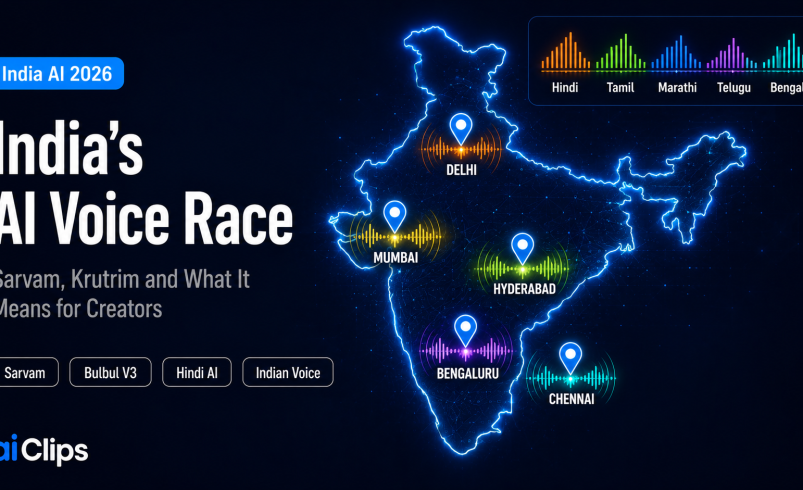

There is one corner of artificial intelligence where India is not catching up to the West but quietly ahead of it: voice. The reason is simple. Indians do not speak in clean, single-language sentences — they slide between Hindi and English mid-thought, and no Silicon Valley model was built for that. In 2026, Indian voice AI from companies like Sarvam is solving it at the model level, and for creators making content in Hindi, Tamil, or Marathi, that changes what is possible.
This is a look at who is building India’s voice stack, where it genuinely leads, where it still trails, and what all of it means for the people actually making content.
| The leader | Sarvam’s Bulbul V3, launched February 2026, with 35+ voices across 11 Indian languages, trained from scratch on Indian speech. |
| The edge | Native code-switching — Hinglish, Tanglish, Benglish handled in a single pass, which global tools struggle with. |
| The proof | In an independent blind study by Josh Talks, 500+ annotators cast 20,000+ votes; Bulbul V3 was the most-preferred for naturalness. |
| The others | Krutrim (cloud and chips), Bhashini (government language infrastructure), and a growing field of startups. |
| For creators | Better Hindi and regional voiceovers, available now, accessible through platforms like AIClips at ₹349/month. |

Why Voice Is India’s Strongest AI Bet
India is a voice-first country. People who skip typing entirely will happily speak to their phone, and over 500 million viewers consume Indian-language content every single day. Gig workers get onboarded through voice agents with no forms to fill. Students ask AI tutors to explain things in their mother tongue. Voice is not a feature here, it is the interface.
The hard part is that Indian speech breaks every assumption a Western model makes. A single sentence might be “Aapka order dispatch ho gaya hai, expected delivery by tomorrow evening.” Hindi and English, woven together, the way people actually talk. Most global text-to-speech tools treat Indian languages as an add-on bolted onto an English model, and it shows the moment a real sentence gets messy. This gap is exactly what Indian voice AI was built to close.
Sarvam’s Bulbul V3: The Model to Watch
If there is a flagship for Indian voice AI right now, it is Sarvam’s Bulbul V3, released in February 2026. What makes it different is that it was trained from scratch on Indian speech rather than fine-tuned from an English base. Hindi sounds like Hindi. Tamil carries its own syllable-timed rhythm. Names and places come out right.
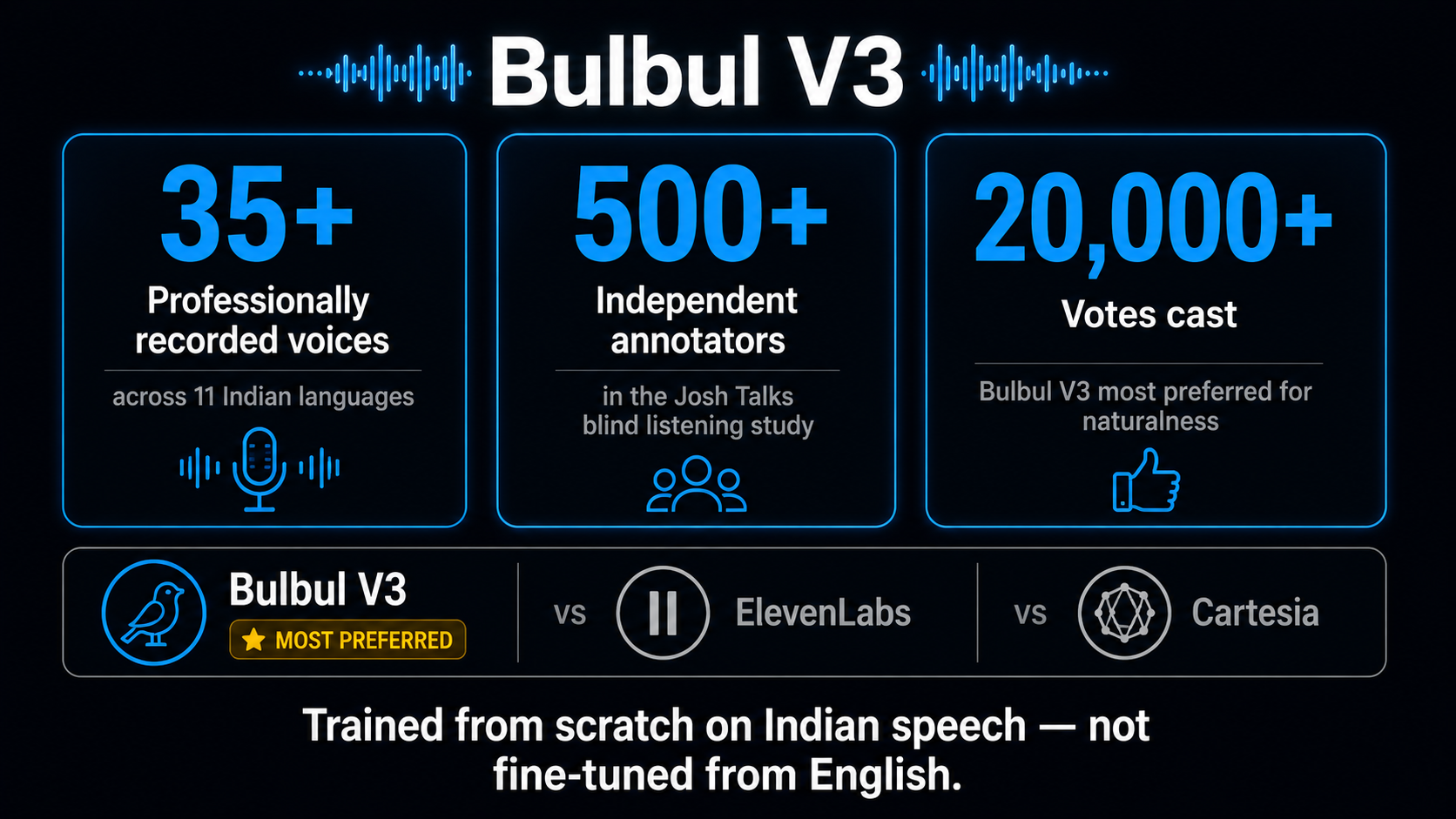
The numbers back the ambition. Bulbul V3 ships with 35+ professionally recorded voices across 11 languages, with plans to reach all 22 scheduled languages. It handles code-switching in a single pass, so a Hinglish line generates with no awkward pause or accent shift at the language boundary. In an independent blind listening study run by Josh Talks, with more than 500 annotators and 20,000 votes across 11 languages, it came out as the most-preferred model for naturalness, ahead of global names like ElevenLabs and Cartesia.
Who Else Is in the Race
Sarvam AI Bengaluru · Voice leader
Government-selected to build a sovereign Indian LLM, Sarvam has become the clearest leader in Indian voice AI through its Bulbul speech models and Saaras speech-to-text. Its tech is increasingly the foundation layer that other Indian voice products build on.
Krutrim India · Infrastructure
Founded by Bhavish Aggarwal, Krutrim has pivoted from chasing frontier language models toward cloud infrastructure and an indigenous AI chip, Bodhi 1. It is less a voice specialist now and more the compute backbone that makes running Indian AI cheaper at scale.
Bhashini Government · Public infrastructure
The government’s language AI platform offers speech recognition, translation, and text-to-speech across 36+ languages as open APIs. It is the public-infrastructure layer beneath much of the ecosystem, deployed at genuine population scale.
Where Indian Voice AI Is Genuinely Ahead
This is not cheerleading. There are specific areas where Indian voice AI leads the world, and they are the areas that matter most for Indian content.
- Code-switching. Handling Hinglish and Tanglish in one pass, at the model level, is something global tools simply do not do well.
- Telephony-grade audio. Bulbul V3 was rated the most-preferred model for 8 kHz telephony, the quality band that actually powers Indian call centres and IVR.
- Indian names and numbers. Pronouncing “Dr. Sharma,” “saadhe saat baje,” and a string of Indian place names correctly is a solved problem here and a recurring failure in Western models.
- Per-language prosody. North Indian rising-falling intonation and Dravidian syllable timing are modelled separately, not flattened into one generic accent.
Where It’s Still Catching Up
An honest picture needs the other side too. On raw full-band audio quality, some global competitors still edge ahead of Indian voice AI in certain tests, even where Indian models win on telephony and robustness. Coverage of the long tail of Indian languages beyond the major 11 is still thin, because the data and the commercial incentive both shrink fast as you go down the list. And on the consumer side, global names remain the default for many users despite the home-grown advantages.
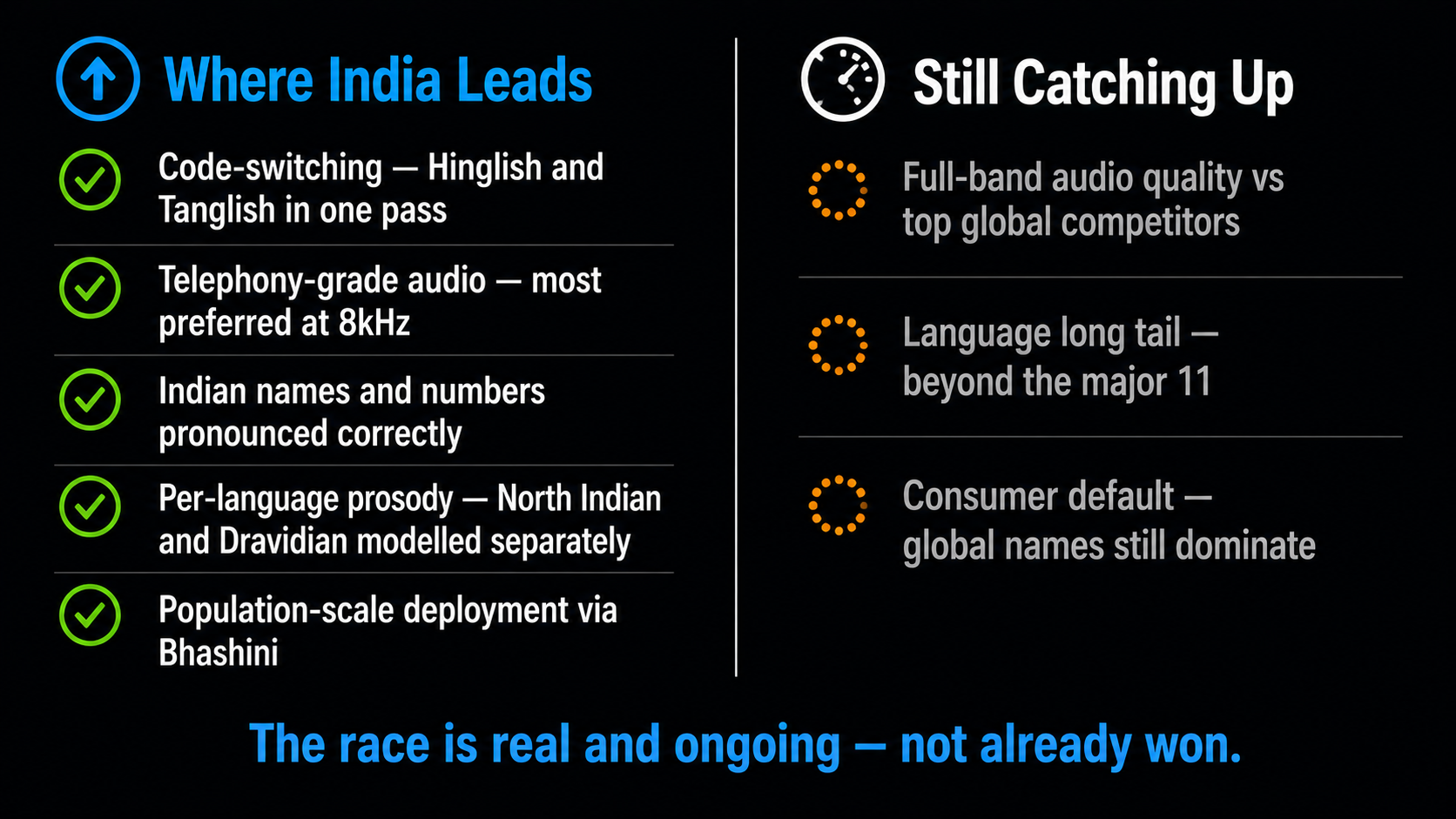
None of this undoes the progress. It just means the race is real and ongoing rather than already won.
What This Means for Indian Creators
You do not need to track any of these companies to benefit from them. The practical upshot is that the Hindi, Tamil, and Marathi voices available to you are getting dramatically better, fast, and the gap between a native speaker and an AI voice is closing in a way it never has before.
This is the layer where AIClips sits. As Indian voice AI infrastructure improves, those gains flow straight through to the voiceover tools creators actually use. You get natural regional voices for your videos, billed in rupees at ₹349/month, without needing an enterprise contract or a developer to wire up an API. For the wider story of why this whole ecosystem is being built in India, see our piece on why Indian creators are building their own AI tools.
Frequently Asked Questions
What is the best Indian voice AI in 2026?
How is Indian voice AI better than ElevenLabs for Hindi?
Does Krutrim make voice AI?
How can creators use Indian voice AI today?
How many Indian languages does Bulbul V3 support?
Use India’s Best Voices on AIClips
Natural Hindi, Tamil, Marathi, and regional voiceovers, plus 460 other AI models. INR pricing, UPI, from ₹349/month.
Start on AIClips →