






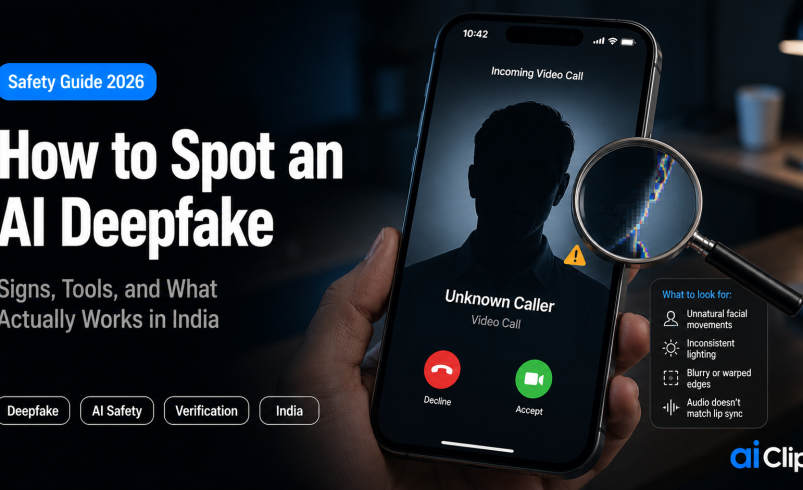

In 2026, a convincing fake video of you can be made from a single WhatsApp profile photo in under a minute. The old advice — “watch for unnatural blinking” — is dead, because modern models blink fine. Here is the uncomfortable truth this guide will not hide from you: on a good fake, your eyes perform at roughly the level of a coin flip. Learning to spot a deepfake in 2026 is less about catching glitches and more about building a habit. This is how to spot a deepfake in practice — and, just as importantly, what to do when your eyes are not enough on their own.
India is being hit especially hard, so this matters whether you are a creator protecting your face and voice or simply someone who does not want a relative scammed. Let us go through the signs that still work, the ones that no longer do, the tools worth using, and the single habit that beats almost every fake.
| The hard truth | On a good fake, human eyes are barely better than a coin flip. Visual signs are a filter, not a verdict. |
| Signs still work | Mismatched lighting, lip-sync drift, blurred face edges, odd skin tone at the jaw, wrong-bending fingers. |
| Tools help, imperfectly | Detectors and C2PA checks add a second opinion, but none are foolproof and a “90% real” score proves nothing. |
| The real defence | Verify through a second, independent channel before acting — especially before sending money. |
| India in 2026 | Around 47% of adults have been affected by, or know a victim of, a deepfake or voice-clone scam. |
Why Spotting Deepfakes Got Harder
Most articles on how to spot a deepfake are stuck in 2019. They tell you to watch for unnatural blinking, robotic movement, and dead eyes. Modern generative models handle all of that now, so that advice quietly fails you at the exact moment you need it. Worse, detection is an arms race that the defenders are losing — new models are trained specifically to defeat the tools built to catch them.
This is why honesty matters here. When researchers test ordinary people against high-quality fakes, performance lands near chance. So the goal is not to become a human lie detector. To spot a deepfake reliably, you stack several weak signals, add a tool, and — most importantly — build a verification habit that does not depend on your eyes at all. Treat every visual sign below as one filter among many, never as proof on its own.
The Signs That Still Work in 2026
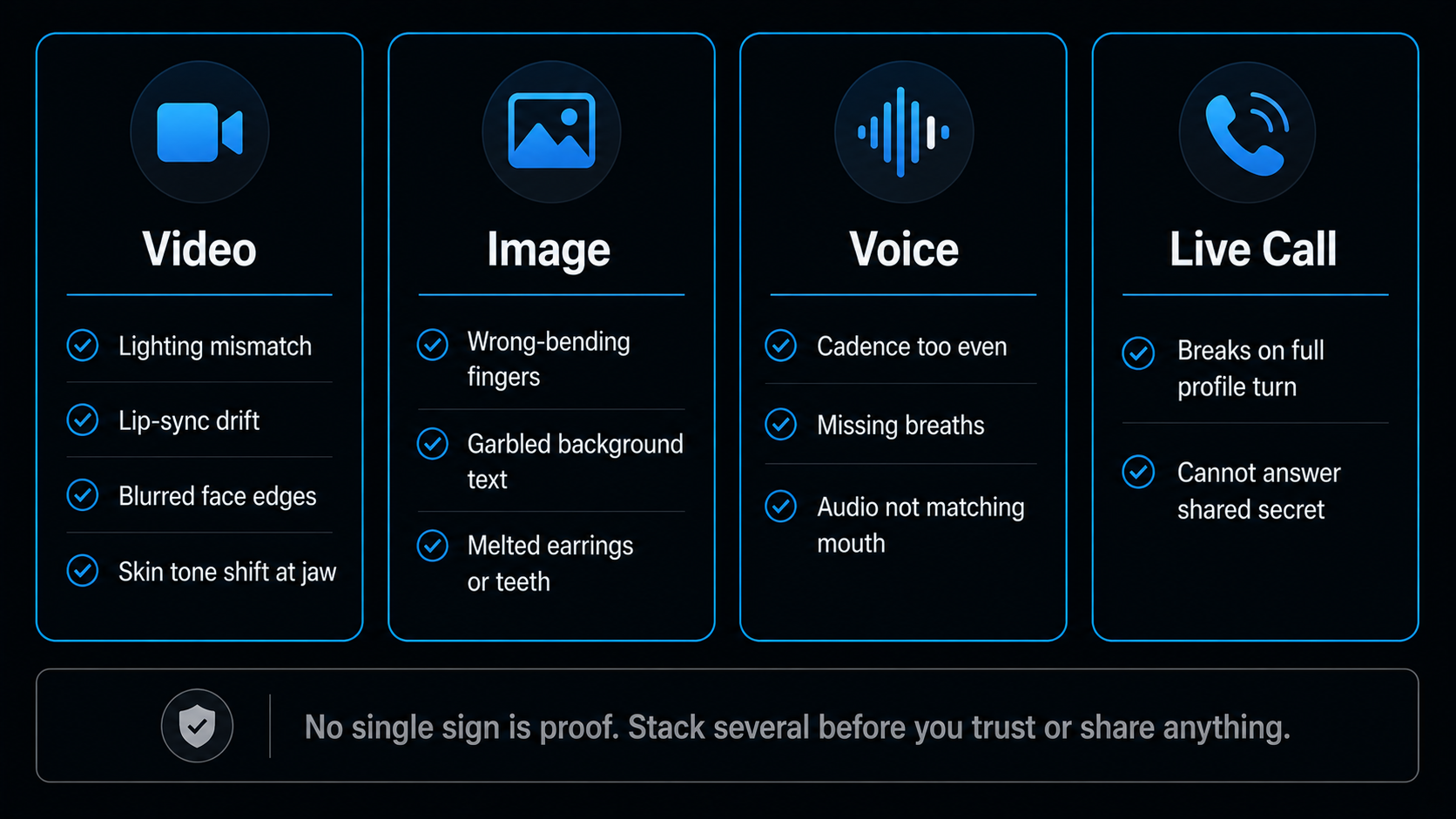
No single sign lets you spot a deepfake on its own. Stack several before you trust or share anything, and group your check by what you are actually looking at.
In video
- Lighting and shadows that do not match between the face and the background.
- Lip-sync drift — the mouth and the audio slipping out of step, especially on hard consonants.
- Blurred or soft face boundaries, hairlines, and edges of jewellery or glasses.
- Skin tone that shifts unnaturally around the jaw and neck, where a swapped face meets a real body.
In images
- Hands and fingers that bend the wrong way or number more than five.
- Garbled text on signs, labels, or clothing in the background.
- Melted or warped details in earrings, teeth, and patterned fabric.
In voice
- Cadence that is slightly too even, with odd pauses or missing breaths.
- Audio that does not match throat and mouth movement when there is video.
On a live call
- Ask the person to turn their head fully to the side. Real-time face-swap tools still break at a full profile — one of the most reliable live checks available.
- Ask a question only the real person could answer.
To keep it handy, here is the same checklist in one place. Run down it before you trust a video, image, or voice message that carries any request or surprise.
| What you are checking | Signs that still work in 2026 |
|---|---|
| Video | Lighting mismatch, lip-sync drift, blurred face edges, skin tone shifting at the jaw and neck |
| Image | Wrong-bending or extra fingers, garbled background text, melted earrings, teeth, or patterns |
| Voice | Cadence slightly too even, missing breaths, audio not matching mouth movement |
| Live call | Breaks when the person turns fully to profile; cannot answer a shared-secret question |
| Source | No provenance, reused profile photo found elsewhere, account created recently |
Detection Tools, and Why They Are Not Enough
Once visual checks have you suspicious, running the file through a detector to spot a deepfake turns a gut feeling into something more concrete, and that is worth doing. Options include dedicated deepfake detectors that give a verdict in seconds, C2PA content-credential validators, security apps with scam-checking features, and a plain reverse-image search on a profile picture to see if it appears elsewhere under another name.
The Shift from Detecting Fakes to Proving What Is Real
Step back and the long game becomes clear. Trying to spot a deepfake after it exists is a losing position, because generation improves faster than detection. So the industry is quietly changing the question — from “can we detect the fake?” to “can we prove the real?” That shift matters for how you think about trust online over the next few years.
The main effort here is content provenance. Standards like C2PA, often branded as Content Credentials, attach a cryptographic signature to a photo or video at the moment it is captured, creating a tamper-evident record of where it came from and how it was edited. Camera makers and software companies have started building this in. In parallel, some AI generators now embed invisible watermarks into what they produce, so their own output can be identified later. Together, provenance and watermarking aim to give you a positive signal of authenticity rather than an endless, unwinnable hunt for flaws.
The catch is real and worth knowing. Many social platforms strip metadata when you upload, which can delete those content credentials in the process, so the proof often does not survive the journey to your feed. That is exactly why, today, you still need the human checklist and the verification habit — the provenance layer is being built, but it is not yet something you can rely on end to end. This is a fast-moving area of policy and standards, and it is worth following as it matures, because it is where the balance of power eventually tilts back toward the honest.
The One Habit That Beats Almost Every Deepfake
If you remember one thing, make it this: verify through a second, independent channel before you act, especially before sending money. A deepfake works by combining a familiar face or voice with real urgency and a time-sensitive request. Break any one of those and the scam collapses.
So when a boss, relative, or colleague appears in a video or voice message with an urgent demand, pause. Call them back on their known number, message them on a different app, or ask something only the real person would know. Legitimate people and institutions will always let you slow down and verify. Urgency itself is the warning sign — treat pressure to act immediately as a reason to stop, not to hurry.
The Four Deepfake Scams You Are Most Likely to Meet
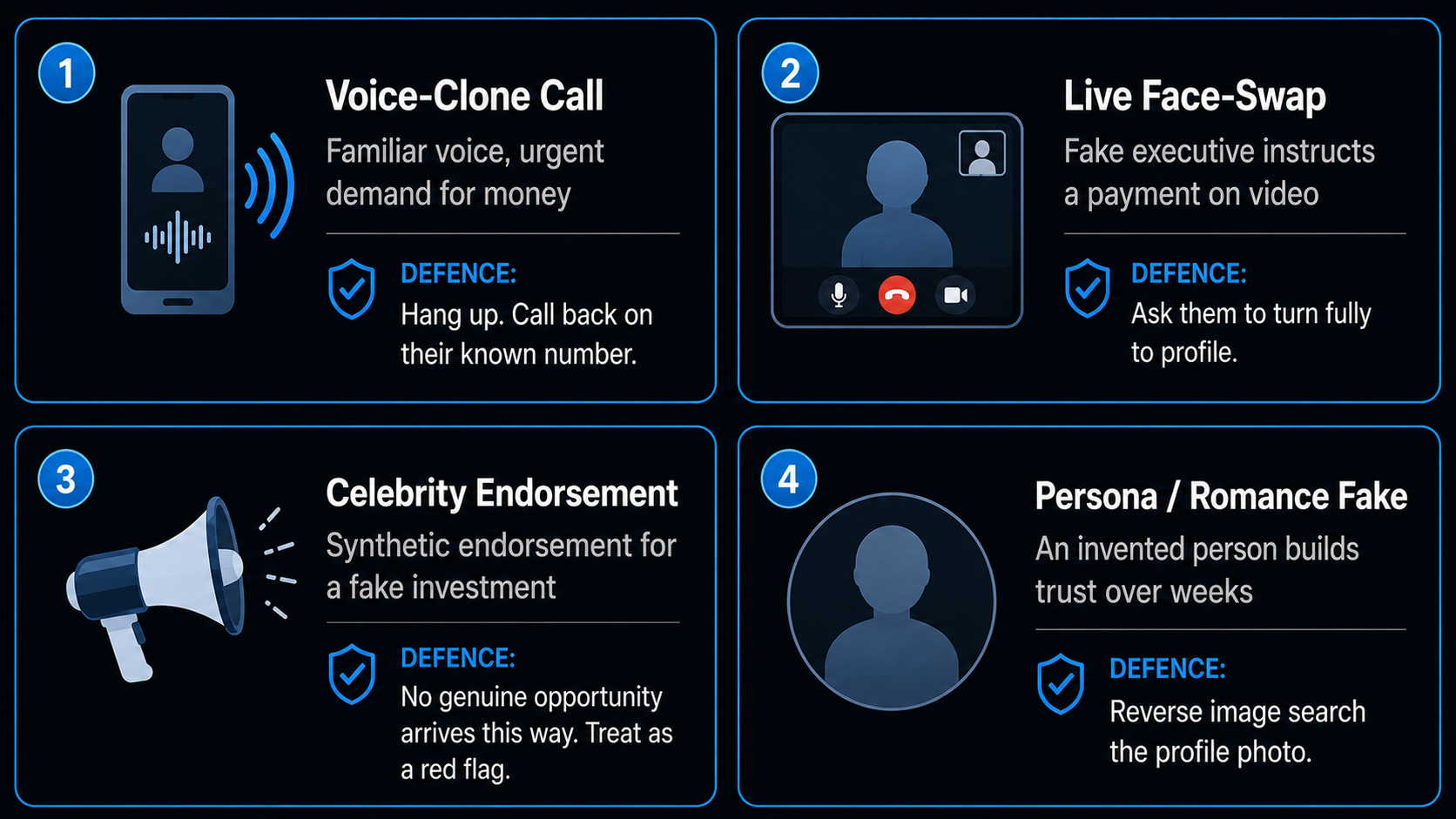
It helps to know the shapes these attacks take, because recognising the pattern lets you spot a deepfake even when the visual signs are perfect. These four cover the overwhelming majority of cases, and every one of them collapses the moment you verify through a second channel.
1. The Voice-Clone Call AUDIO
A scammer harvests a few seconds of clear audio from your social media and clones your voice with alarming accuracy. A relative then gets a panicked call — an accident, an arrest, an emergency — in what sounds exactly like you, demanding money now. The clone cannot improvise well, so an unexpected personal question usually breaks it. The safer move is simply to hang up and call the real person back on their known number.
2. The Live Video-Call Face-Swap VIDEO
Real-time face-swapping software maps a target’s face onto the scammer during a live call, which is how finance staff get “instructed” by a fake executive. This is where the profile-turn check earns its keep — ask them to turn fully side-on, and the illusion tends to fall apart. Never authorise a payment off a video call alone, however convincing the face.
3. The Celebrity or Official Endorsement INVESTMENT
A familiar public figure appears to endorse an investment scheme or trading app, lending instant credibility to a fraud. The face and voice are synthetic; the returns are fake; the money is gone. No genuine investment opportunity arrives through a social-media clip of a celebrity. Treat any such endorsement as a red flag by default, not a green light.
4. The Persona or Romance Fake IDENTITY
An entirely invented person — built from AI-generated photos and sometimes live video — earns trust over weeks before the ask arrives. A reverse-image search on the profile picture often reveals the same face used under different names, which is a strong tell. Be wary of anyone who will video-call but always finds a reason it has to be brief or low-quality.
The India Picture
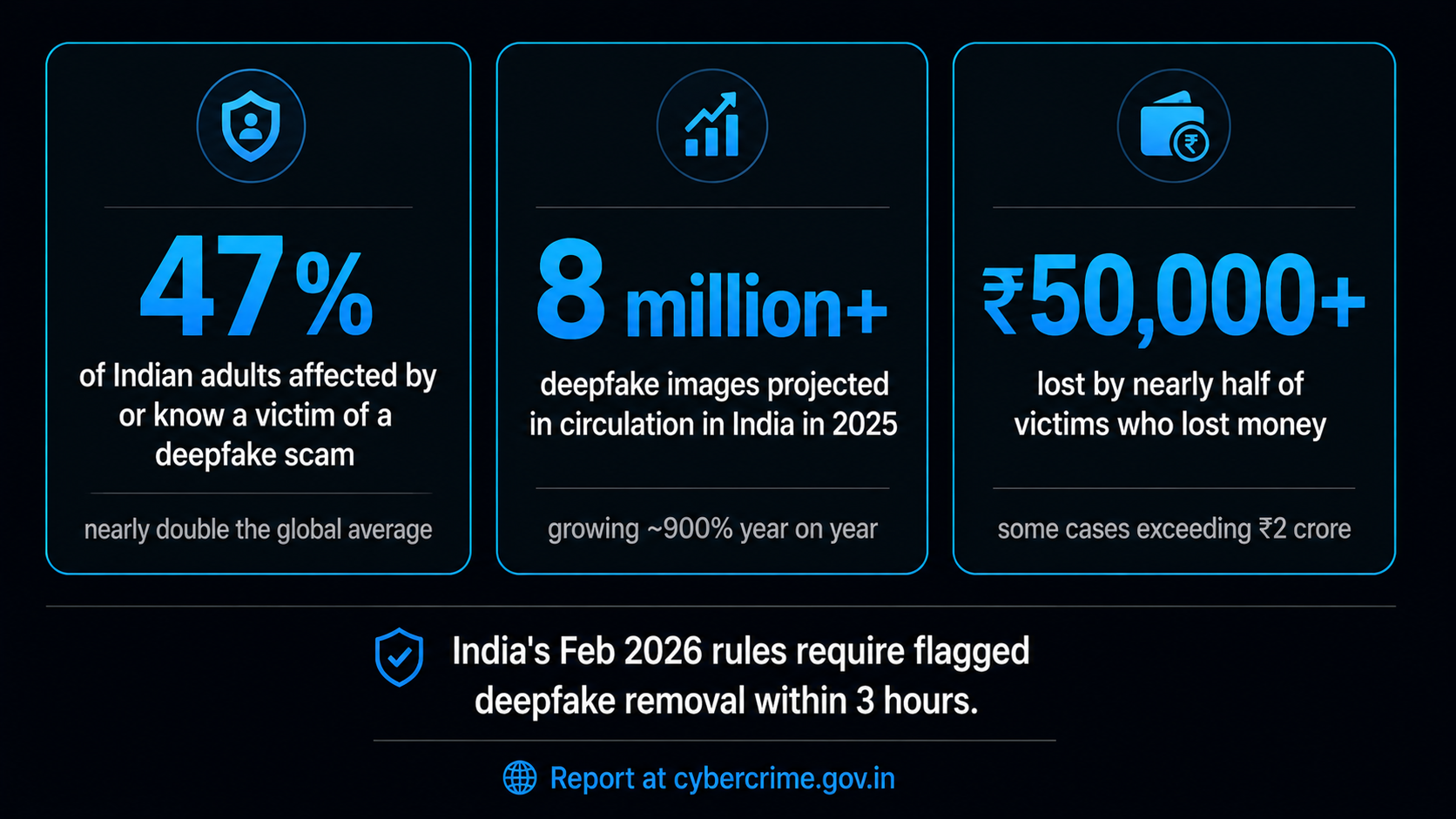
The pressure to spot a deepfake is higher in India than almost anywhere, and the scale here is sobering. India was projected to see around 8 million deepfake images in circulation in 2025, growing roughly 900% year on year according to national cybercrime and industry estimates. One analysis found that about 47% of Indian adults have either been a victim of, or personally know a victim of, an AI voice-cloning or deepfake scam — nearly double the global average. Of those who lost money, most suffered a real financial hit, and nearly half lost more than ₹50,000.
The pattern is consistent: a familiar face, a familiar voice, real urgency, and a request for money too time-sensitive to double-check. In one 2026 case, a deepfake impersonating a senior government minister was used to lend credibility to a fake investment scheme, costing a businessman more than ₹2 crore. Founders and senior executives are prime targets, because their public voices and faces can be used to instruct finance teams.
There is some protection now. India’s February 2026 rules require platforms to remove flagged deepfake content within three hours of a court or government order, and you can report incidents at cybercrime.gov.in. This wider shift toward provenance and accountability is something we cover in our guide to the Indian AI ecosystem.
How to Protect Yourself
- Lock down your biometrics. Enable your phone’s identity or stolen-device protection so a face or voice alone cannot authorise actions.
- Audit your digital footprint. Clear videos of you speaking to camera are training data for voice clones. Consider restricting old public videos to friends only.
- Warn your circle proactively. If synthetic content about you appears, a short heads-up to family, colleagues, and clients removes the scammer’s element of surprise.
- Do not engage or pay. If extortion is attached, paying does not get the content deleted — it gets reused. Report it instead.
- Report and, if needed, seek legal help. File a platform takedown citing the current rules, and consult a lawyer if there is real reputational or financial damage.
If You Are Targeted: A Step-by-Step Response
You will not always spot a deepfake in the moment, so having a plan removes the panic the scammer relies on. If you receive a suspicious video, voice message, or call, work through this in order rather than reacting in the moment.
1. Pause and Do Not Act STOP
Whatever the urgency, do nothing irreversible yet — no transfer, no shared code, no clicked link. The request being time-sensitive is itself the warning sign, not a reason to hurry.
2. Verify on a Second Channel CONFIRM
Contact the real person or institution independently — a known phone number, a different app, an in-person check. Do not use any contact detail the suspicious message gave you. Ask something only the real person would know.
3. Screenshot and Record CAPTURE
Before you respond or the content vanishes, capture evidence — screenshots, the video file, the number or handle it came from, timestamps. You will need this for any report or takedown.
4. Warn Your Circle ALERT
If a fake of you is circulating, a short proactive message to family, colleagues, and clients removes the scammer’s element of surprise. People who are expecting it will not fall for it.
5. Report It ESCALATE
File a platform takedown citing the current rules, and report the incident at cybercrime.gov.in. If there is real reputational or financial harm, consult a lawyer about your options under the relevant laws.
For Creators: Protecting Your Own Face and Voice
The people best placed to spot a deepfake of a creator are that creator’s own audience — but only if you prepare them. If you publish videos of yourself, you are also publishing the raw material for a clone. That is not a reason to stop creating — it is a reason to be deliberate. A few habits meaningfully reduce your exposure without hiding you from your audience.
Think about what a scammer needs: clean, front-facing footage of you speaking, and clear audio. You cannot un-publish your public work, but you can be thoughtful about the rest — restricting old or personal videos, being cautious with long unbroken pieces to camera, and keeping truly private footage private. Build a shared code word with close family and your finance contacts, so a cloned voice on a call can always be tested against something the AI does not know.
It is also worth getting ahead of it publicly. Many creators now tell their audience plainly which channels they will and will not use — for example, that they will never ask for money or promote an investment scheme in a direct message or a random clip. That single statement makes it far harder for a fake of you to succeed, because your audience already knows the real you would never make that ask. As synthetic media becomes normal, this kind of provenance and clear labelling is where trust is rebuilt, and it is a theme worth following as the standards mature.
Frequently Asked Questions
Can you still spot a deepfake by looking for bad blinking?
What is the most reliable way to check a live video call?
Are deepfake detection tools accurate?
What should I do if I think I am being targeted?
Why is India seeing so many deepfake scams?
Can someone make a deepfake from just one photo?
How do I protect my finance team from deepfake fraud?
Check a File with AIClips’ AI Detector
Get a fast second opinion on suspicious content — then always verify through an independent channel. Part of AIClips, from ₹349/month.
Try AIClips →