




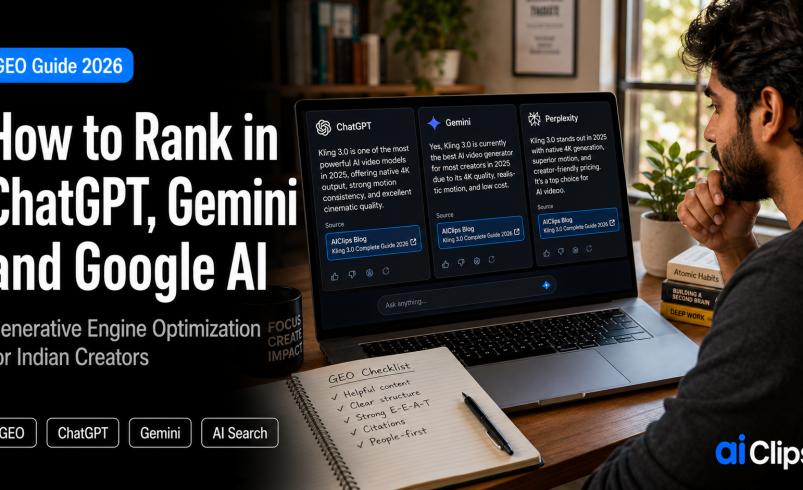

A growing share of your audience no longer scrolls a page of blue links. They ask ChatGPT or Gemini a question, read the answer, and act on it. Generative engine optimization is how you make sure your content is the source that answer is built from. This guide covers what GEO is, why it matters in 2026, and seven things you can do this month to get cited.
None of this is theory for us. It is the exact approach we use on this blog, and the tactics below work whether you are a solo creator in Pune or a brand in Bengaluru.
| What it is | Generative engine optimization (GEO) is the practice of structuring content so AI tools like ChatGPT, Gemini, Perplexity, and Google AI Overviews cite it when answering questions. |
| Why now | AI search handles an estimated 12–18% of English informational queries as of early 2026, up from under 2% a year earlier. |
| The opening | Only about 12% of websites are optimised for AI search, so early movers get cited far more than their size suggests. |
| Top tactic | Answer the question directly in the first two lines. Extractable, self-contained answers get pulled into AI responses. |
What Is Generative Engine Optimization?
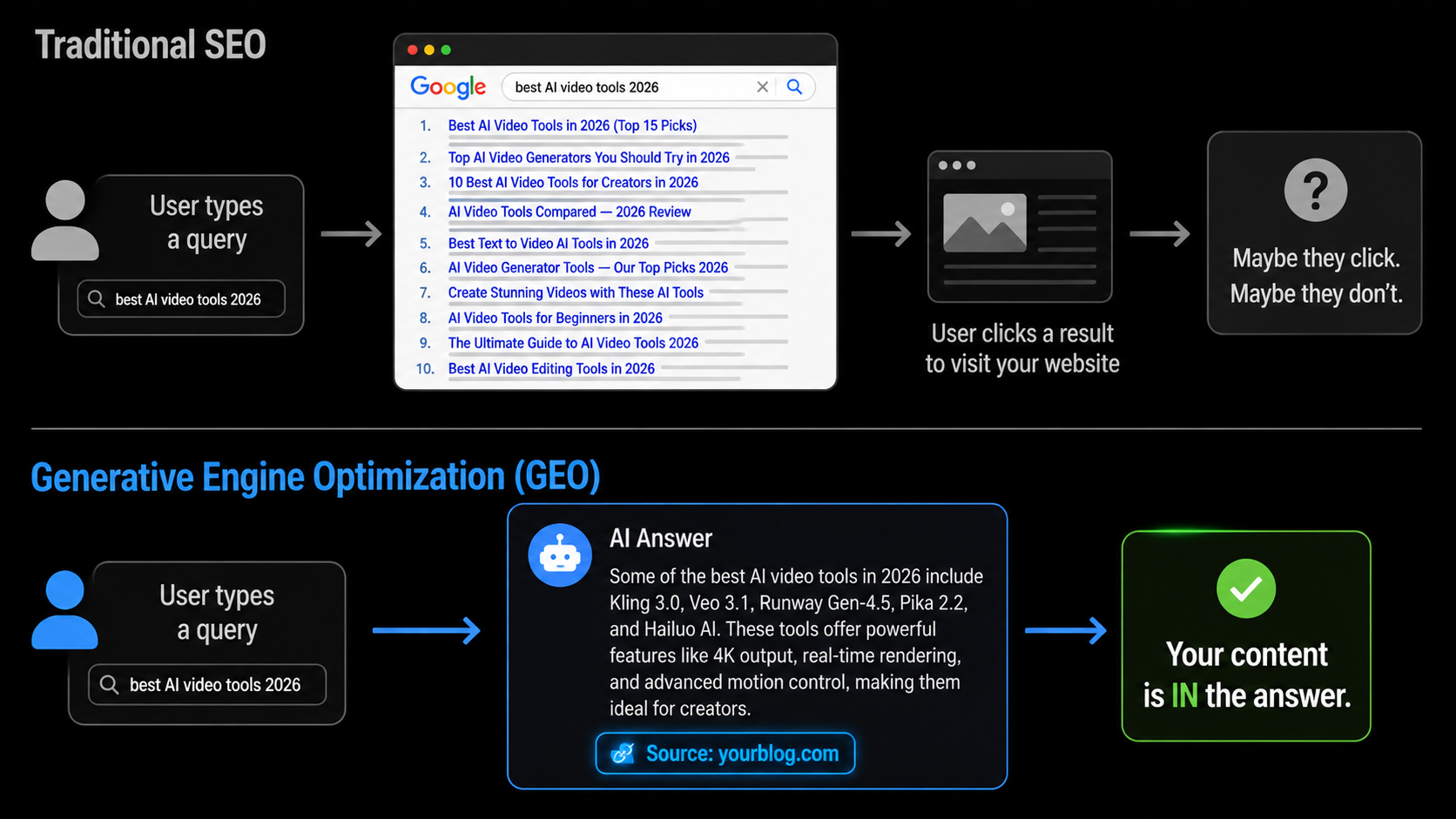
Generative engine optimization is the practice of writing and structuring content so AI systems cite it as a source when they generate an answer. Traditional SEO fights for a position in a list of links. GEO aims for something different: inclusion in the answer itself.
The distinction sounds small and changes almost everything. When someone asks “what is the best AI video tool for Indian creators,” they no longer get ten links to compare. They get a written answer naming a few tools. This is where generative engine optimization earns its place — if your content is what the model pulled from, you are in that answer. If it is not, you are invisible, no matter where you ranked on Google.
| Traditional SEO | Generative Engine Optimization | |
|---|---|---|
| Goal | Rank in a list of links | Get cited inside an AI answer |
| Unit of success | Position on the page | Citation in the response |
| Wins with | Keywords, backlinks | Clear claims, structure, authority |
| Measured by | Rankings, clicks | Citation share, AI referral traffic |
Why This Matters Right Now
The shift is fast, not gradual. AI search engines now handle a meaningful slice of informational queries, and that share was negligible just a year ago. ChatGPT alone crossed 900 million weekly users by early 2026, and a lot of buying research now happens entirely inside the chat, never touching a search results page.
Here is the part that should make you act. Only around 12% of websites are currently optimised for AI search. That is a rare window. The competition for citations is thin, so a small, well-structured site can show up in AI answers next to brands ten times its size, as long as the content is built the way these engines like.
How AI Engines Decide What to Cite
Good generative engine optimization starts with understanding selection. AI answer engines do not rank pages the way Google does. They pull sources based on retrieval confidence, how clearly your claims match the question, citation density, and trust signals. In plainer terms: clear, factual, well-structured content that is easy to verify gets cited. Vague, padded content does not.
Each engine has its own habits worth knowing.
- ChatGPT Search adds inline citations and a Sources panel, and leans on content with clear, checkable claims.
- Google Gemini shows citation chips inside AI Overviews and, in its deeper AI Mode, favours both authoritative editorial sites and forum threads like Reddit and Quora.
- Perplexity is the most publisher-friendly, showing source cards, favicons, and author bylines for almost every claim.
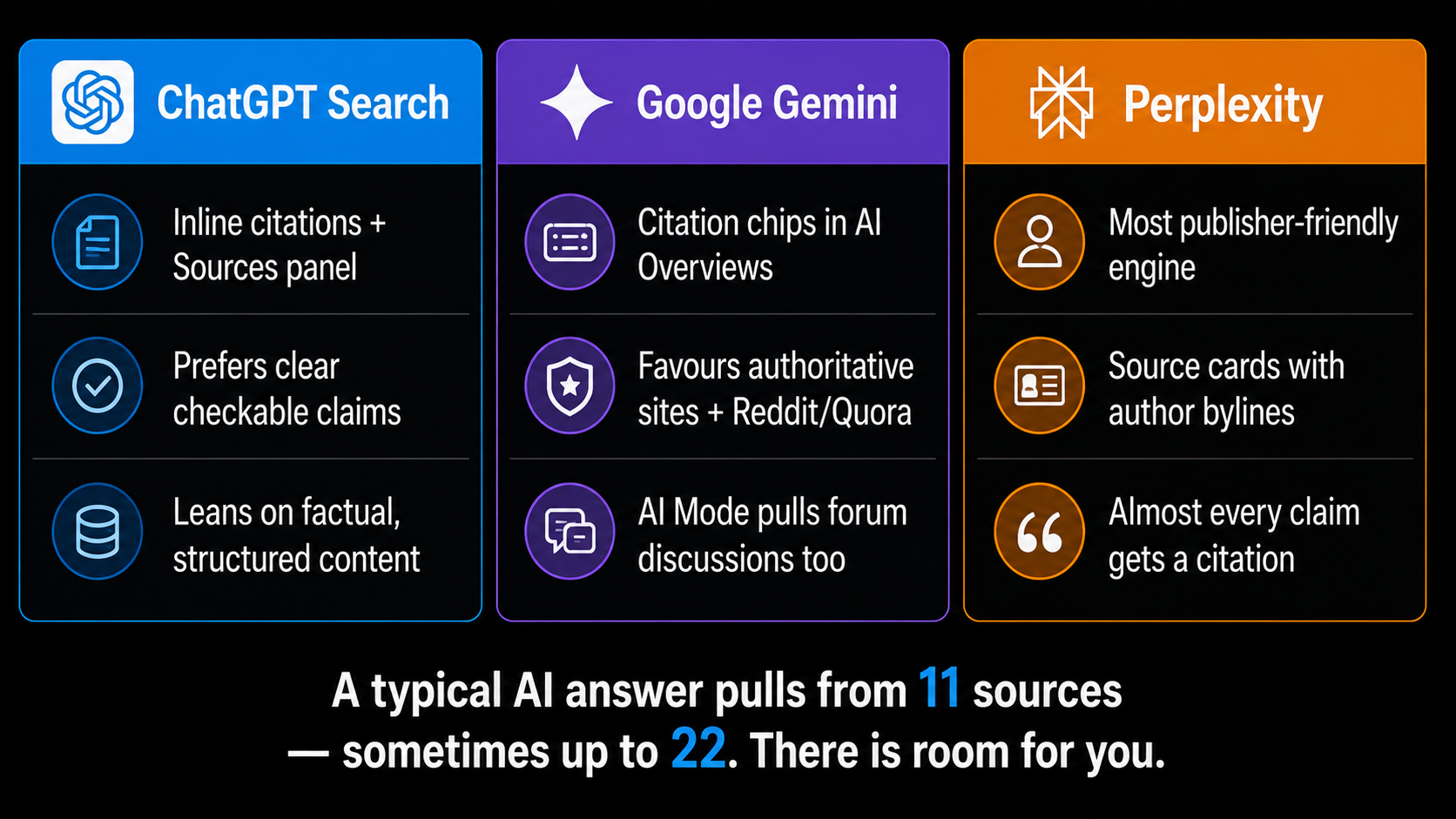
Across engines, a typical answer pulls from around 11 different sources, sometimes as many as 22 on technical questions. That means GEO has room for more than one winner per query, which is good news for anyone starting now.
7 Ways to Get Your Content Cited by AI
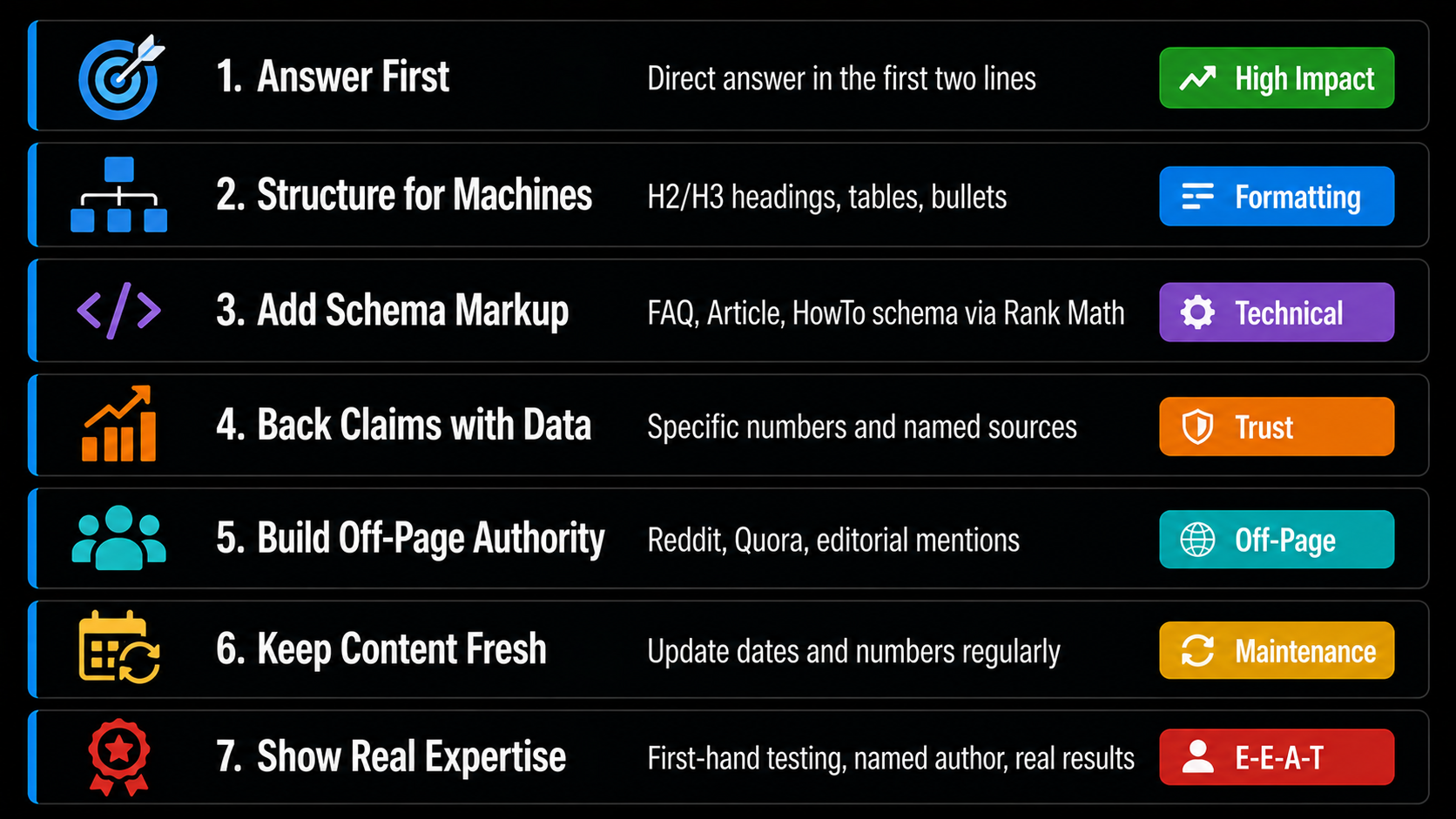
1. Answer the Question in the First Two Lines HIGH IMPACT
Lead with a direct, self-contained answer before any build-up. AI models lift clean, quotable statements, so a sentence like “Generative engine optimization is the practice of structuring content so AI tools cite it” is far easier to pull than a slow introduction. Put the answer first, the context after.
2. Structure for Machines, Not Just Readers FORMATTING
Clear H2 and H3 headings, short paragraphs, bulleted lists, comparison tables, and a question-and-answer section all make your content easier to parse. The same structure that helps a reader skim helps a model extract. Messy walls of text get skipped.
3. Add Schema Markup TECHNICAL
FAQ, Article, and HowTo schema give engines machine-readable signals about what your page contains. In WordPress, a plugin like Rank Math adds this in a few clicks. It will not carry weak content, but on strong content it raises your odds of being cited.
4. Back Every Claim with Data and Sources TRUST
Specific numbers, dates, and named sources read as trustworthy to both people and models, and they are the backbone of good generative engine optimization. “AI search handles 12–18% of informational queries in 2026” gets cited more readily than “AI search is growing fast.” Cite your own references, and the engines treat you as one.
5. Build Authority Beyond Your Own Site OFF-PAGE
Gemini and others draw on Reddit, Quora, and editorial mentions. Being discussed across the web, not only on your blog, raises how often you are named. Answer questions in your niche where your audience already gathers, and let those mentions compound.
6. Keep Content Fresh MAINTENANCE
AI systems favour current information. Update your top pages with new data and dates rather than letting them go stale. A “last updated” date and refreshed numbers signal that the page is still worth pulling from. We refresh ours on a schedule for exactly this reason.
7. Show Real Expertise E-E-A-T
First-hand experience, a named author, and genuine testing stand out. “We tested this on Indian photos and here is what happened” is more citable than a recycled summary. The engines, like readers, reward content that clearly knows what it is talking about.
How to Measure Your GEO Results
Generative engine optimization is harder to measure than rankings, because AI answers shift from one query to the next. Treat the numbers as trends, not gospel.
Three habits work. First, run your target GEO questions through ChatGPT, Gemini, and Perplexity every week and note who gets cited and why. Second, watch AI referral traffic separately in GA4, since it is smaller than organic but tends to convert harder. Third, track your citation share over time. The direction is what matters: is it climbing month over month, and are new pages getting picked up.
GEO for Indian Creators
There is an extra opening here for Indian creators and brands. Far fewer people are optimising for regional and India-specific queries than for global ones. When someone asks an AI tool “best AI voiceover for Hindi” or “how to make a Marathi Reel,” the pool of well-structured, genuinely expert content is small. That is exactly the gap a focused Indian creator can own.
Write the India-specific guide that does not exist yet, back it with real testing and rupee pricing, structure it cleanly, and you can become the cited source for a whole category of questions. The same generative engine optimization habits apply, the competition for these GEO wins is just thinner. For more on the wider shift, see our piece on why Indian creators are building their own AI tools.
Frequently Asked Questions
What is generative engine optimization in simple terms?
Does traditional SEO still matter for AI search?
How do I get cited by ChatGPT and Gemini?
Do backlinks still help with AI search visibility?
How is GEO different from SEO?
Create GEO-Ready Content Faster on AIClips
Research, draft, and structure AI-search-friendly content with the AIClips content tools, plus 460 other AI models. INR pricing, UPI, from ₹349/month.
Start on AIClips →